Unbreakable Ice Cream Cups for Hotels & Buffets: A Wholesale Buyer’s Guide to PC & Acrylic Dessert Cups
Why Dessert Service Breaks More Glass Than Any Other Course
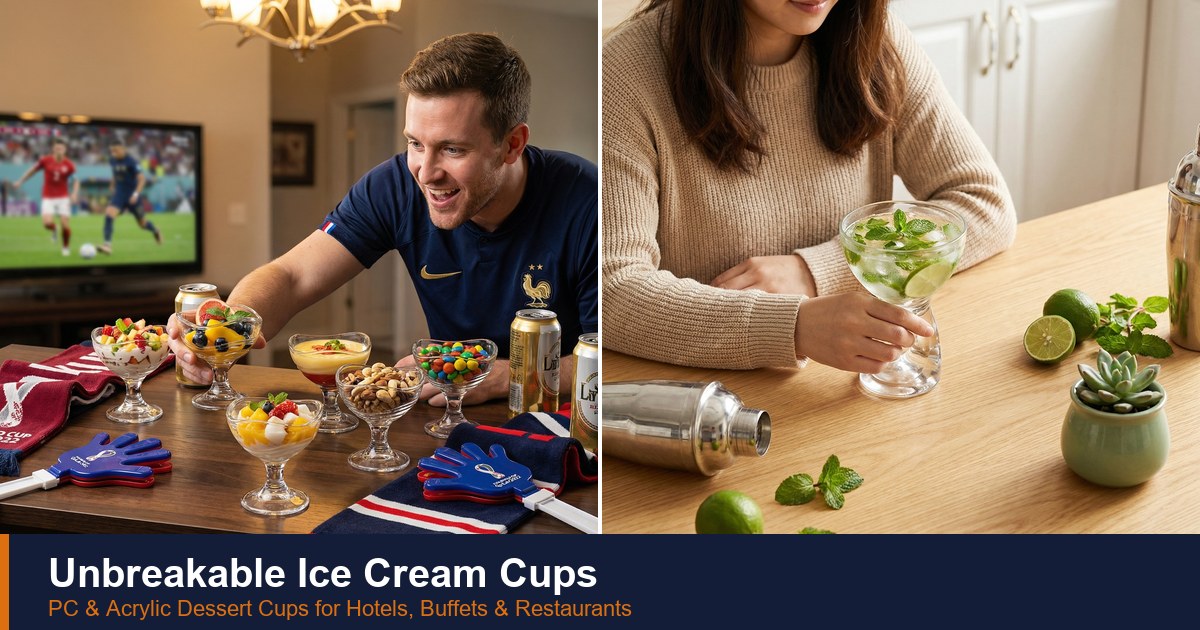
Walk through a hotel buffet at 8 PM and watch the dessert station. Guests reach over each other, lift cups stacked three high, carry them across a crowded room one-handed, and set them down on marble. Children help themselves. Trays get cleared in a hurry. It is the single highest-risk moment in the entire dining room — and it is the one place most properties still put glass.
That is why F&B and procurement teams are converting dessert service to unbreakable ice cream cups: food-grade polycarbonate (PC) and acrylic dessert cups that hold the weight, clarity and cold of glass while surviving the kind of handling that ends a glass dessert bowl on night one. This guide covers what to verify before you place a wholesale order.
Sundae Cup, Dessert Bowl or Coupe? Matching the Shape to the Menu
| Format | Typical Capacity | Best For |
|---|---|---|
| Stemmed coupe | 150–250 ml | Plated dessert courses, afternoon tea, à la carte |
| Footed sundae cup | 250–400 ml | Sundaes, gelato, layered parfaits, pool & terrace service |
| Wide dessert bowl | 350–600 ml | Buffet dessert stations, fruit, sharing desserts, banquets |
A coherent dessert table uses one family across all three shapes — mixed formats with different stem geometry read as an afterthought to guests and to your banquet photos alike.
PC vs Acrylic vs Glass for Cold Dessert Service
| Material | Frozen / Chilled Service | Dishwasher Cycles | Verdict for Dessert Stations |
|---|---|---|---|
| Polycarbonate (PC) | Excellent — handles freezer and ice-bath holds | 500+ commercial cycles | The benchmark for buffet and high-traffic dessert service |
| Acrylic (PMMA) | Very good — best-in-class optical clarity | 200+ cycles | À la carte plating and venues where glass-look sparkle matters most |
| Glass | Thermal-shock risk with frozen desserts | Unlimited (if it survives) | Fine dining only, served and cleared by staff |
Note the thermal point specifically. A frozen scoop dropped into a chilled glass bowl is a stress event; thin-walled glass can craze or crack from the temperature delta alone, with no impact involved. Food-grade PC and acrylic are far more forgiving of that temperature swing — which matters most at exactly the moment dessert is being plated in front of a guest.
8 Things to Check Before Ordering Wholesale
1. Food-Contact Test Documents, By Certificate Number
“Food grade” written on a quotation is a claim, not evidence. Ask for the SGS food-contact test report and RoHS compliance certificate by number and date. A direct manufacturer sends both the same day; a trader usually forwards a blurry photo of someone else’s paperwork, or nothing.
2. Stem Integrity at the Bowl Joint
This is where cheap dessert cups fail first. Under repeated dishwasher heat and lateral load, an under-engineered stem joint develops hairline fractures at the shoulder and the cup begins to weep. Ask whether the stem and bowl are moulded as a single piece with a reinforced shoulder — and ask for a used sample from a reference hotel, not just a new one from the box.
3. Base Diameter and Tip Resistance
A narrow decorative foot looks elegant in a catalogue and tips over on a loaded tray. Measure the base footprint against bowl capacity: for buffet and self-service, favour a wider foot and a lower centre of gravity over a slender stem. A dessert cup that spills is worse than one that breaks, because the mess lands on the guest.
4. Rim Finish and Mouth Feel
Run a finger around the rim of a sample. Any moulding flash, seam line or sharp edge will be felt by every guest who eats from it. A properly polished rim is the single clearest signal of mould quality — and the first thing to degrade when a factory runs a worn tool.
5. Clarity and Long-Term Non-Clouding
Budget material clouds after a few dozen hot dishwasher cycles, and a cloudy dessert cup makes the dessert look cheap. Specify optical-grade resin, and if the supplier claims long-term clarity, ask to see a cup that has actually been through 200+ cycles — not a marketing photo.
6. Stackability for Back-of-House Storage
Banquet season means holding hundreds of units. Confirm the cups stack or nest without scratching or jamming, and that a stacked column is stable at height. Storage footprint and breakage during handling are both real line items in your landed cost, even though neither appears on the invoice.
7. What Is Actually in the Unit Price
Clarify whether spoons, lids or serving trays are included or quoted separately, whether the price is per piece or per set, and what the carton quantity is. The lowest unit price frequently turns out to be the highest landed cost once carton pack, spare parts and ocean freight are counted.
8. MOQ and OEM Customization
Factory-direct wholesale of PC and acrylic dessert cups typically starts around 500 pieces per model. Below that you are generally buying a trader’s warehouse stock at a markup. If you want a hotel logo printed, a custom tint, or a bespoke capacity, confirm the factory moulds in-house — a direct manufacturer handles logo and colour changes at the same MOQ, while a middleman quotes you a separate tooling project.
The Breakage Math on a Dessert Station
Unit price is the least interesting number on the page. Consider what a glass dessert bowl actually costs a hotel over a year:
- In self-service dessert use, a glass bowl typically survives months rather than years — and a single rim chip retires it from service even when it never shatters.
- A quality PC or acrylic cup outlasts 500+ commercial dishwasher cycles and absorbs drops that would end a glass bowl outright, so replacement purchasing effectively stops after the first order.
- Add the costs that never appear in a procurement ledger: glass slivers near food, a floor hazard in a dining room, a paused dessert service while staff sweep, and the guest who remembers finding glass in their sundae.
Most properties find the conversion pays for itself within the first two to three quarters on avoided replacements alone — before counting the safety and guest-experience gains that never show up as a line item at all.
Matching Dessert Cups to Your Operation
- Hotel buffet dessert stations: 350–600 ml wide PC dessert bowls, stable base, stackable for storage.
- À la carte & plated desserts: 150–250 ml stemmed coupes in acrylic for maximum glass-look clarity.
- Pool bars & outdoor terraces: PC only — most international hotel groups prohibit glass poolside for a reason.
- Banquet & event service: one matched family — coupe, sundae cup and bowl from a single stem design — so 200 covers on round tables look intentional.
- Family-style & sharing desserts: wide bowls from the same material family keep the tabletop coherent with your pitcher and salad-bowl service.
FAQ: Buying Unbreakable Ice Cream Cups Wholesale
Do PC and acrylic dessert cups really look like glass?
Optical-grade polycarbonate is visually near-identical to glass, and acrylic is closer still. Most guests cannot tell until they drop one. Weighted, thick-walled designs also mimic the hand feel of glass, which matters more than appearance for perceived quality.
Can they go in the freezer?
Food-grade PC and acrylic handle normal freezer and ice-bath holding temperatures well — they are substantially more tolerant of rapid temperature change than thin-walled glass. For your specific process (blast freezing, holding times, display cases), put the question to your supplier in writing and request the matching test documentation.
Are they dishwasher safe?
Commercial dishwashing is exactly what these materials are specified for, and quality PC is rated well beyond 500 commercial cycles. Two practical rules: keep to the resin’s stated temperature ceiling, and avoid stacking heavy items on top of cups during the cycle.
What certifications should I require?
At minimum, third-party food-contact test reports (SGS or your market’s equivalent) and RoHS compliance — requested by certificate number, not by claim. Match the test standard to your destination market before you commit to a container.
What MOQ should I expect, and can I get my logo?
Factory-direct MOQ is typically around 500 pieces per model. Logo printing and custom colours are standard OEM services from a direct manufacturer — confirm they mould in-house, which keeps custom work at the same MOQ rather than turning it into a separate tooling project.
The Bottom Line
Dessert service is the highest-handling, highest-risk course in the room, and it is usually the last one still running on glass. Converting it to unbreakable takes three decisions: the right material for each service style, test documents you have actually read, and a manufacturer that moulds its own product rather than reselling someone else’s.
Looking for a factory-direct source? Benyang Supplies manufactures food-grade PC & acrylic dessert cups, ice cream bowls and stemmed coupes alongside a full drinkware range — with 17+ years of injection-moulding experience, SGS food-grade and RoHS certification, wholesale MOQ from 500 pcs, and OEM logo service. Browse the ice cream cups range or send us your target models — our export team replies within one business day.