Cake Domes & Covered Plates for Hotels: Two Units of Measure, One Pair
The One Line Here That Is Not a Single Object
Every other item in this catalogue stands on its own. A glass is ordered, counted and
replaced by itself. A jug, a bowl, a carafe — each is one object with one job, and the
specification table describes that object. The covered-plate line is the exception. What a hotel actually buys is a
cover and a plate, and they arrive as one line on the order.
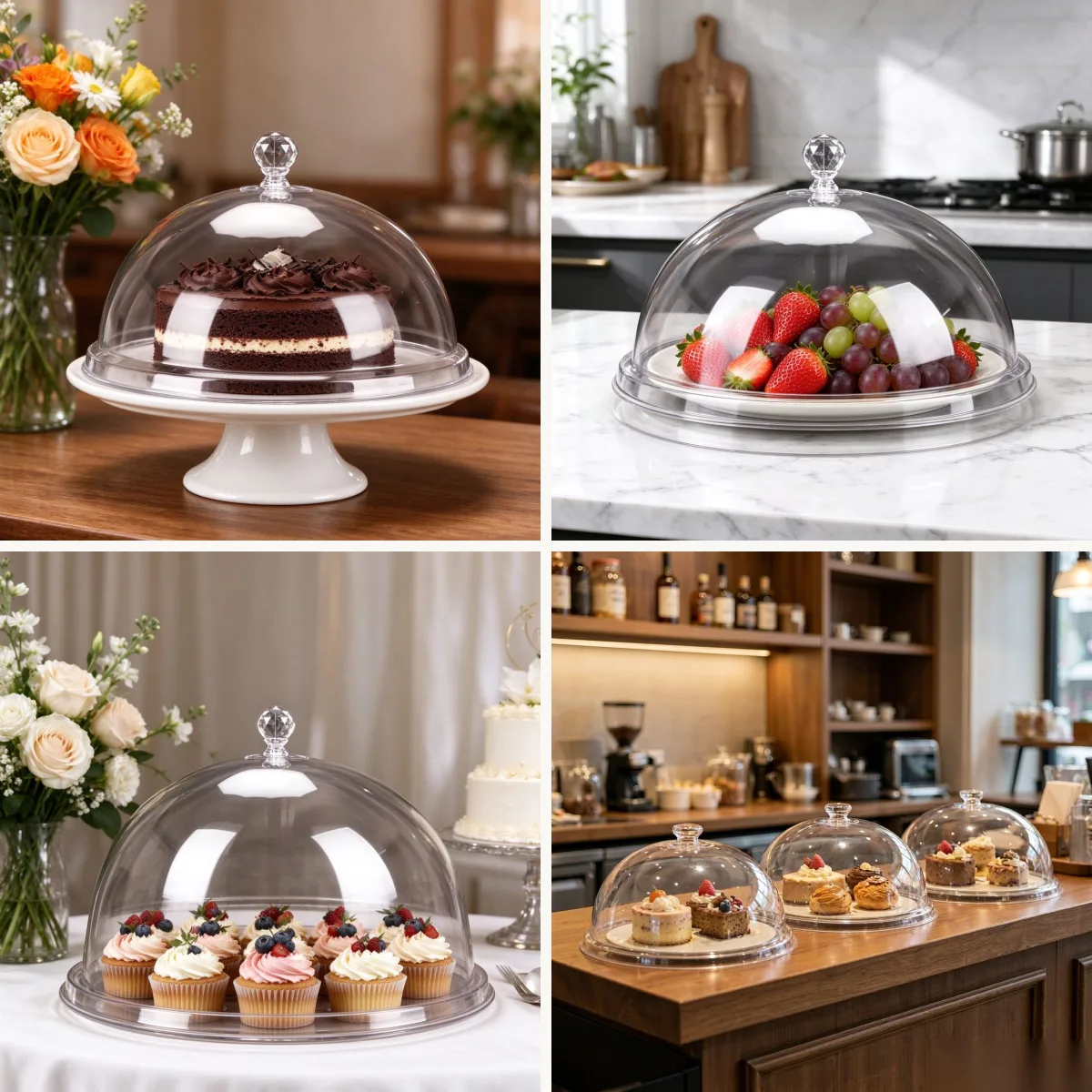
Fourteen products carry this shape. Five of them are covers on their own, sitting in the cake dome category.
The other nine are the matched pairs: the same cover, dropped over the plate it was cut for, with a
combined model number on the page. The pairs are the interesting half, because that is where the two
measurements that decide anything at all run into each other.
The pairing is not loose. Each of the five covers has one plate built to sit under it, and the
plate is not shared between sizes. A 14-inch cover has a plate; an 8-inch cover has a different plate,
and the two will not swap. If you order one size and later want another, the earlier plate does not
help you.
Here is the first thing to notice, and it is visible in the model number itself before you
open a single page. The cover is named in inches. The plate is named in centimetres. One product, one
line, two measuring systems, no conversion anywhere on the page that carries them.
| Pair | Cover, as named | Plate, as named | What the page prints |
|---|---|---|---|
| BY-9251 + BY-8X01 | 14 inch | 35 cm | 14 inch Food Cover + 35 cm Fruit Plate |
| BY-9252 + BY-8X02 | 12 inch | 30 cm | 12 inch Food Cover + 30 cm Fruit Plate |
| BY-9253 + BY-8X03 | 10 inch | 25 cm | 10 inch Food Cover + 25 cm Fruit Plate |
| BY-9254 + BY-8X04 | 8 inch | 20 cm | 8 inch Food Cover + 20 cm Fruit Plate |
| BY-9255 + BY-8X05A | 6 inch | 15 cm | 6 inch Food Cover + 15 cm Fruit Plate (with Base) |
That split is not an accident of presentation; it follows the trade. Cake sizes are quoted in
inches wherever cakes are sold in inches, and plates are cut in centimetres at the works. Both numbers
are correct. The problem is that a buyer comparing two suppliers will read one of them as the size,
decide the two are the same, and find out otherwise at the buffet.
Five Sizes, Two Unit Systems, and Only One Honest Conversion
Set the inch label against the centimetre figure the same page publishes in its own
specification table, then against the arithmetic.
| Model | Named as | Exact conversion | Published in the table | Published / exact |
|---|---|---|---|---|
| BY-9251 | 14 inch | 35.56 cm | 35.5 cm | 0.998 |
| BY-9252 | 12 inch | 30.48 cm | 31.5 cm | 1.033 |
| BY-9253 | 10 inch | 25.40 cm | 26 cm | 1.024 |
| BY-9254 | 8 inch | 20.32 cm | 21.5 cm | 1.058 |
| BY-9255 | 6 inch | 15.24 cm | 16 cm | 1.050 |
One of the five agrees with its own label. The other four are wider than the inch figure
implies — by 0.6 cm at the ten-inch, and by 1.18 cm at the eight-inch, which is nearly five per
cent of the diameter. That is not an error. A nominal size and an as-built outside diameter are
different things in every trade that names products by size, and the catalogue here has published
both.
The plate ladder is cleaner. Thirty-five, thirty, twenty-five, twenty, fifteen — a
straight five centimetres at every step, no exceptions. The cover ladder over the same five models runs
4.0, 5.5, 4.5 and 5.5 cm. So one of the two halves of every pair is a regular series and the other is
not, and it is the cover — the half that has to clear the other one — that moves in
irregular steps.
The practical rule is short. Order by the centimetre figure, because that is the one that
describes the object, and keep the inch label for the conversation with your pastry section, who will
recognise it.
How Much Slack a Cover Has Over Its Own Plate
Subtract the plate from the cover and you get the only dimension that decides whether the
pair behaves as a pair. This is the seating clearance: the room the cover has, all the way round, to
drop past the rim of the plate and come to rest on it.
| Pair | Cover diameter | Plate diameter | Total difference | Per side |
|---|---|---|---|---|
| 14 inch BY-9251 + BY-8X01 |
35.5 cm | 35 cm | 0.5 cm | 0.25 cm |
| 12 inch BY-9252 + BY-8X02 |
31.5 cm | 30 cm | 1.5 cm | 0.75 cm |
| 10 inch BY-9253 + BY-8X03 |
26 cm | 25 cm | 1.0 cm | 0.5 cm |
| 8 inch BY-9254 + BY-8X04 |
21.5 cm | 20 cm | 1.5 cm | 0.75 cm |
| 6 inch BY-9255 + BY-8X05A |
16 cm | 15 cm | 1.0 cm | 0.5 cm |
The range is half a centimetre of total play at the top and a centimetre and a half at the
bottom. Put the other way: on the largest pair the cover has a quarter of a centimetre of room on each
side, and that is the pair most likely to be carrying the heaviest load and the tallest pile.
Whether a quarter of a centimetre is enough is not a question this page can answer. It depends
on how flat the plate stays under load, how the rim is finished, and how much a full tray of pastries
makes it bow. What can be said is that the number is small enough to matter and that no page in the
range prints it in this form — you arrive at it by subtracting one published figure from
another.
There is a second clearance nobody prints either, and it is the one that catches people out on
the second order: the height inside. A cover of this type encloses a volume, and what limits that
volume is not the outside height but the distance from the seating surface up to the underside of the
crown. A plate of croissants and a plate of profiteroles with a piped top are the same diameter and not
the same order.
Every Size Comes in Two Heights, and the Step Is Eight Centimetres
Four of the five plates exist in two versions. One is flat; the other carries a foot. The
difference appears in the model number as a single letter — BY-8X01 against BY-8X01A — and in the
specification line as two words in brackets: with Base.
Two words is all the specification table says. No height, no diameter, nothing to compare. The
product photographs, which do carry dimension callouts, give the rest of it.
| Size | Flat plate, as drawn | Footed plate, as drawn | Difference |
|---|---|---|---|
| 14 inch | 17 cm (8X01) | 25 cm (8X01A) | 8 cm |
| 12 inch | 14 cm (8X02) | 22 cm (8X02A) | 8 cm |
| 10 inch | 13 cm (8X03) | 21 cm (8X03A) | 8 cm |
| 8 inch | 19 cm (8X04) | 10 cm (8X04A) | photographs are of different objects |
| 6 inch | — | reuses the large-plate photograph (8X05A) | footed version only |
Three times out of three, where the two photographs describe the same object, the foot raises
the whole assembly by exactly eight centimetres. That is a large step on an object whose own specified
height is between nine and fourteen centimetres. The cover itself is unchanged; it has simply been
carried upwards by the plate it rests on, and everything above it moves with it.
The two rows that do not fit that pattern are worth reading carefully rather than skipping. The
eight-inch pair publishes two photographs at nineteen centimetres and ten centimetres, and they are not
the same object at either end — the first is a large cover on a flat plate, the second a small
cover on a plain plate with no foot in sight, despite carrying the model number of the footed version.
The six-inch pair has one photograph, and it is the large-plate picture again. Where the flat and
footed figures are missing from the table above, the reason is not that the variants do not exist. It is
that the images supplied for those two sizes are not images of them.
Eight centimetres decides more than it sounds like. It decides whether the pair fits under a
sneeze guard, how much of the pastry the guest sees from a seated position, whether it can be stacked
two high on a shelf, and how far a server has to lift the cover to clear the pile. All of that is
settled by choosing one letter at the end of a model number, and the specification table gives you the
letter and nothing else.
The smallest pair has no plain version at all. Only the footed configuration is
listed — BY-9255 + BY-8X05A — and it is the one size where you cannot choose. Worth knowing before the
enquiry is written, because a quotation for a six-inch covered plate is a quotation for a stand.
The Photograph and the Specification Table Rarely Agree
This is the part that takes longest to explain and matters most. Each product page carries two
descriptions of the same object: a specification table, and a product photograph with the dimensions
drawn on it. Read one against the other and they are not the same product.
| Model | Diameter in the table | Diameter on the photograph | Agrees? |
|---|---|---|---|
| BY-9251 | 35.5 cm | 31.5 cm | No |
| BY-9252 | 31.5 cm | 26.5 cm | No |
| BY-9253 | 26 cm | 16 cm | No |
| BY-9254 | 21.5 cm | 21.5 cm | Yes |
| BY-9255 | 16 cm | the 8-inch photograph, unaltered | No photograph of its own |
Four of the five pages disagree with themselves, and the disagreements are not small. On BY-9251
the picture is four centimetres smaller than the table. On BY-9252 it is five centimetres smaller. On BY-9253 the
picture shows sixteen centimetres against a table that says twenty-six — a difference of ten.
Now look at the pairs, where the same cover appears twice under one model number, once over a
flat plate and once over a footed one. BY-9254 + BY-8X04 publishes two photographs. One is drawn at thirty-five and a
half centimetres and nineteen centimetres high, and is labelled on the image as the large cover. The
other is drawn at sixteen centimetres and ten centimetres high, and is labelled as the small plate and
cover. Both belong to the same eight-inch dome. The two pictures differ by nineteen and a half
centimetres in diameter and are captioned at opposite ends of the size range.
What is happening is not mysterious, and it is worth saying plainly rather than dressing up:
the dimension drawings were produced for a five-step ladder of covers and then attached to the models,
and at least a few of them landed one or two places away from the product they describe. The ladder
itself is consistent — thirty-five and a half, thirty-one and a half, twenty-six and a half,
twenty-one and a half, sixteen, a clean descending sequence — which is exactly how you can tell
the pictures are of real objects and simply filed against the wrong rows.
One thing the images get right, and it is worth crediting because it is not universal in this
catalogue: every cover here is round, and every one of them is marked with the diameter symbol. In
neighbouring lines the same symbol appears on items that are plainly rectangular. Here the notation
matches the object.
So which figure do you order by? Neither, on its own. The specification table gives the
outside diameter of a finished moulding and is the better of the two for freight. The photograph is a
drawing of something, and on four pages out of five it is a drawing of a different size. What settles a
purchase is a third set of numbers that belongs to you: the footprint of what you intend to put
underneath, and how tall it stands.
One Model Has No Photograph of Its Own
The smallest cover, BY-9255, is the one in the range with the least to look at, and it is worth
setting out exactly how little.
Its product thumbnail is the eight-inch model’s thumbnail. Not a similar
photograph — the same file, byte for byte, with the eight-inch dimensions and the eight-inch
caption drawn on it, carrying a diameter that belongs to a model two sizes up. Its gallery image is the
photograph of the six-inch pair, not of the cover. So the one page in the family that shows the cover
by itself is showing a different cover.
Then the table. The larger covers carry six attributes, and always the same six: the model
reference, the size, the resin, how many go in a box, the box itself, and the minimum order. The
six-inch page publishes five of them. There is no box. And in the size row it gives one figure,
“16 cm”, where its four siblings give two — a diameter and a height. So the shortest cover in the
range is the only one whose height is not stated anywhere, on a page where height is the dimension that
decides what fits under it.
None of this is a reason to avoid the model. It is a reason to ask a different question about
it than you would about the others, because the two shortcuts a buyer normally relies on —
comparing the picture and reading the size row — both fail on this page at once.
The same is true in a milder form of the pairs. Nine pages carry a covered-plate pair, and
every one of them publishes three attributes: model number, size, and material. Not one of the nine
gives a packing quantity or a carton size. So the half of this family that contains two objects per
unit is the half with half the documentation — nine pages on which freight cannot be calculated
at all, because there is no box to calculate it from.
Four Cartons, and a Factor of Three Point Seven Between Them
Four of the five covers print both a packing quantity and a carton size, so the container cost
of a single piece can be worked out rather than guessed. The fifth prints one of the two, and that is
why the table below has four rows rather than five.
| Model | Pieces per carton | Carton, cm | Pieces per m³ | Cartons for MOQ 500 |
|---|---|---|---|---|
| 14 inch BY-9251 |
40 | 73 × 36.5 × 30 | 500 | 13 |
| 12 inch BY-9252 |
40 | 65 × 33 × 30 | 622 | 13 |
| 10 inch BY-9253 |
60 | 53 × 27 × 35 | 1,198 | 9 |
| 8 inch BY-9254 |
80 | 44 × 22 × 44 | 1,878 | 7 |
| 6 inch BY-9255 |
240 | not published | — | 3 |
From the largest cover to the smallest, the same cubic metre holds three point seven six times
as many pieces. A forty-foot container loaded to sixty-seven cubic metres carries roughly thirty-three
thousand of the fourteen-inch covers and about a hundred and twenty-five thousand of the eight-inch.
Those two numbers describe the same product family, in the same resin, on the same pallets.
The minimum order line turns the same arithmetic into cartons. Every model starts at five
hundred pieces, and because the packing quantities differ, that one number becomes a different pile of
boxes size by size: thirteen cartons of the fourteen-inch, thirteen of the twelve-inch, nine, seven
— and three cartons of the six-inch, whose page gives a packing quantity but no box to put it
in.
Three cartons is a small shipment to build a landed-cost calculation on, and it is the reason
the smallest size usually travels with something else. Ordered beside the twelve-inch, or alongside the
low napkin racks or the covered sugar bowls, it fills out a container without adding a pallet, and the freight that would have been
carried by three cartons alone is absorbed by the rest of the load.
Two Resins, Three Material Words
Every specification table in this family says the same thing: PC / PS. All fourteen, covers and
pairs alike, on every page. That is one clear answer, and it is the one to order against.
The titles are less disciplined. Two of the five cover pages call the object an acrylic cake
cover. Three call it a PC food cover. The nine pair pages decline to name a resin in the title at all.
Set the three side by side and a reader has three different impressions of the same fourteen
products.
The distinction is not academic here in the way it is on a napkin box, because a cover holds
food. Air is not a barrier: pastries under a dome sit in the same air as the room, and the underside of
the crown is directly over what is being served. This is a food-contact article, and it is documented as
one. The testing behind it is SGS, for food contact, and the material file is RoHS. If either has to sit
in your records, give us the article numbers on the order and the country the container is bound for, so
that the documents travelling with your consignment are the ones your market expects to see.
The second half of the material question is cleaning, and it has a harder edge than it does on
drinkware. A domed cover is a large thin-walled moulding with a knob on top and a rim around the
bottom; it is awkward in a rack and vulnerable at both ends. Polystyrene does not take a hot wash
without going cloudy and soft, and a cover that has gone cloudy loses the one quality it was bought
for. Whether these can go through your machine, and at what temperature, belongs in the enquiry rather
than in the first season of use.
Five Sentences to Send With the Enquiry
None of the difficulty in this family is about quality. It is about which of two published
numbers you are agreeing to, and what sits under the cover when it is closed. Five sentences close that
gap, and each one can be pasted into an email as it stands.
“The largest item under the cover measures ___ cm across and ___ cm high.”
The two measurements that decide the size. Take them off the tallest thing you intend to serve, not
off the plate, because the cover has to clear the pile rather than the china. This one sentence
replaces the whole photograph-versus-table problem.
“The footprint of the tray or plate it will sit on is ___ cm.”
If the cover is going over your own plate rather than one of ours, this is the number that has to be
smaller than the cover diameter by enough to seat. Ask for the seating clearance in writing rather
than deriving it, since the two published figures may not be measuring the same edge.
“The assembly can stand ___ cm high where it will be used.”
The height of the gap it has to live in: under a shelf, inside a display case, below a guard. This
is the sentence that decides between the flat plate and the footed one, and it is the only way to make
that decision, because no page publishes the height of either.
“It will / will not be machine washed.”
State it either way, but state it. A yes narrows the material conversation and may move you off the
standard grade. A no means the cleaning instruction is what has to be agreed, and it should be in
writing before the order rather than after the first cloudy batch.
“The order is ___ pieces, and it will / will not travel with other lines.”
Nothing here ships below five hundred pieces per model. Whether that order travels alone decides which
size carries the freight sensibly, since the same five hundred pieces is three cartons of one size and
thirteen of another.
Send those five and the reply can be a straight confirmation against a particular model,
rather than a set of photographs. A stock line is boxed in about two weeks; a first order built to a
new drawing takes roughly a month. Where the pair is going to sit beside a fruit display, the fruit plate range and
the underplates and base trays belong to the same stage of the fit-out, and the sugar bowl guide covers the drinkware that shares the same
table.
Stemware begins with the wine glass range; the table itself with the bowl and plate lines and the cups and tumblers; the drinks side with the
decanter range and the champagne glasses; and where a covered plate is going into a bakery or a buffet rather than a dining room,
the napkin and tissue holder guide covers what sits beside it. The kitchen half of the same project is the cutlery line, the resin question is
worked through in the materials comparison, and the about page explains where the works are. Send the five sentences to the
address on the contact page, and the answer will be a quotation rather than a question.
FAQ: Cake Domes and Covered Plates for Hotels
Does the cover in a pair fit the plate in a pair, or do I have to check?
Each cover is paired with one plate of a matching size, and the pairing is fixed: a fourteen-inch cover goes with the thirty-five centimetre plate, an eight-inch cover with the twenty centimetre plate. What is not published is the seating clearance between them, which works out between half a centimetre and one and a half centimetres of total play depending on the size. Ask for that figure in writing if the tray will be heavily loaded.
Why does the photograph show a different diameter from the specification table?
Because the dimension drawings were made for a five-step ladder of covers — 35.5, 31.5, 26.5, 21.5 and 16 cm — and on four of the five pages the drawing is attached to a model other than the one it depicts. The specification table and the photograph are both real; they are describing different sizes of the same design. Order against a figure confirmed in writing.
What is the difference between the plain plate and the one marked (with Base)?
Eight centimetres of height. The footed plate raises the whole assembly by that much at the fourteen, twelve and ten inch sizes, taking the total from 17 cm to 25 cm, 14 cm to 22 cm and 13 cm to 21 cm. The cover is unchanged; it simply rides up on the plate. The specification table gives the word and no figure, so this is worth confirming for whichever size you choose.
Can these covers be used to cover hot food as well as pastry?
They are designed and photographed for ambient display — bakery counters, pastry trolleys, buffet tables. The material is the limiting factor rather than the shape. Polystyrene softens and clouds under a commercial dishwasher cycle, and for the same reason it is not the grade to put over anything held at serving temperature for long periods. If your service involves heat, say so in the enquiry and confirm the material grade before the order is placed.
How many pieces do I need to order, and how much space will they take?
The minimum is 500 pieces per model, the same as every other line in the catalogue. Because the packing quantities run from 40 pieces per carton on the large covers to 240 on the smallest, that floor is thirteen cartons at one end of the range and three at the other. A full forty-foot container takes roughly 33,500 of the largest and about 125,800 of the eight-inch.