Never Compare Suppliers by Product Count: A Catalogue Is Three Counts
Every supplier conversation starts with a number. “We carry two thousand products.” It is offered as proof of range and it is almost never a count of anything a buyer can order. A catalogue can be counted three ways — how many pages it has, how many shelf entries those pages occupy, and how many distinct models sit behind them — and the three totals differ by nearly half.
That difference is not a rounding issue. It is the difference between a list you can browse and a list you can put on a purchase order. This guide takes one catalogue of 665 items and counts it all three ways, then shows what the shelf layer does and does not separate, so that the number in a supplier’s pitch can be replaced with one you can check.
Three Numbers, One Range
The same body of goods produces three totals. They are not competing estimates; they answer three different questions, and only one of them belongs on a purchase order.
| Count | Figure | What it answers |
|---|---|---|
| Pages / models | 665 | How many distinct items exist, one page per model (or per model group) |
| Shelf entries | 983 | How many times those items appear across 61 categories |
| Shelves | 61 | How many browsing destinations a visitor can click |
983 entries describe 665 items, an inflation of 47.8 per cent. Nothing has been invented to produce that figure: 318 of the 665 items are filed on two shelves at once, and each of those items is a real, orderable model that would be counted twice by anyone reading the shelf totals as a product count.
For a buyer, the practical consequence is simple. A supplier who quotes a shelf total is quoting the size of their navigation. A supplier who quotes a model total is quoting the size of their range. The two are only comparable between suppliers if both are quoting the same one, and in practice they rarely are.
The Shelf Count Is Not a Product Count
The doubling is not random. Of the 318 items that sit on two shelves, 250 belong to the cutlery family and 67 to the cookware family. One more — a pentagonal glass filed under both a shape shelf and the tumbler series — accounts for the remainder. In other words, 317 of the 318 come from just two families, and both families are built the same way: a parent shelf that holds the whole family, with child shelves that divide it.
The arithmetic of that arrangement is exact, which is what makes it easy to misread. The cutlery parent holds 250 models. Its five child shelves hold 162, 56, 22, 7 and 3 — which sum to 250. Every child model is also on the parent, so the family contributes 500 entries for 250 models. The cookware parent works identically: 67 models divided across seven child shelves holding 15, 14, 13, 8, 8, 7 and 2, summing to 67, and doubling to 134 entries.
Read that way, a parent shelf is not an extra shelf. It is the sum of its children, published twice. That is a perfectly reasonable way to build a shop — a visitor who lands on the family page sees everything at once, and a visitor who knows what they want can jump straight to the sub-shelf. It is a poor way to estimate range, because the same goods are being counted at both levels.
The Second Door Is Always the Same Door
There is a version of this pattern that would mean something quite different. If a product appeared on two shelves because it genuinely serves two rooms — a pitcher that belongs to both the water service and the bar, a tray that belongs to both the buffet and the banquet — then the second shelf would be information. It would tell a buyer that one purchase covers two outlets.
On this catalogue that never happens. All 318 double-listed items are parent-and-child pairs inside a single family. Not one is filed under two unrelated shelves. The apparent cross-listing is therefore never a claim about dual use; it is only a claim about where the item can be found.
This is worth stating plainly because the opposite assumption is natural. A buyer scanning a list of categories tends to read overlapping membership as versatility, and to expect that an item on two shelves has been placed there for two reasons. Before treating a second shelf as evidence of a wider application, ask the supplier directly whether the item is sold into two channels or simply indexed twice. The answer changes what the range is worth.
Half the Shelves Are Labels, Not Ranges
Shelves also vary wildly in what they hold. The ten largest account for 70.6 per cent of all entries, and the top twenty for 83.3 per cent. At the other end, 31 of the 61 shelves hold five models or fewer.
Four shelves hold exactly one item each: a leaf-shaped fruit plate, a crystal fruit plate, an ice cube tray, and a tumbler series. That last one is instructive. The tumbler shelf contains a single page, and the page itself covers a model that is also filed under its own shape category — so a visitor who clicks the shelf expecting a series of tumblers arrives at one item.
The crystal fruit plate is stranger still. Its shelf holds one page, but that page is titled for five model numbers at once — BY-8101 through BY-8105 — because the five sizes share a single listing. Counting pages would score the shelf as one; counting model numbers would score it as five. Neither number is wrong. They are answers to different questions, which is precisely why a single headline figure cannot be trusted.
The practical lesson for a buyer assembling a first order is to weight the shelves by what they actually contain. A category list of 61 entries sounds like breadth. In this case 31 of those entries are thin enough that a buyer looking for a full range within them will find nothing to compare — and the range they were hoping for is concentrated in the ten shelves that hold most of the goods.
What the Sub-Shelf Actually Separates
If the sub-shelf is not separating product type, what is it separating? On the cutlery family the answer is visible in the published fields, and it is packaging.
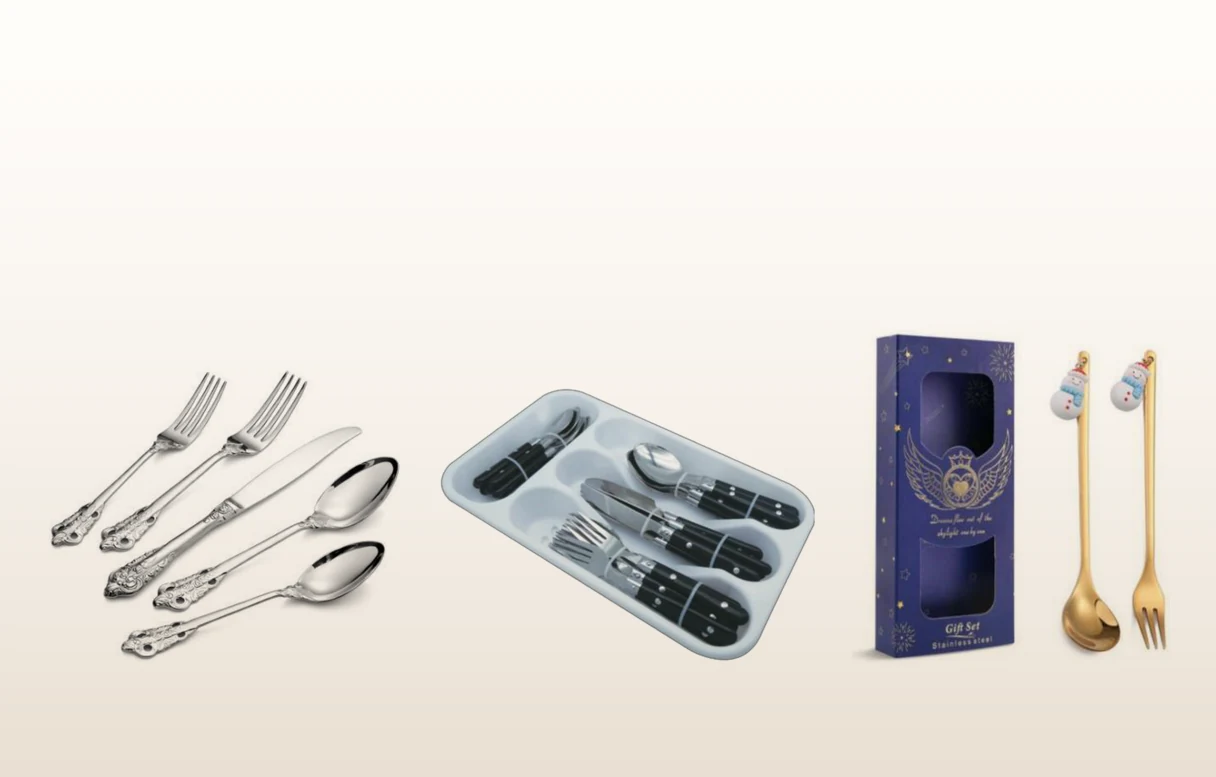
The family’s 250 models divide into four packaging forms and one silent group. Sixty-four models name a printed gift box, five a clear storage tube, five a moulded serving tray, two a blister card with a euro slot, and 174 name no packaging at all. The sub-shelves map onto those forms closely: the gift-set shelf is 54 gift boxes and 2 blister cards, the canteen shelf is 5 tubes and 5 trays, and the loose-set shelf names no packaging on any of its 162 models.
| Sub-shelf | Models | Packaging named | Finish | Set sizes |
|---|---|---|---|---|
| Gift sets | 56 | Printed gift box 54 · blister card 2 | Gold 49 · silver 7 | 6 pcs 19 · 4 pcs 18 · 2 pcs 15 |
| Loose sets | 162 | None on all 162 | Silver 156 · gold 5 | 4 pcs 82 · 5 pcs 49 · 3 pcs 14 |
| Canteen & tube | 22 | Tube 5 · moulded tray 5 · none 12 | Silver 20 · gold 2 | 24 pcs 6 · 16 pcs 5 · 32 pcs 3 |
| Christmas sets | 7 | Printed gift box 7 | Silver and gold 4 · gold 3 | 6 pcs 4 · 4 pcs 2 · 2 pcs 1 |
| Kids sets | 3 | Not published | Silver | Small sets |
So the shelf that reads “gift sets” is not a different fork. It is the same family, in a printed box, in smaller counts. A buyer who treats the shelf name as a product category will conclude the supplier offers six distinct cutlery types. A buyer who reads the fields will conclude the supplier offers one family in four packaging forms, and that the form is what changes between shelves.
The Finish Rides With the Box
Packaging drags a second attribute with it, and this is the part that catches banquet buyers. On this range, gold is not a free-standing choice of finish. It travels with the box.
Across the whole 354 models that publish a finish, gold is named on 71 — and every one of those sits in the cutlery family. Within the family the split is sharp: the gift-box shelf is 49 gold to 7 silver, while the loose-set shelf is 156 silver to 5 gold — YS03 is a typical row on it. The set sizes move with it. The gift shelf is dominated by two-, four- and six-piece sets; the loose shelf by four- and five-piece sets in quantities meant to be broken up across covers.
The commercial consequence is a specifying error that is easy to make and expensive to unwind. A buyer who writes “gold cutlery for the banquet department” is, on this range, describing mostly a retail gift SKU: a small set in a printed box. A buyer who writes “silver, loose, five-piece” is describing the bulk line. The finish and the packaging are two decisions that happen to correlate strongly here, and a specification that names only the finish leaves the supplier to guess the other one.
The safe habit is to name both, separately. Finish, then packaging, then set size. Three fields, not one.
The Two Rows That Break Their Own Shelf
Two models on the gift-set shelf do not carry a printed gift box, and they are the best argument for reading fields rather than shelf names. One, YT004, names a blister card with a euro slot — a retail hanging pack, not a box. Another, YR-FT161, carries a silver finish in a shelf that is otherwise 49 parts gold.
Neither is an error. They are evidence that the shelf is a merchandising decision made by a person, while the fields are a specification made about the goods. When the two disagree, the field is what a purchase order will be built on, and the shelf is what a visitor will have clicked to arrive. Two rows out of 56 is a small exception rate, but it is not zero, and the only way to see it is to compare the field against the shelf.
The Model Number Is the Only Key
If shelves are unreliable as counts, what should a buyer key an order to? The model number, with one caveat that has to be checked rather than assumed.
613 of the 665 models publish a model number. Those 613 carry 591 distinct numbers, which means 22 numbers are used on two pages apiece — 44 rows in total. The pairs are not obscure: BY-9013, BY-9310A, BY-9310B, BY-9330A, BY-9330B, BY-8018, WMJ-02 and WMJ-10 all appear twice. In each case the same number leads to two listings, which may be a duplicate page, a size variant that kept the number, or a genuine second configuration.
For a buyer the implication is procedural. A model number is the strongest key available on a catalogue of this size, but it is not self-validating. The way to use it is to quote it back to the supplier in the enquiry and ask for confirmation that the number, the finish, the packaging form and the set size all describe one item. A supplier who can answer that in one line has a controlled catalogue; a supplier who cannot has a list of pages.
How to Compare Two Suppliers in One Page
The comparison a buyer actually needs is not “how many products” but “how many orderable models, in how many families, in which packaging forms”. That is four numbers, and they can be requested in a single email.
| Ask for | What it settles | Why the alternative fails |
|---|---|---|
| Model count per family | The real breadth of the range | A page count rewards duplicate listings |
| Packaging forms offered | Whether gift, bulk and tray formats exist | Shelf names describe intent, not packing |
| Set sizes per form | Whether the line suits covers or retail | A finish alone does not fix the piece count |
| Carton quantity per model | What an order of 500 actually ships as | Model counts say nothing about freight |
| Whether model numbers are unique | Whether a PO can be keyed to one item | Duplicate numbers create two possible goods |
Two of those five — carton quantity and the uniqueness of the model number — are the ones suppliers are least likely to volunteer and most likely to have on hand. Both are worth asking for at quotation stage rather than at order stage, because both change what the order looks like before any money moves.
Everything downstream depends on the same distinction. A pallet plan is a function of cartons, not of pages. A store room calculation is a function of cartons and their dimensions. A damage claim is a function of how many pieces a carton was supposed to hold. In each case the number that matters is the one attached to a physical unit, and the number offered in a pitch is the one attached to a web page. They are rarely the same number, and on this catalogue they differ by 47.8 per cent.
Five Questions to Settle a Range
Why does a catalogue show more products than it sells?
Because a shop indexes by shelf as well as by model. Products can sit on a parent shelf and a child shelf at the same time, so the entries multiply while the goods stay the same. Here 318 of 665 models are double-listed, which turns 665 models into 983 shelf entries.
If an item is on two shelves, does that mean it suits two uses?
Not necessarily, and on this catalogue never. All 318 double-listed items are parent-and-child pairs inside one family; none is filed under two unrelated shelves. A second shelf indicates where an item can be found, not what else it can do.
Is a large category list a sign of a wide range?
Only if the shelves are populated. On this catalogue 31 of 61 shelves hold five models or fewer, and four hold exactly one. Half the navigation is labels rather than ranges, so the useful measure is models per family, not categories per menu.
Why is gold cutlery usually packaged in a box?
Because finish and packaging correlate in how the line was built. Here 49 of the 56 gift-box models are gold, while 156 of the 162 loose-set models are silver. A specification that names only the finish leaves the packaging form, and therefore the set size, open to interpretation.
Can I order by model number alone?
Usually, with one check. 613 models publish a number and 591 of those numbers are distinct, so 22 numbers appear on two pages. Quote the number, then ask the supplier to confirm that number, finish, packaging and set size all describe a single item.
All 49 buyer guides, grouped by product family, are indexed on the guides page.