Chafing Dishes & Buffet Warmers for Hotels: Three Columns the Table Never Has
The Only Line in This Catalogue Bought for Heat
Everything else on this site is a vessel. A wine glass, a pitcher, a cake dome, a stack of
cutlery — you choose it on what it holds and how it survives a wash. The cookware line is not that. Sixty-five
items sit under that heading, and not one of them is chosen for what it contains. They are chosen for
what they do to it afterwards.
That single difference changes which numbers matter. For a jug, the specification table can be
short and still be complete, because the jug’s job is geometry. For a warming stove or a soup pot, the
geometry is the easy half. The hard half is the heat: what produces it, how long it lasts, and whether
the thing you already have in the kitchen is allowed to touch it. Those three questions never appear on
a specification table for this line. Not once, in sixty-five rows.
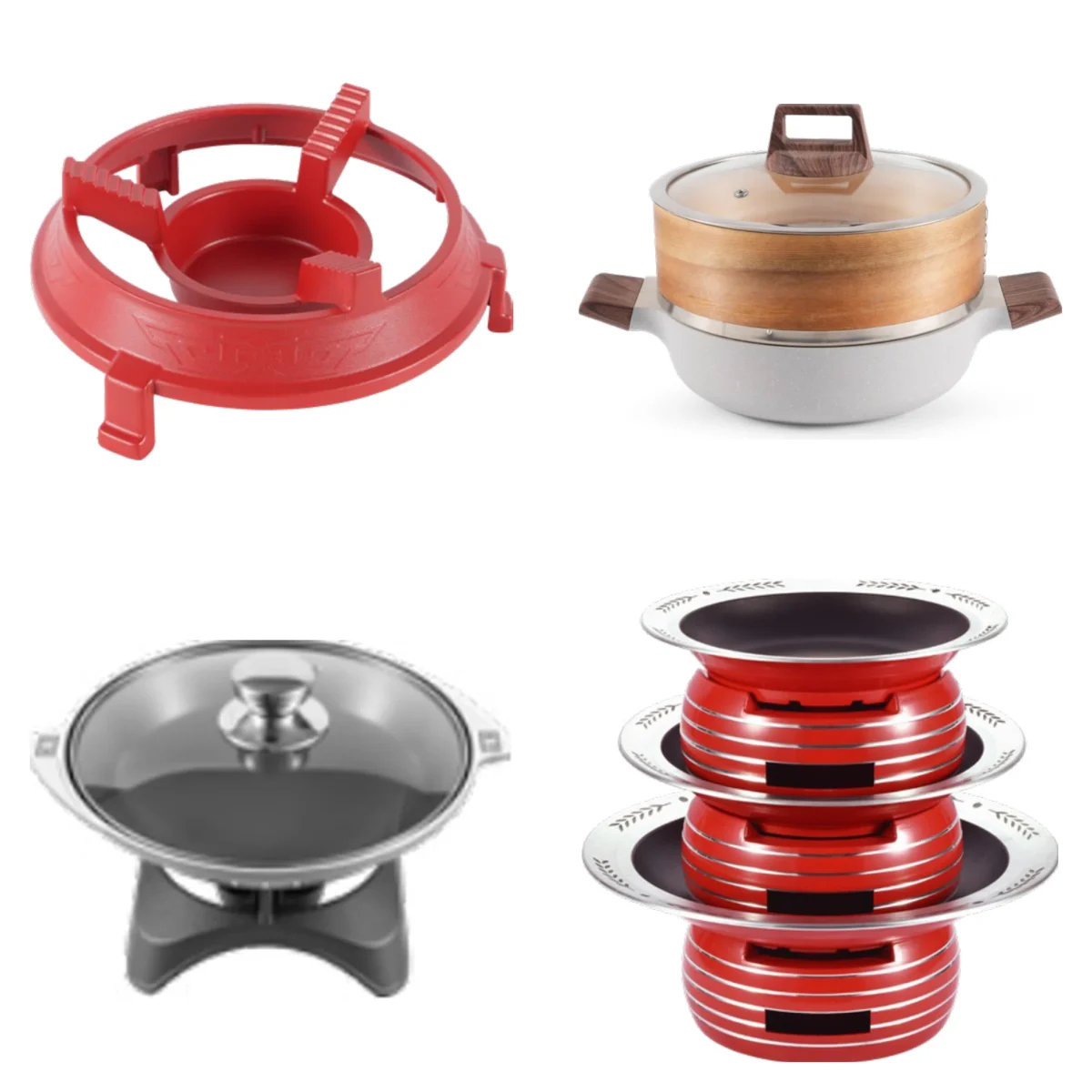
The line itself is broad, and it divides into four jobs that are usually bought by four
different people in a hotel. Warming stoves sit under a pan on a buffet. Soup pots hold the soup. Plate
sets put the heat under a dish at the table. Grills, woks and pans do the cooking. All of it is the same
metal — sixty-one of the sixty-five publish Aluminum alloy in the material row — and
that is exactly why the material row tells you so little here. When everything is the same metal, the
purchasing decision moves entirely to the things the table does not say.
What follows is what those sixty-five pages actually publish, counted, and where the gaps fall.
The gaps are not hidden. They are simply in columns that were never created, and the first job of a buyer
is to know which ones to ask for by name.
Three Columns, Sixty-Five Rows
Across the whole line, five attribute names are in use. Three of them appear on every single
product. Counting them is the fastest way to see the shape of the data.
| Attribute | Products that carry it | What it answers |
|---|---|---|
| Product Size | 65 of 65 | How wide the thing is |
| Material | 65 of 65 | Aluminum alloy, nearly always |
| Packing Quantity | 65 of 65 | How many fit in a carton |
| Available Colors | 28 of 65 | Which finishes exist |
| Model Number | 15 of 65 | What to quote |
| Capacity | 0 of 65 | How much it holds |
| Carton Size | 0 of 65 | What the freight costs |
| Compatible heat source | 0 of 65 | Whether your hob will work |
Read the bottom three rows together and the problem is not subtle. A pot’s entire purpose is
to hold food, and the line does not publish how much food. A carton’s entire purpose is to describe
freight, and the line does not publish how big the carton is. And a warming stove’s entire purpose is to
apply heat, and the line does not publish what applies the heat.
Thirty of the sixty-five print the same three fields
The five attribute names are not spread evenly. Thirty of the sixty-five products carry exactly
three of them and no more: size, material, packing quantity. Not a colour, not a model number. On those
thirty pages there is no field left over to carry any of the missing three even if someone wanted to add
it.
Twenty-seven carry four fields, and only eight carry five. So the most detailed page in the
line publishes five facts about the object. A hotel buying a warming stove is choosing between thirteen
stove designs that do genuinely different things — some sit a fuel canister under the pan, some sit
on a hob, some hold a water jacket, some are a frame you drop a dish into — and the most detailed
page in that set carries five facts about it, none of which is how it gets hot.
What a packing quantity is worth without a carton size
This is the one that costs money, and it is worth being blunt about. Every other guide in this
series has been able to finish a freight comparison, because every other line publishes a carton
dimension. Publish forty pieces to a carton and a carton size, and you can work out pieces per cubic
metre, then ask a freight forwarder for a real number.
For this line that arithmetic cannot be started. Sixty-five products, sixty-five packing
quantities, zero carton dimensions. You know a carton holds thirty plates. You do not know whether it is
a shallow crate or a half-pallet, and for cast aluminium that is most of the cost.
Five Rows Where the Size Column Contains No Number
The size column is the one field that appears on all sixty-five rows, so it is the one place
where a number is always expected. On five of the sixty-five, there is no number in it. Instead there is
a phrase.
| Product | What the size column says | Packing quantity |
|---|---|---|
| Drawer-type alcohol stove | Standard tabletop chafing footprint | 36 pcs / carton |
| Pull-free alcohol stove | Standard tabletop chafing footprint | 36 pcs / carton |
| Simple eco oil stove | Standard tabletop chafing footprint | 36 pcs / carton |
| WMJ-05-12 Volcano warming stove | Compact tabletop footprint | 120 pcs / carton |
| Interchangeable mini pots | Assorted diameters to suit the warmer range | Cartons are built to order |
Two of those cells are doing something defensible. A footprint phrase tells you the stove is
sized to sit under a standard pan, and if you already run a chafing line that is enough. The last row is
more interesting still: it is the only product in the entire line whose packing quantity contains no
number either, because the carton is described as built to order alongside whichever stove you bought it
for. That is an honest answer to an awkward question — a set of interchangeable pots genuinely
cannot have one carton figure — and it is also the only page in sixty-five that explains itself.
The first three rows are the ones to watch. Three different stoves — a drawer type, a
pull-free type and an oil stove — publish not merely the same kind of phrase but the identical
string, and they pair it with the identical packing quantity and the identical material. In the
specification table the three products are indistinguishable from each other. Only the title separates
them, and the title is not the part a purchasing sheet gets copied from.
Heat Arrives Four Ways, and No Table Names One
This is the section the line does not have. Set the table aside and sort the sixty-five by how
the food actually gets hot, and four routes fall out. Each route has its own failure mode and its own
question, and none of the four is a field anywhere on the site.
Route one: a canister under the pot
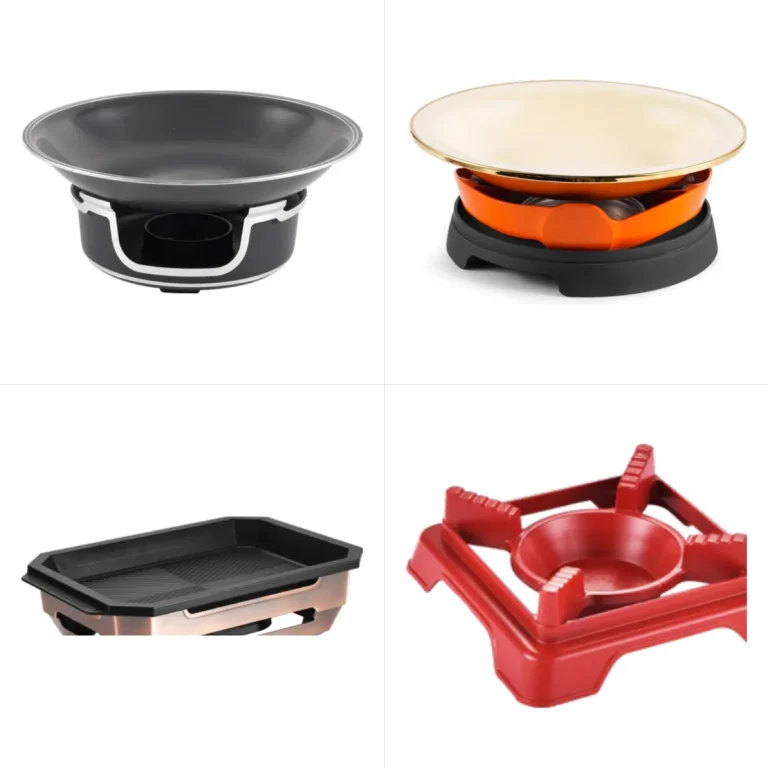
The thirteen items in the warming stove group are not cookware at all. They are frames. You put a fuel canister in
the middle, a pan on top, and the frame holds the two at the right distance. That is why the size column
has so little to say: what matters is the height of the flame relative to the pan base, not the pan’s
diameter.
Thirteen designs, and the packing quantity swings from twelve to one hundred and twenty pieces in
a carton. That range is a design decision made visible: a stove that folds flat and stacks packs ten times
as densely as one with a fixed steel body. If you are comparing a fixed-body warmer against a compact one, you are not comparing
two stoves, you are comparing two shipping profiles for the same job.
Three of the thirteen carry the phrase standard tabletop chafing footprint and nothing
else, which means the frame is sized to a pan you are expected to already own. The rest publish a
diameter, which means the frame and the pan are sold as a pair and you should not assume a pan you have
will sit level on it.
Route two: a hob
Somewhere between the frame and the soup pot there is a boundary the catalogue never draws:
which of the sixty-five can go on a hob, and which of those hobs is an induction hob. Pans, woks, grills,
casseroles and soup pots together make up most of the line, and a kitchen will expect most of them on a
burner. The word induction appears in eight titles and in the size cell of one more. The other
fifty-six pages say nothing at all, and the words gas, electric and hob do not
appear anywhere in the line’s specification text — not in a size cell, not in a material row, not
in a packing note.
An aluminium pan on an induction hob is not a marginal fit; it does not heat. So on fifty-six
pages, a buyer who has already moved their kitchen to induction has no way to know whether the item in
front of them is usable. One page solves this honestly by naming the constraint, and it is worth reading
as a model for how the rest should read.
Route three: a water jacket
The seven items in the soup warmer group are the gentlest of the four. A pot sits inside a base, the base holds
water, and the heat arrives through the water rather than through the metal. Soup survives that; a sauce
does not separate; nothing scorches onto the bottom.
The trade-off is time and space, and neither is on the page. A water jacket takes longer to come
up to temperature, and it needs a footprint larger than the pot it holds. The one figure that would let
you plan it — how much the pot holds — is the capacity figure that all sixty-five products
omit. A soup warmer is the single case where that gap bites hardest: you cannot size a buffet station
round a pot whose volume is not published.
Route four: the plate sits on its own stand
The plate and hot pot sets hold the opposite arrangement. The heat does not go under a pan; the dish itself is the
vessel, and it sits over a base with the burner between them. That is why the packing quantity for these
products splits in two, one figure for the dish and one for the base.
| Route | How the food gets hot | Items | What the page names |
|---|---|---|---|
| Canister | A fuel canister sits between frame and pan | 13 | The frame’s footprint, sometimes |
| Hob | The pan goes on the burner | 10 of 65 | The word “induction”, in nine places |
| Water jacket | A water bath under the pot | 7 | Rim diameter only |
| Stand and burner | The dish sits over its own base | 14 | Dish diameter and base diameter |
Four routes, four sets of questions, and not one of them labelled on the page you are buying
from. That is the actual finding here. The line is not short of information about its objects; it is
short of information about its function, which for this line is the only information that
matters.
Eight Titles Say Induction, and the Field Does Not Exist
Eight products carry the words for Induction Cookers in the title. That is a real and
useful claim, and it is the only place the heat source is named across the whole line. It is worth seeing
how thin the coverage is.
| Product | Where the heat source appears |
|---|---|
| WMJ-01 Korean aluminum wok | In the title only |
| WMJ-02 Korean shallow soup pot | In the title only |
| WMJ-02 side-handle shallow soup pot | In the title only |
| WMJ-08 clear-broth hot pot | In the title only |
| 3828 induction grill pan | In the title only |
| Ribbed induction grill pan | In the title only |
| Side-handle aluminum wok | In the title only |
| Induction seafood soup plate | In the title only |
| WMJ-10 Chuancheng casserole set | Inside the size cell |
One row in that table is doing something no other page in the line does. The WMJ-10 casserole set writes its own
size ladder with the constraint built into it: 24, 26, 28 and 30 centimetres marked open flame,
and 32, 34 and 36 centimetres marked induction.
Read that carefully, because it is the most useful sentence on any of the sixty-five pages and it
is buried in a field meant for measurements. The same casserole design, in the same finish, is sold in six
sizes, and the four smallest of them will not work on an induction hob. If a hotel buys 24 and 26
centimetres for a buffet and later converts the kitchen to induction, those two sizes become unusable
while the 32 does not. Nothing about the product changed. The buyer simply could not tell, because the
information was written into the size column instead of a field of its own.
The same product exists in a second finish, and it carries the identical sentence. Two finishes,
six sizes each, one constraint between them, and no field to hold it. If you take one thing from this
section, take the question: which sizes in this model are rated for the hob I have.
Two Products Carry One Model Number
Fifteen of the sixty-five publish a model number. Most follow house codes: WMJ, TCFS, or a
plain figure such as 3828. Three of them collide, and in a way that would matter at the quotation
stage.
| Product | Model Number | Size ladder | Packing |
|---|---|---|---|
| WMJ-02 Korean shallow soup pot | WMJ-02 | 24 / 28 / 32 cm | 10 pcs / carton |
| WMJ-02 side-handle shallow soup pot | WMJ-02 | 24 / 26 / 28 / 30 / 32 cm | 10 / 10 / 10 / 8 / 8 pcs |
| WMJ-02-A crystal lacquer soup pot | WMJ-02-A | 24 / 28 / 32 cm | 10 pcs / carton |
Two different pots, two different titles, one identical model number. And they are not the same
pot: the Korean shallow soup pot is offered in three diameters, and the side-handle version in five. A
quotation that says WMJ-02 and nothing else does not identify a product, and the size ladder is
the only place the difference shows.
The third row is the one that shows how easily this is fixed. The crystal lacquer pot uses
WMJ-02-A, a distinct code, and it is the only one of the three that does. Two of the three share a code
and one has a suffix — which means somebody, somewhere, was already tracking the problem and only
finished half the job.
For a buyer the practical rule is simple. On this line, treat a model number as a family name
rather than a part number, and always quote the diameter alongside it. Where a page gives you both, the
diameter is what identifies the object.
Three Gold-Rimmed Plate Sets, Four Shared Facts
The plate sets at the top of the hot pot range come in a family of three, and they are a good
illustration of how much a specification table can blur.
| Product | Rim ladder | Depth published | Material row | Packing |
|---|---|---|---|---|
| Gold rim shallow plate set | 28 / 31 / 34 / 37 / 40 cm | 3 / 3 / 3.5 / 3.5 / 3.7 cm | Aluminum alloy | 24 / 24 / 24 / 12 / 12 pcs |
| Gold rim 3-ply steel plate set | 28 / 31 / 34 / 37 / 40 cm | 3 / 3 / 3.5 / 3.5 / 3.7 cm | Aluminum alloy with 3-ply stainless steel rim | 24 / 24 / 24 / 12 / 12 pcs |
| Gold rim deep plate set | 28 / 31 / 34 / 37 / 40 cm | 4.4 / 4.8 / 5.2 / 5.3 / 5.4 cm | Aluminum alloy | 24 / 24 / 24 / 12 / 12 pcs |
All three publish the same rim ladder, the same packing, and the same colour line —
gold rim on white body. The shallow set and the deep set differ in exactly one published field:
the depth. That is a real difference and the table states it clearly, which is what the table is for.
The third row is the one worth pausing on. The 3-ply steel set is the only product in the whole
sixty-five whose material row mentions steel, and its depth is published as 3 / 3 / 3.5 / 3.5 /
3.7 — the shallow figures, not the deep ones. So the one member of the family whose name
promises metal construction publishes the depth of the shallow plate. Whether that is deliberate —
a reinforced rim on a shallow profile — or a copy-paste from the page above it, the table cannot
tell you. Ask.
Widen the lens and the same pattern repeats across the line. Four product titles contain the word
steel. Exactly one material row does. Fifteen of the sixty-five products share a size, packing
and material string with at least one other product, and in four of those groups the two items are not
even the same kind of object — a warming stove and a seafood soup plate carry the identical three
fields, as do a plate set and a dry pot. Sixty-five rows, fifty-seven distinct combinations of the three
universal fields.
The Two Halves of a Set Pack at Different Rates
Six products on this line are sold as two pieces: the dish or pot, and the base it sits on. Their
packing quantity names both, and this is where the arithmetic starts to matter, because the two halves
almost never pack at the same rate.
| Set | Dish packs | Base packs | At 500 pieces |
|---|---|---|---|
| Harvest plate set | 30 pcs / carton | 60 pcs / carton | 17 cartons (510) + 9 cartons (540) |
| Gradient color dry pot set | 30 pcs / carton | 60 pcs / carton | 17 cartons (510) + 9 cartons (540) |
| WMJ-04 classic dry pot | 30 pcs / carton | 60 pcs / carton | 17 cartons (510) + 9 cartons (540) |
| Hammered composite steel dry pot | 30 pcs / carton | 60 pcs / carton | 17 cartons (510) + 9 cartons (540) |
| Line texture warmer set | 24 pcs / carton | 12 pcs / carton | 21 cartons (504) + 42 cartons (504) |
| Shanpin seafood hot pot with stand | 10 pcs / carton | 20 pcs / carton | 50 cartons (500) + 25 cartons (500) |
Four of the six land on a mismatch. The dish packs thirty to a carton and the base packs sixty, so
the minimum order becomes seventeen cartons of dish and nine cartons of base. That is 510 dishes and 540
bases: thirty extra bases in the warehouse, and no way to buy a whole carton of each that brings the two
numbers level.
The other two land cleanly, and the reason is instructive. Twenty-four and twelve are multiples
of each other, so 504 and 504 match at twenty-one and forty-two cartons. Ten and twenty do the same at
fifty and twenty-five. The sets that work are the ones whose two halves pack in a simple ratio.
This is not a fault in the products. It is a fault in the way the figure is presented, and it has
a one-line fix: ask your supplier to quote the dish and the base as separate line items with their own
carton counts, and the mismatch becomes visible before the order rather than after it. On four of these
six products, a buyer who does not ask will find out from the warehouse.
Cartons from Four to a Hundred and Twenty
The packing quantity column is the most complete field on the line, and it is also the one with
the widest spread.
| Product | Packing quantity | At the 500 piece minimum |
|---|---|---|
| Artisan grill pan set | 4 sets / carton | 125 cartons |
| TCFS-20-JG steel fish grill | 8 pcs / carton | 63 cartons |
| WMJ-05-12 Volcano warming stove | 120 pcs / carton | 5 cartons |
| Ultra-slim round warming stove | 60 pcs / carton | 9 cartons |
| Antique-style alcohol stove | 60 pcs / carton | 9 cartons |
Four sets to a carton at one end, a hundred and twenty pieces at the other. That is a factor of
thirty in the same column, on the same line, and it means the minimum order is a hundred and twenty-five
cartons of one product and five cartons of another. Neither number is remarkable in itself. What matters
is that you cannot compare two suppliers’ minimums on price alone when one ships five cartons and the
other ships a pallet.
Narrow the view to the warming stoves alone and the spread is still ten to one: twelve pieces to a
carton for the largest of the Taishan warmers, a hundred and twenty for the compact one. Ten times the warehouse space
for the same five hundred units.
And here the line runs into the gap from the start of this article. Every other guide on this site
can turn that carton count into a container figure, because every other line publishes a carton
dimension. This one does not. Sixty-five packing quantities and no carton size means the five-carton
product and the hundred-and-twenty-five-carton product cannot be compared on freight at all, from the
information published. You can count cartons. You cannot price them.
So ask for the carton dimensions in the quotation, as a matter of course, on whichever of the
sixty-five you are considering. It is a single line of data, it costs the supplier nothing, and on this
line it is the difference between knowing your landed cost and guessing it.
The Same Base Packs Twelve or Sixty
One more collision, and it is a small one that tells you a lot about how these pages were
assembled. The bases that sit under the hot pot sets are the same accessory, described across several
products. Their packing quantities do not agree.
| Page | What it says the base packs |
|---|---|
| Line texture warmer base, bought alone | 12 pcs / carton |
| Line texture warmer set | 12 pcs / carton |
| WMJ-04 classic dry pot | 60 pcs / carton |
| Gradient color dry pot set | 60 pcs / carton |
| Harvest plate set | 60 pcs / carton |
Twelve or sixty, a factor of five, for the same word in the same field. The purchases where the
base is bought on its own and the purchases where it is bundled agree with each other internally —
the two line-texture pages both say twelve, the three bundled sets all say sixty — which suggests
two different people filled in two different sets of pages and neither saw the other’s work.
Whichever figure is right, they cannot both be, and the consequence is a real one: at 500 pieces
the base is either forty-two cartons or nine. Ask for the base to be quoted on its own line, with its own
carton count, and the answer settles itself.
The Six Questions the Table Does Not Answer
Everything above reduces to a short list, because the gaps on this line are consistent. Six
questions cover the whole sixty-five.
- For each item: what does it hold? In litres or in millilitres, for the pan or pot
itself and not the frame around it. No page on this line publishes it, so ask for every SKU on your
list. - For each item: which heat sources is it rated for? Name your hob — induction,
gas, electric, or a fuel canister — and ask for a yes or no per item. Eight titles answer this in
passing; the other fifty-seven do not. - For each item: the carton dimensions, and the carton count at 500 pieces. You will
receive the count. You will not receive the dimensions unless you ask, and without them the freight
cannot be quoted. - For the sets: quote the dish and the base separately. Their packing rates differ on
four of the six sets, and a combined figure hides which half you are over-buying. - For anything carrying a model number: quote it with the diameter. Two products share
WMJ-02, so the code alone does not identify what you are buying.
A single message covering those six points, sent with your size list, will come back with more
usable information than any sixty-five of these pages currently carry. That is not a criticism of the
line — it is a good line, and the aluminium is the same aluminium whether it is a wok or a soup
warmer. It is simply a line whose catalogue was built around what the objects look like, and whose buyers
need to know what the objects do.
If your interest is the cold half of the same table instead of the hot half, the bowl and plate guide and the platter guide
cover the serving side, and the table service guide covers what sits underneath it. This article is the first on the site
to deal with the side of the kitchen where the food is warm, and it is worth treating its numbers the
same way: confirm them in writing before the order, not after it.
For anything specific — a diameter, a finish, a colour match to a room — the contact page and
the about page both come straight back to a person. Send the size list and the six questions above, and the
quotation will carry the figures the pages do not.
FAQ: Chafing Dishes and Buffet Warmers for Hotels
Does the specification table tell me whether a pot will work on my induction hob?
Not as a rule. There is no heat source field anywhere on the cookware line, and across sixty-five products the word induction appears in eight titles and in one size cell. The clearest example is the WMJ-10 casserole set, whose size ladder reads 24, 26, 28 and 30 cm for open flame and 32, 34 and 36 cm for induction — so four of its six sizes will not work on an induction hob. Name your hob in the enquiry and ask for a per-item answer.
How much does each pot or pan hold?
That figure is not published for any of the sixty-five products, including the soup pots and casseroles where it matters most. Capacity is absent from the whole line, so the only reliable route is to ask for a volume per SKU, in litres, alongside the diameter. Sizing a buffet station from the published diameters alone will over- or under-shoot.
Can I get a freight estimate from the packing quantities?
No — and this is the single biggest gap on the line. Packing quantity is published on all sixty-five products, but carton size is published on none of them, so pieces per cubic metre cannot be worked out. Other lines on the site carry both and support a container calculation. Here you can count cartons, from five for the compact warming stove to a hundred and twenty-five for the grill pan set, but you cannot price them without asking for the carton dimensions.
Why do some products share a model number?
Two distinct products both publish WMJ-02, and their size ladders differ: one is offered in 24, 28 and 32 cm, the other in 24, 26, 28, 30 and 32 cm. A third, the crystal lacquer soup pot, uses WMJ-02-A. Treat model numbers on this line as family names rather than part numbers, and always quote the diameter with the code.
What is the minimum order, and what does it work out to in cartons?
The minimum is 500 pieces per model, as with the rest of the catalogue. Because packing quantities on this line run from four sets per carton to a hundred and twenty pieces, that floor is five cartons for the most densely packed warming stove and a hundred and twenty-five for the grill pan set. On the six two-piece sets, remember that the dish and the base pack at different rates, so the carton counts for the two halves will not match.