Water Pitchers for Hotels: Pallets, Cartons and the Container You Actually Pay For
A Jug Leaves as a Product and Arrives as Freight
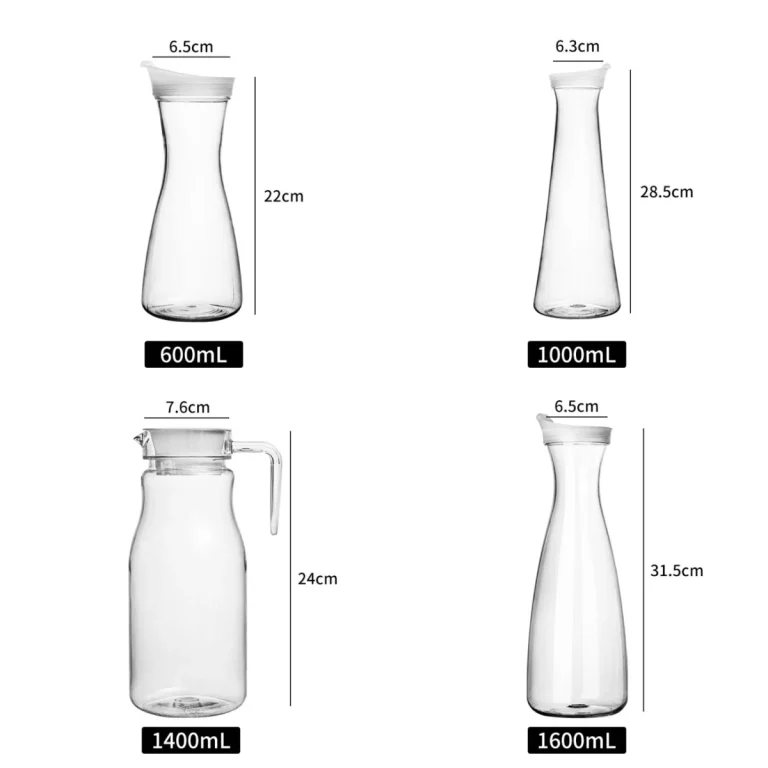
A water jug leaves a workshop as a product and reaches a hotel as freight, and the two are counted differently. Everything upstream of the carton is the jug: the mould, the resin, the wall thickness, the polish, the handle. Everything downstream of the carton is logistics: the pallet, the container, the rack, the trolley that takes it up to the fourth floor. This range holds ninety-four jugs across four sub-lines, and the specification table documents the join carefully on one side of the carton and not at all on the other.
Material and model number are on all ninety-four rows. Capacity is on ninety-one, a pack count on seventy-nine and a carton size on seventy-five — enough to work out how many pieces fit in a box and how many boxes fill a container by hand. What no row carries is anything about a pallet. There is no pallet footprint, no cartons per layer, no stack height, no pallet weight. The unit the workshop packs into is on the page. The unit your goods-in team books into is not.
That gap is worth closing, because on this range the pallet is not a rounding adjustment. It is the difference between a container carrying sixteen thousand of a jug and the same container carrying four thousand of it — same mould, same resin, same capacity, same fifty pieces in the carton, same price. Nothing about the jug changes. One number about the box does.
What Ninety-Four Jug Rows Actually Publish
Start with the columns rather than the rows. The jug specification fills some of them in on every product and leaves others empty on every product, and the blanks are not scattered at random.
| Field | Rows carrying it | Out of 94 | What it is for |
|---|---|---|---|
| Material | 94 | 94 | The body |
| Model Number | 94 | 94 | The order line |
| Capacity | 91 | 94 | What the jug holds |
| Packing Quantity | 79 | 94 | The shipping unit |
| Carton Size | 75 | 94 | The freight unit |
| Product Size | 54 | 94 | Whether it fits your shelf |
| Available Colors | 47 | 94 | Whether it matches your trolley |
| Cartons per pallet layer | 0 | 94 | The pallet unit |
| Cartons per pallet | 0 | 94 | The pallet unit |
| Stack height | 0 | 94 | The warehouse unit |
Two things stand out. The first is that capacity is published more often than the box — ninety-one rows against seventy-five — which is the reverse of the pattern across the catalogue as a whole, where carton dimensions appear on 303 rows and capacity on 187. On the jug line the sheet tells you what the jug holds more reliably than it tells you what the jug travels in, and for a buyer building a landed cost that is the wrong way round.
The second is the bottom of the table. Weight, packaging and pieces-per-set are at zero across the whole range, and so is every field that would describe a pallet. A buyer comparing two jug quotations on unit price is comparing the one figure both sheets are guaranteed to agree on, and price per piece is the figure that decides least about what the shipment costs.
The four sub-lines are not equal in size either. Full-handle premium models account for thirty-four rows, half-handle universal twenty-five, juice pitchers nineteen and half-handle stainless models sixteen. Carton data is not spread evenly across them, and the empty carton cells cluster at the newest end of the premium group.
The Carton Is Square and the Pallet Is Not
Of the seventy-five jug rows that publish a carton, sixty-four have a footprint where the length equals the width. Eighty-five per cent of the boxes on this shelf are square.
The reason is upstream. The body of a jug is round, so the smallest box that clears it is a square, and a square carton is the simplest thing in the world to buy, print, label and stack. It is a good decision made at the level of the carton. It becomes an awkward one a level further down, because the deck underneath is almost never square.
| Square carton footprint | Jug rows using it | Typical capacity band |
|---|---|---|
| 36 × 36 cm | 1 | 500 ml |
| 42 × 42 cm | 2 | 600–800 ml |
| 45 × 45 cm | 10 | 800–1100 ml |
| 47 × 47 cm | 7 | 900–1400 ml |
| 48 × 48 cm | 15 | 500–1500 ml |
| 49 × 49 cm | 1 | 1100 ml |
| 50 × 50 cm | 4 | 1400–1600 ml |
| 51 × 51 cm | 5 | 1250–1600 ml |
| 53 × 53 cm | 1 | 1400 ml |
| 54 × 54 cm | 3 | 1250–2000 ml |
| 55 × 55 cm | 4 | 1000 ml |
| 56 × 56 cm | 1 | 1000 ml |
| 57 × 57 cm | 3 | 2000 ml |
| 58 × 58 cm | 1 | 1500 ml |
| 61 × 61 cm | 2 | 1500 ml |
| 65 × 65 cm | 4 | 1400–1800 ml |
The eleven rows that are not square are the exceptions, and they are worth listing because they turn out to be the best-behaved boxes on the shelf: BY-9163 (1100 ml, 63 × 38 × 47 cm), BY-9183B (1500 ml, 58 × 52 × 44.5 cm), BY-8553 (2000 ml, 68 × 56 × 50 cm), BY-8554 (2000 ml, 68 × 56 × 50 cm), BY-9162C (1000 ml, 55 × 52 × 42 cm), BY-9141B-1 (1500 ml, 64 × 48 × 49 cm), BY-9142A (1600 ml, 67 × 45 × 51 cm), BY-9141A-1 (1800 ml, 56 × 41 × 49 cm), BY-9141A (2000 ml, 60 × 57 × 52 cm), BY-9141D (500 ml, 48 × 45 × 49.5 cm), BY-9174B (1100 ml, 71 × 54 × 33 cm).
A box one centimetre wider than another is not a better or a worse box in itself. It is a different fit against whatever sits underneath it, and this shelf runs from 36 cm to 71 cm, which means it is asking a pallet to accept twenty-six different footprints. A pallet edge does not divide by twenty-six numbers evenly.
There Is No Such Thing as a Pallet
Pallets are not one object. Three standards cover most of the warehouse floors that jugs land on, and they are not the same shape as each other.
| Standard | Deck | Deck area | Where it is the default |
|---|---|---|---|
| EUR / EPAL wooden pallet | 1200 × 800 mm | 0.96 m² | European warehouses, and much of the hotel supply chain that feeds them |
| ISO / industrial pallet | 1200 × 1000 mm | 1.20 m² | General export and industrial racking, including most North American distribution |
| Square block pallet | 1100 × 1100 mm | 1.21 m² | Widely used across Asia, the Gulf and parts of East Africa |
All three take twenty pallets in a forty-foot high-cube. The floor of a high-cube is 12.03 m by 2.35 m, and a 1200 mm pallet, a 1100 mm pallet and an 800 mm pallet each divide into it ten times along and twice across. So the container itself does not care which of the three you use. What it carries does.
The Number Is Floor Division, and Nothing Rounds Up
Cartons per pallet layer are not found by dividing deck area by carton area. They are found by asking how many whole carton edges fit along each pallet edge, once in each orientation, and multiplying. The result is a whole number both times, and the fraction is thrown away rather than rounded up.
Put a 55 cm square box on an 1100 mm square pallet and the division is 1100 ÷ 550, which is exactly two. Two boxes across, two boxes down, four to a layer — and the layer is the pallet, 100 per cent of the deck covered, which is something a square box almost never achieves on a rectangular deck.
Change the box to 56 cm and the same division becomes 1100 ÷ 560, or 1.96. That is not two. One box across, one box down, one box to a layer, and 26 per cent of the deck in use. A tenth of a box short of two full boxes is still one box.
This is the entire mechanism, and it is worth stating plainly because it does not behave like the arithmetic buyers are used to. Area, volume and density all move smoothly: a slightly taller carton is slightly worse, a slightly larger capacity is slightly heavier, and a small change produces a small change. Cartons per layer does not move smoothly. It steps, and the steps are wide enough that one centimetre of box can take a pallet from four cartons a layer down to one.
Eight Rows at One Litre, Two Boxes, One Centimetre
The premium full-handle sub-line is where this stops being a thought experiment. Eight of its rows are one-litre jugs. Five of those eight publish a carton size; all five pack fifty pieces; between them they use exactly two box sizes. Four use 55 × 55 × 39 cm — BY-9193C, BY-9195C, BY-9197C, BY-9198C. One, BY-8553C, uses 56 × 56 × 38 cm. The remaining three publish no carton at all (BY-9190C, BY-9191C, BY-9192C), which is a separate problem discussed below.
On a 1200 × 800 wooden pallet the two boxes are three per cent apart: 63.0 per cent of the deck against 65.3. On a 1200 × 1000 pallet they are two per cent apart. On a 1100 × 1100 pallet the 55 cm box puts four cartons on the layer and fills the deck completely, and the 56 cm box puts one carton on the layer and fills a quarter of it.
| Model | Capacity | Carton | Pieces / carton | EUR 1200 × 800 | ISO 1200 × 1000 | Square 1100 × 1100 | Pieces / pallet on the square deck |
|---|---|---|---|---|---|---|---|
| BY-9193C | 1000 ml | 55 × 55 × 39 cm | 50 | 2 a layer, 63.0% | 2 a layer, 50.4% | 4 a layer, 100.0% | 800 |
| BY-9195C | 1000 ml | 55 × 55 × 39 cm | 50 | 2 a layer, 63.0% | 2 a layer, 50.4% | 4 a layer, 100.0% | 800 |
| BY-9197C | 1000 ml | 55 × 55 × 39 cm | 50 | 2 a layer, 63.0% | 2 a layer, 50.4% | 4 a layer, 100.0% | 800 |
| BY-9198C | 1000 ml | 55 × 55 × 39 cm | 50 | 2 a layer, 63.0% | 2 a layer, 50.4% | 4 a layer, 100.0% | 800 |
| BY-8553C | 1000 ml | 56 × 56 × 38 cm | 50 | 2 a layer, 65.3% | 2 a layer, 52.3% | 1 a layer, 25.9% | 200 |
Nothing distinguishes those five lines except the box. They are all one litre, all polycarbonate, all full-handle premium models, all fifty pieces to the carton, all from one sub-line of one range. Two of them are within a millimetre of each other in carton size. On two of the three pallet standards the millimetre is worth a per cent or two, and on the third it is worth a factor of four.
The Same Centimetre Cuts Both Ways
It would be easy to read the last section as “the 55 cm box is the good one”. It is not, and the honest version of the comparison is more useful than the headline.
Against the European pallet the 56 cm box is the better of the two: 65.3 per cent of the deck against 63.0. Against the ISO pallet it is also the better of the two: 52.3 against 50.4. The 56 cm carton only fails on the square block, and there it fails completely. The box is not bad. It is badly matched to one of three floors, and which floor it meets is decided by a warehouse on the receiving end of the shipment rather than by anyone in the quotation.
Which produces the rule that governs the rest of this guide. A carton dimension on its own has no ordering. It only becomes better or worse once a pallet is named, because the thing that converts one into the other is an integer division against a deck edge. A supplier quoting a carton without knowing your pallet is answering a question nobody asked, and a buyer comparing two cartons without naming a pallet is comparing two numbers that cannot yet be ranked.
Three Pallet Standards, Fourteen Answers
Extend the comparison across the range and the reversals stop looking like accidents. The table below takes the representative footprint of each carton group on this shelf and puts all three decks against it.
| Carton | Jugs on the shelf | EUR per layer / deck used | ISO per layer / deck used | Square per layer / deck used |
|---|---|---|---|---|
| 36 × 36 × 54 cm | 1 | 6 — 81.0% | 6 — 64.8% | 9 — 96.4% |
| 42 × 42 × 47 cm | 1 | 2 — 36.8% | 4 — 58.8% | 4 — 58.3% |
| 45 × 45 × 55 cm | 3 | 2 — 42.2% | 4 — 67.5% | 4 — 66.9% |
| 47 × 47 × 64 cm | 3 | 2 — 46.0% | 4 — 73.6% | 4 — 73.0% |
| 48 × 48 × 49 cm | 12 | 2 — 48.0% | 4 — 76.8% | 4 — 76.2% |
| 49 × 49 × 49 cm | 1 | 2 — 50.0% | 4 — 80.0% | 4 — 79.4% |
| 50 × 50 × 67 cm | 4 | 2 — 52.1% | 4 — 83.3% | 4 — 82.6% |
| 51 × 51 × 57 cm | 4 | 2 — 54.2% | 2 — 43.4% | 4 — 86.0% |
| 53 × 53 × 50 cm | 1 | 2 — 58.5% | 2 — 46.8% | 4 — 92.9% |
| 54 × 54 × 52 cm | 2 | 2 — 60.8% | 2 — 48.6% | 4 — 96.4% |
| 55 × 55 × 39 cm | 4 | 2 — 63.0% | 2 — 50.4% | 4 — 100.0% |
| 56 × 56 × 38 cm | 1 | 2 — 65.3% | 2 — 52.3% | 1 — 25.9% |
| 57 × 57 × 54 cm | 3 | 2 — 67.7% | 2 — 54.1% | 1 — 26.9% |
| 58 × 58 × 44 cm | 1 | 2 — 70.1% | 2 — 56.1% | 1 — 27.8% |
| 61 × 61 × 46 cm | 2 | 1 — 38.8% | 1 — 31.0% | 1 — 30.8% |
| 65 × 65 × 40 cm | 2 | 1 — 44.0% | 1 — 35.2% | 1 — 34.9% |
| 68 × 56 × 50 cm | 2 | 2 — 79.3% | 2 — 63.5% | 1 — 31.5% |
| 71 × 54 × 33 cm | 1 | 2 — 79.9% | 2 — 63.9% | 2 — 63.4% |
Four things in that table are worth naming.
The ranking is not the same in any two columns. The 50 cm box is the best performer on the ISO deck at 83.3 per cent and only joint fourth on the square deck. The 71 cm box, the widest on the shelf, is second on the European deck at 79.9 per cent and sixth on the square. There is no single ordering of these cartons; there are three, and they disagree.
The ISO pallet is not the middle option. It is the best of the three on the 48 cm box at 76.8 per cent and the worst of the three on the 51 cm box at 43.4 per cent and the 55 cm box at 50.4 per cent. A 1000 mm edge takes two 480 mm boxes and one 550 mm box; the extra 200 mm of deck over a European pallet buys literally nothing for the sizes in the middle of the range.
The square block is the most extreme standard in both directions. It produces the best single result on the shelf — four cartons of 55 cm on a layer, 100 per cent of the deck — and several of the worst, including 25.9 per cent for the 56 cm box and 26.9 per cent for the 57 cm.
Everything below 50 cm behaves well everywhere. A 45 cm box takes two per layer on the European deck and four on the other two, and no standard wastes more than two thirds of the deck on it. The small end of this line is not where the money is being left on the floor.
Cartons per Layer Is Only Half a Pallet
The other half is how many layers fit, and that comes from the carton height rather than its footprint. The figures below assume a two-metre finished stack: 144 mm of wooden pallet, then 1.856 m of cartons, which clears the 2.58 m door of a high-cube container with room for the forks and is roughly where rack beams are set in a conventional warehouse. It is a working assumption, not a published number. If your warehouse stacks to 2.4 m every figure below rises; the ranking between rows does not change, because the layer count moves with the height and the footprint count does not.
| Carton height | Layers in a two-metre stack | Capacities that use it |
|---|---|---|
| 33 cm | 5 | 1100 ml |
| 35.5 cm | 5 | 1400 ml |
| 38 cm | 4 | 1000 ml |
| 39 cm | 4 | 1000 ml |
| 40 cm | 4 | 1800 ml |
| 42 cm | 4 | 1000 ml, 800 ml |
| 44 cm | 4 | 1500 ml |
| 44.5 cm | 4 | 1500 ml |
| 46 cm | 4 | 1500 ml, 800 ml |
| 47 cm | 3 | 1100 ml, 600 ml |
| 48 cm | 3 | 1250 ml |
| 49 cm | 3 | —, 1000 ml, 1100 ml, 1200 ml, 1250 ml, 1500 ml, 1800 ml, 500 ml, 800 ml |
| 49.5 cm | 3 | 500 ml |
| 50 cm | 3 | 1400 ml, 2000 ml |
| 51 cm | 3 | 1300 ml, 1600 ml |
| 52 cm | 3 | 1800 ml, 2.0 L, 2000 ml |
| 54 cm | 3 | 2000 ml, 500 ml |
| 54.5 cm | 3 | —, 1100 ml |
| 55 cm | 3 | 1100 ml |
| 56 cm | 3 | 1250 ml |
| 57 cm | 3 | 1600 ml |
| 58 cm | 3 | 900 ml |
| 63 cm | 2 | 1400 ml |
| 64 cm | 2 | 1600 ml |
| 67 cm | 2 | —, 1400 ml, 1450 ml, 1600 ml |
Push that against the footprint and the two best and worst results on the shelf swap places. The 65 × 65 × 35.5 cm box takes one carton per layer on every standard, which is the worst layer count in the range, but it is short enough for five layers, and five cartons of fifty pieces is 250 pieces a pallet — close to the middle of the shelf. The 50 × 50 × 67 cm box takes four cartons per layer, the best footprint in the range, and only two layers, which leaves it at the bottom of the same table. Optimising the footprint without the height, or the height without the footprint, produces the wrong answer about as often as the right one.
And the 55 cm box still wins by a distance on the square deck: sixteen cartons and eight hundred pieces a pallet, against four cartons and two hundred pieces for its 56 cm neighbour. Same jug, same price, same order line.
One Container, Three Answers
A forty-foot high-cube takes twenty pallets on any of the three standards, so the per-pallet figures translate straight into a shipment figure. The comparison below uses the one-litre premium jug, at the five hundred piece minimum order this range starts from.
| Carton | Pieces / pallet, square deck | Pieces / 40HQ, square deck | Pieces / pallet, EUR deck | Pieces / 40HQ, EUR deck | Pieces / 40HQ, loose-stowed |
|---|---|---|---|---|---|
| BY-9193C — 55 × 55 × 39 cm | 800 | 16000 | 400 | 8000 | 28395 |
| BY-9195C — 55 × 55 × 39 cm | 800 | 16000 | 400 | 8000 | 28395 |
| BY-9197C — 55 × 55 × 39 cm | 800 | 16000 | 400 | 8000 | 28395 |
| BY-9198C — 55 × 55 × 39 cm | 800 | 16000 | 400 | 8000 | 28395 |
| BY-8553C — 56 × 56 × 38 cm | 200 | 4000 | 400 | 8000 | 28111 |
Sixteen thousand against four thousand, for the same jug at the same price, freighted to the same port. The container is not making the choice. The pallet standard on the receiving end is.
Loose stowage is on the same table for scale, and it deserves an honest caveat rather than a recommendation. Hand-stacking cartons to the roof of a high-cube uses the full 67 cubic metres of usable volume and lands between two and three and a half times what a pallet programme achieves — on the one-litre jugs above, 28,396 pieces against 16,000 or 4,000. It is also not an option most importers can take: it arrives as a wall of cartons that has to be unloaded by hand, and the two-metre pallet programme is what your racking was bought for. The row is there to show the size of the decision, not to argue for abandoning pallets. What it does argue for is knowing which of the two you are paying for before the container is booked, because the gap between them is not a rounding error either.
Where This Line Wastes a Pallet, and Where It Does Not
Read across all thirty-seven carton sizes and twenty-six footprints on the shelf, and the spread is wide enough that the median tells you more than the extremes.
| Pallet standard | Worst footprint | Best footprint | Median across the line |
|---|---|---|---|
| EUR 1200 × 800 | 36.8% — the 42 cm box | 81.0% — the 36 cm box | 52.1% |
| ISO 1200 × 1000 | 31.0% — the 61 cm box | 83.3% — the 50 cm box | 63.5% |
| Square 1100 × 1100 | 25.9% — the 56 cm box | 100.0% — the 55 cm box | 66.9% |
A median of 52 per cent on the European deck means the typical box on this range leaves very nearly half the deck empty. The other two standards sit above 60 per cent, which is better and still not good. None of this is a mistake in any single row. It is what happens when square boxes of twenty-six different sizes are laid on rectangular decks, and only the sizes that divide a deck edge exactly are ever going to look efficient.
The Rows That Lose on Every Deck
Some cartons are a bad fit on all three standards, and they can be named.
The 61 × 61 × 46 cm box, used by the two 1500 ml half-handle stainless and universal rows (BY-9162B and BY-9162B-1), places one carton per layer on the European deck, one on the ISO and one on the square — 38.8 per cent of the deck at best. The 65 × 65 cm box is the same story: one carton a layer everywhere, 44.0 per cent on the European deck and 35 per cent on the other two, across four rows (BY-9196A, BY-9196B, BY-9199A, BY-9199B). And at the other end of the shelf the smallest box, the 42 × 42 cm used by BY-9310A and BY-9170, is the worst fit of all on the European deck at 36.8 per cent — a small pallet cannot recover a box that will not divide into it.
None of those five cartons is a defective product. Each was sized to hold a jug and to survive a courier, and none was ever sized to sit on a named deck. That is the whole problem in one sentence.
The Rows That Lose on Exactly One
More interesting, and more fixable, are the cartons that are good on two standards and poor on one.
The 51 × 51 cm box, used by BY-9160A and three sibling rows, covers 86.0 per cent of the square deck, 54.2 per cent of the European deck and 43.4 per cent of the ISO deck. The middle-sized pallet is the bad one here, which breaks the reasonable-sounding assumption that a larger deck always takes at least as many boxes. The 55 cm box repeats the pattern on a different standard: perfect on the square deck, 50.4 per cent on the ISO. The two-litre bowl-shaped jugs, BY-8553 and BY-8554, come in the only non-square box in the efficient group — 68 × 56 × 50 cm — and cover 79.3 per cent of the European deck, 63.5 per cent of the ISO deck and 31.5 per cent of the square deck. The three 2000 ml premium rows at 57 × 57 cm (BY-9195A, BY-9197A, BY-9198A) reach 67.7 per cent on the European deck and 26.9 per cent on the square.
These are the rows where a conversation pays. Sometimes the box is the size the jug needs and the answer is to accept it and plan around it, and sometimes it is a centimetre over a division and the answer is to take the centimetre off. Either way the decision needs both numbers in the same sentence, which is exactly what the specification sheet does not do.
What to Send, and What to Ask For Back
Three of the numbers that decide this are not on the product pages at all, and all three are yours: the pallet footprint your warehouse actually runs, the finished stack height your racking will accept, and the clear height of the rack opening the pallet has to enter. Send those three in the first message and the pallet plan is answerable on the first reply rather than after the container is booked.
Ask for three back, per model number rather than as a range average: cartons per pallet layer, cartons per pallet at your stack height, and the carton written as a footprint rather than as a size. A range average is the one number that is certainly wrong for every row inside the range.
The last of the three is a small edit to a specification line with a large effect, because it converts a number nobody downstream can use into one they can check. Written the usual way, a jug row says this:
Carton Size: 55 × 55 × 39 cm. Packing Quantity: 50 pcs / carton.
That line supports one calculation — pieces per cubic metre — which is the calculation the workshop needs and the buyer does not. Written for the order instead, it reads like this:
| As published | As it should be quoted |
|---|---|
| 55 × 55 × 39 cm, 50 pcs / carton | 4 cartons per layer and 100% of a 1100 × 1100 deck; 4 layers; 16 cartons and 800 pcs per pallet. 2 per layer and 400 pcs per pallet on a 1200 × 800 deck. |
| 56 × 56 × 38 cm, 50 pcs / carton | 1 carton per layer and 26% of an 1100 × 1100 deck; 4 layers; 4 cartons and 200 pcs per pallet. 2 per layer and 400 pcs per pallet on a 1200 × 800 deck. |
| 65 × 65 × 35.5 cm, 50 pcs / carton | 1 carton per layer on every standard, 35–44% of the deck; 5 layers; 5 cartons and 250 pcs per pallet. |
| 48 × 48 × 49 cm, 50 pcs / carton | 2 per layer on a 1200 × 800 deck (48%) and 4 per layer on both larger decks (76%); 3 layers; 6 cartons and 300 pcs per pallet on the European deck, 12 cartons and 600 pcs on the others. |
Four rows, four different pallet answers, and the right-hand column is the only one a goods-in team can act on. The resin grade, the food-contact documentation and the paperwork behind a polycarbonate jug programme are all questions worth asking, and all of them are settled in the first exchange. The pallet question is the one that normally gets asked a fortnight later.
The Same Shelf, Read from Other Angles
The water pitcher range splits into four sub-lines: juice pitchers, half-handle universal models, half-handle stainless models and full-handle premium models. Three earlier guides take the same range from different ends: the model number guide reads the numbering rather than the box, the handle and carton guide follows the load path from the joint to the density figure, and the wholesale pitcher guide covers materials, lids and pour control. The three-range guide sets the same carton arithmetic beside stemware and tumblers, the serve-size guide works backwards from a beverage list, the materials comparison covers the resins, and the ice service guide applies the same field-reading method to the bucket on the back bar.
Water Pitcher Pallet and Container Questions from Hotel Buyers
Do we have to palletise the shipment at all?
No, and the table in this guide shows what loose stowage buys: on the one-litre premium jugs, 28,396 pieces in a forty-foot high-cube against 16,000 on a square pallet programme or 4,000 on the worst-matched one. What it costs is a manual unload and a warehouse full of loose cartons. If your goods-in team runs a pallet truck and rack locations, a pallet programme is the only practical option, and the question becomes which pallet rather than whether.
Which pallet standard should we specify?
The one your racking and your pallet truck already use, measured rather than assumed. A 1200 × 800 deck is the European default; 1200 × 1000 is common for export and industrial distribution; 1100 × 1100 is standard across much of Asia and the Gulf. All three take twenty pallets in a high-cube, so the container is indifferent. What is not indifferent is that the same carton can be the best performer on one of the three and near the worst on another, as the 55 cm and 56 cm boxes on this shelf show.
Why is a 56 cm carton worse than a 55 cm carton?
Because 1100 ÷ 550 is exactly two and 1100 ÷ 560 is 1.96, and pallet loading discards the fraction rather than rounding it. Two boxes across becomes one, and four cartons a layer becomes one. On a 1200 × 800 deck the same 56 cm box is actually the better of the two, at 65.3 per cent of the deck against 63.0. The carton is not good or bad on its own; it is matched or mismatched to a deck.
Can the carton be changed to fit our pallet?
Often, yes, and it is worth asking before the order rather than after. A carton is a die-cut, and a die-cut can be re-cut. Where the box is a centimetre over a deck division the change is trivial; where the box is the size the product genuinely needs, the honest answer is that the box stays and the pallet plan works around it. The question to send is specific: what would this model cost in a carton that divides a 1200 × 1000 deck, and what does the change do to the pack count.
Does a pallet programme really cost us container space?
It costs some, and on this range rather more than most buyers expect. Twenty pallets of 1100 × 1100 cover about 24 square metres of a 28 square metre container floor, and a two-metre stack stops well short of the roof, so a palletised load lands between a half and a third of what the same cartons would hold loose-stowed. The reason to look at the per-layer figure first is that it is the one part of that loss you can actually influence. Choosing a carton that fills the deck recovers more than choosing a taller stack.
Also on this shelf: BY-9311, BY-9177A, BY-9177B, BY-9176A, BY-9176B, BY-9175B, BY-9173B, BY-9141C, BY-9147, BY-9146, BY-9144A, BY-9142B, BY-9168, BY-9164, BY-9160B-1, BY-9160B, BY-9190A, BY-9190B, BY-9191A, BY-9191B, BY-9192A, BY-9192B, BY-9193A, BY-9193B, BY-9194A, BY-9194B, BY-9197B, BY-9162A, BY-9165, BY-9167, BY-9172, BY-9173, BY-9181, BY-9148, BY-9143, BY-9145B, BY-9161. The about page covers how the drinkware ranges are made, and the contact page is where to send your pallet footprint and stack height.