Ice Buckets, Scoops, Tongs and Cube Trays for Hotels: Buying the Cold, Not the Container
Ice Is the Only Thing on This Shelf That Leaves by Itself
Everything else in this catalogue is bought to hold something still. A jug holds water, a bowl holds a salad, a glass holds a drink — and the question the buyer asks is how much goes in. Ice is the opposite case. You buy it, it arrives solid, and then it spends the whole of its working life turning into something else and walking off the table as water. Nothing else you order for a hotel behaves that way, and that one fact rearranges which numbers matter on the page.
A water jug is judged on capacity because capacity is the thing it delivers. A bucket of ice delivers time — a stretch of cold — and the two figures that decide how much of it you get are how long the load stays solid and where the meltwater goes when it stops being solid. The six rows that make up the ice side of this catalogue are grouped under bar supplies, and between them they publish a model, a material, a size and a carton. What they do not publish, on any row, is how much ice the object holds. That is worth knowing before the order, not after it.
Three Jobs Wearing One Category Name
The six rows divide into three sub-groups — ice cube trays, scoops and tongs, and tall buckets — and the grouping is by what each object holds rather than by what each object has to do. They are three unrelated engineering problems.
| Job | ||||
|---|---|---|---|---|
| The object | ||||
| What it fixes | ||||
| How it fails first | ||||
| The number that decides it | ||||
| Making | Cube tray | The size and shape of the cube | The tray splits in the freezer, or the cubes weld themselves in | The resin, and the cavity |
| Moving | Scoop and tongs | How much ice lands in the glass | The bowl seam goes, or the tool disappears off the station | The bowl volume |
| Keeping | Ice bucket | How long the load survives on the counter | Meltwater reaches the table before the ice does | Dwell time, not litres |
Buying all three because the word ice appears on each is the first mistake an order can make. The tray is chosen by the freezer: it is the only object on the shelf that is loaded at −18 °C and then flexed to release its contents. The scoop is chosen by the pour, and lives or dies on how the bowl meets the handle. The bucket is chosen by the service cycle — how many times a shift somebody lifts it, refills it and puts it back.
Six Rows, and Not One of Them States a Volume
Here is the whole group as the catalogue publishes it.
| Model | |||||
|---|---|---|---|---|---|
| Size | |||||
| Resin | |||||
| Colours | |||||
| Per carton | |||||
| Carton | |||||
| BY-9131 | Φ13 × 14 cm | PS | Transparent, Purple, Blue | 36 | 53 × 42 × 44 cm |
| BY-9130 | Φ13 × 12.5 cm | PS | Transparent, Blue, Red, Purple, Gray | 36 | 50 × 36 × 40 cm |
| BY- Ice Scoop Large | 26 cm | PC (Polycarbonate) | — | 168 | 51 × 42 × 32 cm |
| BY- Ice Scoop Small | 23 cm | PC (Polycarbonate) | — | 256 | 51 × 41 × 36 cm |
| Ice Tongs | 15.2 × 2 cm | PS | — | — | — |
| BY-9129 | — | PP | Transparent, Pink, Blue | 120 | 63 × 32 × 58 cm |
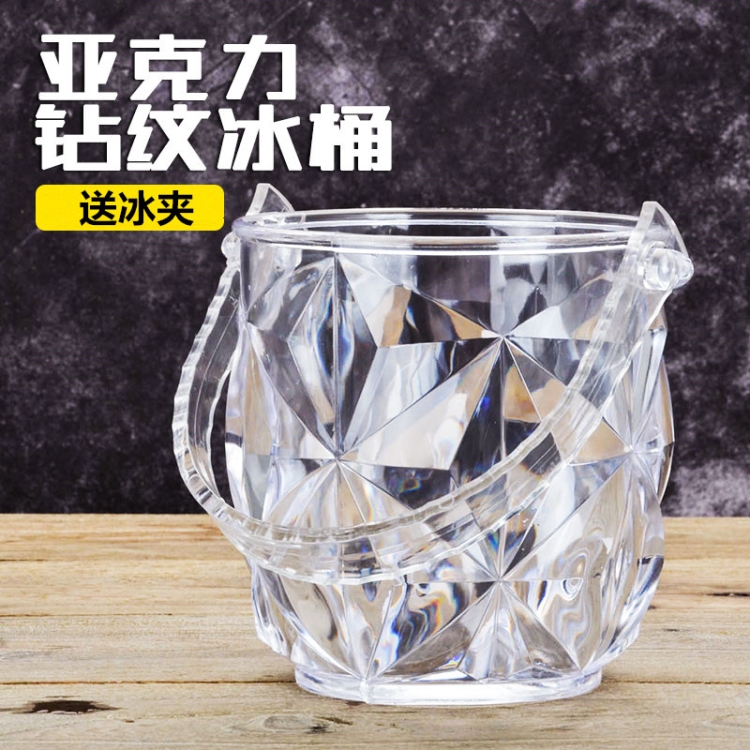
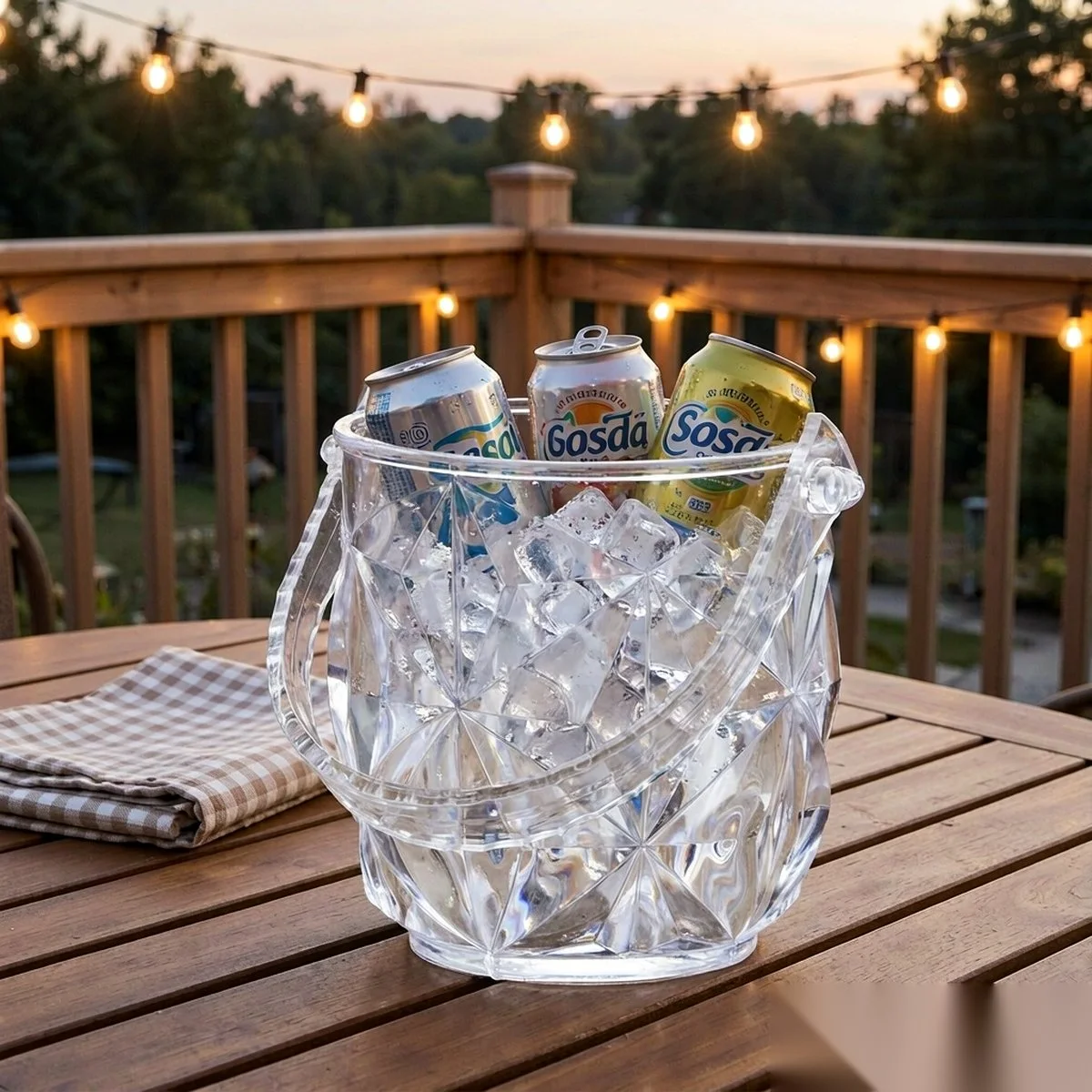
Read the second column and a gap opens. Six rows, six resin declarations, five sizes, five cartons — and nothing anywhere that says how much ice goes in. The bucket, the one object in the range whose entire purpose is to contain a quantity of ice, is described as Φ13 × 12.5 cm and Φ13 × 14 cm. That is an envelope. It is not a load.
The arithmetic is available to anyone who wants to do it. Treating the bucket as the cylinder it looks like, 6.5 cm of radius against 12.5 cm of wall gives about 1.7 litres of nominal space, and the taller of the two about 1.9. But a bucket packed with broken ice is nowhere near solid: roughly half of that space is air between the pieces, so the figure a bar actually cares about — kilograms of ice — lands near a kilogram rather than near two. Nobody should be deriving that from a photograph. The instruction that removes the guesswork takes one line: ask the supplier to fill a bucket with the ice your machine makes and weigh what it takes. Fill weight, not envelope.
Dwell Time, and Where the Water Goes
The second missing figure is the one that decides the service. How long a bucket of ice lasts is not a property of the bucket alone; it is a property of the bucket, the ambient room and the shift. Four things move it, and only one of them is on the page.
- Surface against volume. Heat reaches ice through the container wall, so a tall, narrow load outlasts a wide, shallow one holding the same weight. The two buckets here share a diameter of 13 cm, which means the extra 1.5 cm of height on BY-9131 buys time rather than capacity.
- What covers it. An open bucket on a back bar is a melting machine; the same load under a lid is a different object. Neither page states whether the buckets are supplied with a cover.
- What surrounds it. A bucket standing beside an ice machine or under a pass lamp is in a warmer place than the specification sheet assumes.
- The water underneath. This is the one buyers forget. Once the first centimetre of melt has collected in the bottom, the cubes above it are sitting in water, and water conducts heat into ice far faster than the cold air that was there before. The load then collapses from the bottom up, and the last third of the bucket is gone long before the first third would have been.
That last point is a service decision rather than a purchasing one, and it is worth settling in writing before the order: does the ice sit in the melt, or does something lift it clear? A bucket drained or replaced twice a shift and a bucket left standing for six hours are two different requirements, and the six rows here cannot tell you which one you have bought.
Two Buckets, One Carton Count, Two Freight Bills
The pair of buckets is the clearest example on this shelf of a specification that looks identical and behaves differently. Same diameter, same resin, same 36 pieces to a box, 1.5 cm apart in height.
| Model | ||||||
|---|---|---|---|---|---|---|
| Height | ||||||
| Per carton | ||||||
| Carton | ||||||
| Carton volume | ||||||
| Pieces per m³ | ||||||
| Per 40 ft container | ||||||
| BY-9130 | 12.5 cm | 36 | 50 × 36 × 40 cm | 72 litres | 500 | ≈33,500 |
| BY-9131 | 14 cm | 36 | 53 × 42 × 44 cm | 98 litres | 368 | ≈24,600 |
One and a half centimetres of product becomes twenty-six litres of air in the box, and the taller bucket moves at 368 pieces per cubic metre against 500 for the shorter one. On a full container the difference is roughly nine thousand buckets, which is a third of the load, and it is not a difference any catalogue page flags. If a programme is priced on the shorter bucket and then specified on the taller one, the freight line moves without the unit price appearing to.
The same reading applies to the rest of the group, and the spread is wider than the buckets suggest.
| Row | |||
|---|---|---|---|
| Per carton | |||
| Carton volume | |||
| Pieces per m³ | |||
| BY-9131 bucket | 36 | 98 litres | 368 |
| BY-9130 bucket | 36 | 72 litres | 500 |
| BY-9129 cube tray | 120 | 117 litres | 1,026 |
| BY- Ice Scoop Large | 168 | 69 litres | 2,451 |
| BY- Ice Scoop Small | 256 | 75 litres | 3,401 |
From 368 pieces per cubic metre to 3,401 — a factor of nine, inside a group of five rows that all carry the word ice. Scoops ship as a dense, nestable pile; buckets ship as a set of open cylinders that will not nest, which is the whole reason the ceiling is so low at that end. Any plan that treats the group as one purchase with one freight assumption is going to be wrong at one end or the other.
The Only Polypropylene Row in the Catalogue
Of the printed products in this catalogue, the plastic declarations are dominated by three words: polycarbonate on the drinkware, polystyrene on the tabletop and bar pieces, stainless steel on the cutlery and cookware. Polypropylene appears exactly once — BY-9129, the cube tray. The only other polyolefin anywhere on the shelf is polyethylene, on three squeeze-bottle rows. Everything else is PC, PS, acrylic or AS.
The reason is the freezer. A tray is loaded at −18 °C, then twisted or pressed twice a day to break the cubes out. The resins this range is otherwise built from are chosen for what they do at room temperature, in the hand and on a table. A freezer asks a different question: does the material stay flexible when it is cold and being bent? That is why the cube tray is the one row where the usual answer is the wrong answer — and why a buyer who standardises on one resin across the whole ice purchase will get the other two objects right and this one wrong.
Two further details on this row are worth catching before it is ordered. Its size field is empty, which makes it the only row in the group that publishes colours — three of them — and no dimension at all; a tray with no published cavity count is being bought on a photograph. And its title describes it as clear acrylic while the material field reads PP, which are not the same substance and do not behave the same way in a freezer. Where a page names a resin and the headline names another, the field is the one to order against.
A Scoop Is a Portion, and the Shelf Measures Only Its Length
The two scoops are polycarbonate, which puts them on the travelling side of this range’s usual split: the bucket is loaded where it stands, the scoop goes to the ice machine and back dozens of times in a shift. Their model fields read BY- Ice Scoop Large and BY- Ice Scoop Small — the only two rows in the group where the field holds a description instead of a code, which is worth knowing if an order is being matched against a spreadsheet.
Each publishes one dimension: 26 cm and 23 cm. That is a length, and a length is not what a bar works with. What is being controlled behind the counter is a count — one scoop of ice, two — and a count is a volume. The bowl volume is on neither page. What the two lengths do tell you is direction: a longer scoop reaches deeper into a chest machine and a smaller bowl delivers less per lift. Converting centimetres into grams of ice is a job for a sample and a scale, not for the specification sheet.
The packing figures are more useful than they look. 168 pieces to a carton against 256 for the smaller scoop is a 52 per cent difference in units per box, and in density it is 2,451 against 3,401 pieces per cubic metre — a 39 per cent swing between two tools that differ by three centimetres. Where the quantities in a bar programme are large, the smaller scoop is the cheaper one to move by a margin that has nothing to do with its price.
The One Row You Cannot Put on a Container Plan
The ice tongs are the smallest object in the group — 15.2 × 2 cm, polystyrene — and the only row in it that carries neither a packing quantity nor a carton size. Every other item here can be costed as freight: so many per box, so many boxes to a cubic metre. The tongs cannot. There is no figure on the page with which to work out how many leave in a container, so the honest way to buy them is as a consumable against a known replacement rate rather than as a line on the container.
That is not a criticism of the row; it is a warning about using it in a calculation. A buyer who loads tongs into the same spreadsheet as buckets and scoops will find the line blank, and the blank will be filled in by assumption. Ask for the pack count in writing, or order them separately from the container load.
What to Bring to the Enquiry
Because the two figures that matter are not printed, the ice purchase only closes cleanly when the buyer supplies half of the specification. Three numbers belong on the enquiry, and three come back.
| You bring | |
|---|---|
| Why it changes the answer | |
| Ice per cover or per scoop | Sets the bowl size you need, and whether one bucket serves a table or a section |
| Hours on station | Sets the height and the covering, and decides whether meltwater management is needed at all |
| Water plan | Drained, lifted or stood — decides whether the bucket is adequate or whether a lined or drained version is required |
| They return | |
|---|---|
| Why you cannot get it from the page | |
| Fill weight in kilograms of ice | The size field gives an envelope; only a filled sample gives a load |
| Cartons and pieces per m³ for each row | The figures exist per row but nothing pairs them, and the spread is ninefold |
| The resin, per object | Three different resins cover the three jobs, and one of them appears nowhere else in the catalogue |
One figure is worth carrying into the same conversation. The minimum order on this range is 500 pieces to a model, and on these rows that translates very differently: fourteen cartons of buckets, five cartons of cube trays, three cartons of the large scoop, or two cartons of the small one. The same order line is a quarter of a pallet for one object and a filler for a mixed container for another — which is normally the moment a buyer discovers that the trays and the tongs are the items that make a container add up.
Questions Buyers Ask About Hotel Ice Service
How much ice does one of these buckets hold?
Not from the catalogue. The two buckets publish a diameter of 13 cm and heights of 12.5 cm and 14 cm, and no volume figure on either row. Treated as cylinders they enclose roughly 1.7 and 1.9 litres, but broken ice leaves about half of that space as air, so the working load is nearer one kilogram than two. Ask the supplier to fill a sample with the ice your machine produces and weigh it; that is the only figure worth quoting in a tender.
Why is the cube tray polypropylene when the bucket is polystyrene?
Because it is the only object in the group that goes into a freezer and is then flexed to release its contents. Polypropylene is the one polyolefin on the shelf and it appears on exactly this row; the resins the rest of the range uses are chosen for impact and clarity at room temperature. If an order standardises on a single resin for the whole ice purchase, three objects come out right and this one does not.
Which parts meet ice that goes into a drink, and what paperwork covers them?
On the ice-facing parts — bucket, scoop, tongs and tray — ask for the food-contact testing held under SGS together with the RoHS material declaration, and ask for both under the code the document carries, so that what arrives in your file is the paperwork for the goods you actually received. Keep the two ideas apart: a material test describes the plastic, and says nothing about whether a particular market will admit the container. Name the destination country on the enquiry and settle which documents travel with each order before it is placed.
Can these pieces go through a commercial dishwasher?
The bucket, scoop and tongs are normally hand-rinsed at the station and washed between services rather than racked. Where they do go into a machine, the limit to respect is the resin’s stated temperature ceiling, and the two practical rules are the same as anywhere else on this shelf: keep heavy items off the top of them in the rack, and do not stack a loaded tray of ice on a hot surface straight out of the wash.
What does the 500-piece minimum order look like in cartons?
It depends entirely on the row. Five hundred pieces is fourteen cartons of buckets, five cartons of cube trays, three cartons of the large scoop and two of the small one. The minimum is counted in pieces rather than in sets or boxes, so the physical size of the order swings by a factor of seven across the group — worth knowing when a container is being planned around it.
Alongside the Ice: Taps, Table and Counter
Around the ice, the rest of the bar is covered elsewhere: the bar supplies range for the stirring and serving end, the beer glasses and the cups and tumblers for the taps and the counter, the champagne glasses and the water jugs for the table service. Where the underlying question is simply which plastic belongs in which job, the materials comparison is the shortest way in, and the serve-size guide works the same problem from the menu end.
These parts come off our own moulding floor in Zhejiang province, and finished goods leave China either through Ningbo or through Shanghai. A model already on the shelf is ready in seven to fifteen days; anything that requires fresh tooling runs nearer a month. Each model carries a 500-piece floor, and a printed logo, a custom tint or branded packaging is quoted inside that same run instead of as a separate tooling line.
Put the three objects you are pricing — bucket, scoop or tray — into one message on the contact page, together with the ice-per-cover figure and the hours the ice has to last, and the export desk will come back with the row, the carton count and the resin for each. The works side of the business explains how the moulding is set up if that is the question.
Also on this shelf: BY-9301, BY-9302, BY-9304, BY-9305, BY-9309, BY-9315, BY-9310A and BY-9310B carry the decanting and dispensing side of the counter; BY-9307 and BY-9308A/B the spirit measures; BY-8191 and BY-8291 the snack plates; BY-1511, BY-1512, BY-1513 and BY-1514 the bulk drink dispensers. The taps themselves are here; the bar and milk-tea end is here; the wine service here; and the bowls and plates and fruit plates and platters cover the counter the ice sits beside.