Bar & Milk Tea Cups for Hotels: Two Resins on One Shelf
The Range Is Named After One Drink and Photographed With Another
The heading over these twenty-four items says bar and milk tea beverage. Open the pages and the
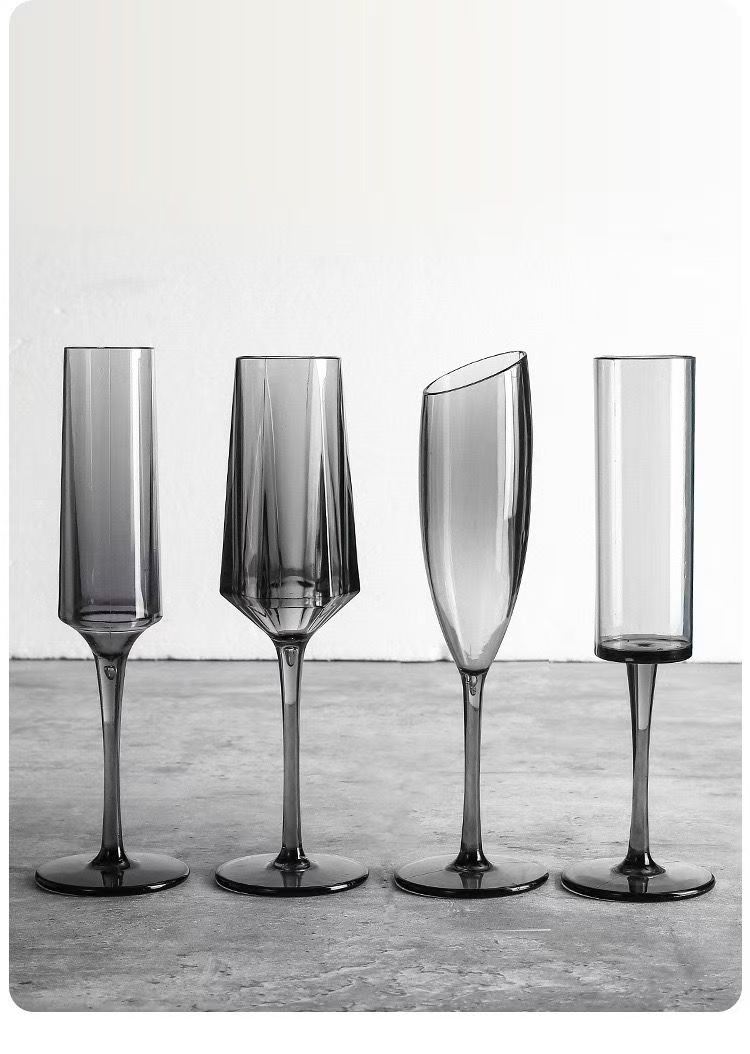
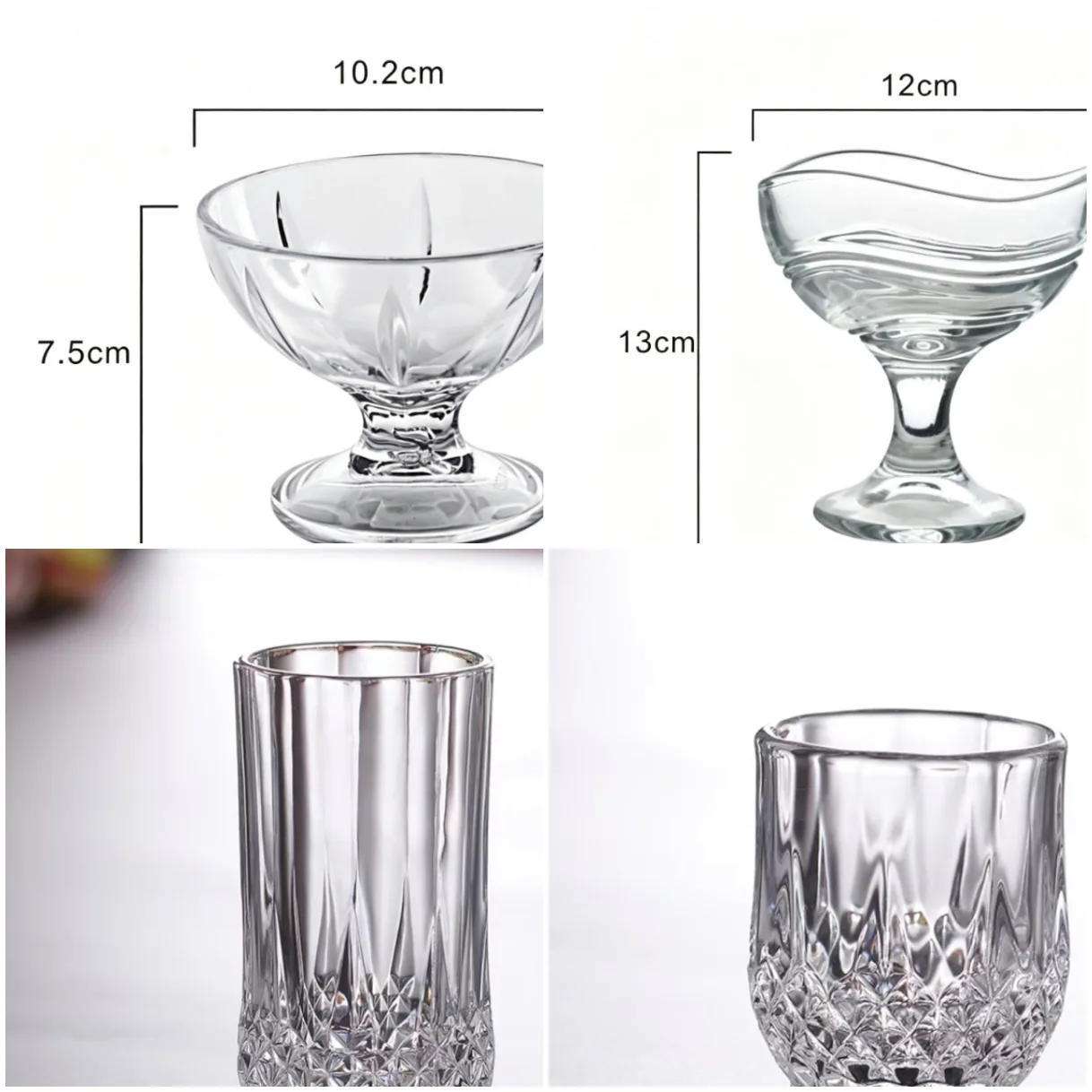
photographs tell a different story. Six of the twenty-four are tall stemmed goblets with a foot — the
shape a hotel puts ice cream or a fruit sundae into, not a drink it serves from a counter. The liquid
poured into them in the studio shots is orange juice. And the smallest item on the shelf, BY-6621, holds
50 ml, which is a measure, not a serving.
None of that is a defect in the goods. It is a defect in the label. A category name is written
once, when the first product goes into it, and it never gets rewritten as the shelf fills with things that
do not belong to it. What matters for a buyer is that the range is really three ranges holding one
name: stemmed dessert goblets, tall straight beverage glasses, and short tumblers. Anyone ordering from the
heading alone will get the wrong one.
So the useful exercise is to sort the twenty-four by capacity first and by shape second, and then
look at the one field that quietly divides them into two eras. That field is the material row, and the
dividing line is not a technical one. It is a date, printed in the part number.
Two Resins, and the Part Number Is the Dividing Line
Every product page on this site publishes a material row. On these twenty-four, that row gives
one of three answers: polycarbonate, polystyrene, or the two written together as a straddle. Sorted by
part number, the three answers do not scatter. They fall into blocks, and the blocks have no exceptions
inside the range.
| Part number block | Material published | Items | What it is |
|---|---|---|---|
| BY-66xx and BY-80xx (six items below BY-8039) | PC (Polycarbonate) | 6 | Straight polycarbonate, written out in full |
| BY-8039A, BY-8039B, BY-8049 | PS / PC | 3 | Both resins named, no order given |
| BY-9313S through BY-9342 | PS | 13 | Polystyrene only |
| BY-9335 and BY-9336 | PS / PC | 2 | Both resins named, inside the new block |
Read it as a rule and it holds without a single counter-example. No cup in the old block
is polystyrene, and no cup in the new block is written as straight polycarbonate. The word order in
the straddle rows is the only thing that changes — the middle group writes it one way round, and the
two stragglers in the new block write it the same way — but the division itself is clean.
What the Two Resins Do Differently
Two plastics with this much daylight between them behave differently in the places a hotel
notices. The harder-wearing of the two is the polycarbonate: it shrugs off a knock and tolerates a hot
wash without argument. Polystyrene is the more brittle of the pair, dislikes heat, and costs less. That is the
whole reason a range migrates from one to the other over time: the newer mouldings were costed again. The
buyer’s problem is that both generations are on the same shelf, under the same heading, at the same
minimum order, and nothing on the page announces which one you are looking at except a part number and a
line in a table.
The commercial consequence is a quote-sheet problem rather than a plastic problem. A property
restocking from this shelf has to decide, capacity by capacity, whether it is reordering what it already
holds or moving to the newer moulding, and the page cannot help, because it presents one item per part
number with no lineage drawn between them. Sorting the quotation by part number before comparing prices
does help: everything from BY-9313S upward is the newer polystyrene generation, everything at BY-8046 and
below is the older polycarbonate one, and the items between the two are the shapes that were tooled
twice. Sorted that way, one question to the supplier settles the whole sheet.
Both resins in this range are, in any case, named in the specification rather than left blank —
the file percentage is total, one hundred per cent of twenty-four rows carry a material value. That is
better than several other lines on this catalogue manage. It simply is not the same as being easy to
read.
The Twenty-Four, Ordered by Capacity
Capacity is the one field that is genuinely complete here: twenty-four rows, twenty-four values,
from 50 ml to 500 ml. Laid out in order, the range reads as tenfold, and the part numbers do not run in
the same direction as the sizes — the smallest cup on the shelf carries the longest-established code
and the largest carries one of the newest.
| Product | Model | Capacity | Size as printed | Material | Packing |
|---|---|---|---|---|---|
| BY-6621 | BY-6621 | 50 ml | 4.4 × 5.6 cm | PC | 200 pcs |
| BY-6622 | BY-6622 | 150 ml | 6 × 9 cm | PC | 100 pcs |
| BY-9330C | BY-9330C | 150 ml | 9.4 × 10 cm | PS | 72 pcs |
| BY-8007 | BY-8007 | 180 ml | D7.2 × 7.7 cm | PC | 150 pcs |
| BY-9331 | BY-9331 | 180 ml | D10.2 × 7.5 cm | PS | 144 pcs |
| BY-9334 | BY-9334 | 180 ml | D8.7 × 11.1 cm | PS | 72 pcs |
| BY-8046 | BY-8046 | 200 ml | 10 × 8 cm | PC | 120 pcs |
| BY-8049 | BY-8049 | 230 ml | 9.5 × 7.5 × 12.5 cm | PS / PC | 90 pcs |
| BY-9313S | BY-9313S | 270 ml | D10.5 × H8 × 7 cm | PS | 144 pcs |
| BY-9330B | BY-9330B | 300 ml | 11.5 × 7.8 × 12 cm | PS | 72 pcs |
| BY-9332 | BY-9332 | 300 ml | D12.5 × 17.5 cm | PS | 72 pcs |
| BY-6623 | BY-6623 | 320 ml | 7 × 13.5 cm | PC | 50 pcs |
| BY-9342 | BY-9342 | 330 ml | 10.8 × H13 cm | PS | 50 pcs |
| BY-8037 | BY-8037 | 340 ml | D6.8 × 12.9 cm | PC | 120 pcs |
| BY-8039B | BY-8039B | 340 ml | D7 × 16.3 cm | PS / PC | 90 pcs |
| BY-9330A | BY-9330A | 350 ml | 12 × 8 × 13 cm | PS | 72 pcs |
| BY-9341 | BY-9341 | 350 ml | 11.2 × 7.2 × H13 cm | PS | 72 pcs |
| BY-9336 | BY-9336 | 350 ml | D8 × 5.7 × 18 cm | PS / PC | 144 pcs |
| BY-9340 | BY-9340 | 400 ml | H16.7 × T11.3 × D11.3 × B8.1 cm | PS | 72 pcs |
| BY-9339 | BY-9339 | 420 ml | D7 × 23.5 cm | PS | 72 pcs |
| BY-8039A | BY-8039A | 450 ml | 6 × 7 × 19.3 cm | PS / PC | 100 pcs |
| BY-9335 | BY-9335 | 450 ml | D8 × 19 cm | PS / PC | 144 pcs |
| BY-9337 | BY-9337 | 480 ml | D9 × 6.5 × 20 cm | PS | 144 pcs |
| BY-9338 | BY-9338 | 500 ml | D7.9 × 24.5 cm | PS | 72 pcs |
Two things are worth noticing in that table before it is read for anything else. The size column
is written five different ways inside one range, which is the subject of a section further down. And the
capacity ladder is not a ladder: five different heights of cup share the same volume, and six of the
capacities on the list are served by more than one item.
Six Capacities Are Served by More Than One Cup
For a hotel deciding what to stock, a duplicated capacity is not a redundancy. It is a choice
between two resins at the same serving size, which is exactly the decision a beverage outlet has to make
when it prices a glass for a menu. Here are all six of them, with the resin each one publishes.
| Capacity | Products | Resin on each page |
|---|---|---|
| 150 ml | BY-6622 / BY-9330C | PC / PS |
| 180 ml | BY-8007 / BY-9331 / BY-9334 | PC / PS / PS |
| 300 ml | BY-9330B / BY-9332 | PS / PS |
| 340 ml | BY-8037 / BY-8039B | PC / PS + PC |
| 350 ml | BY-9330A / BY-9341 / BY-9336 | PS / PS / PS + PC |
| 450 ml | BY-8039A / BY-9335 | PS + PC / PS + PC |
The 180 ml row is the one to study. Three cups, one volume, and two different resins among
them: the oldest of the three, BY-8007, is polycarbonate and packs at 150 to a carton, while the two newer
ones are polystyrene and pack at 144 and 72. Same serving, three lead times, three prices, and no
photograph that lets you tell them apart at a glance.
Five Ways to Write a Size in Seventy-Two Rows
Take the whole shelf of seventy-two drinking glasses that this range belongs to — the shelf that runs from beer glasses for the taps
through the octagonal and diamond cuts — and read only the product size column. It has been filled in by more
than one hand, and the hands do not agree on how a glass is measured.
| How the size is written | Rows | Example |
|---|---|---|
| Two numbers, no letter in front | 32 | BY-9330C — 9.4 × 10 cm |
| Diameter and height, D in front | 25 | BY-9331 — D10.2 × 7.5 cm |
| Three numbers, no letter in front | 13 | BY-9330A — 12 × 8 × 13 cm |
| D and H mixed in one row | 1 | BY-9313S — D10.5 × H8 × 7 cm |
| Four letters before four numbers | 1 | BY-9340 — H16.7 × T11.3 × D11.3 × B8.1 cm |
The Row With Four Letters
The last row deserves a slow read. BY-9340 gives eight numbers and four letters — height, top
diameter, a second diameter and a base figure — which is far more information than any other row in
the range and far less useful, because the range never defines what T and B stand for. Search the whole
catalogue and six products use that style of notation. Four of the six are champagne flutes from a single
family, and within that family the letters are printed in two different orders: two rows read H, T, D, B
and three read H, T, B, D. Same house, same products, two conventions.
What this means in practice is simple. A buyer comparing these cups on dimension alone will get a
different answer depending on which two numbers they assume are the width and which is the height, because
the table never tells them. The fix is not to ask for a definition — it is to ask for the two figures
you actually need: rim diameter and overall height, named in the enquiry, so the answer comes back in your
convention instead of theirs.
The Word Polycarbonate Has Ten Spellings on This Site
Go up from this range to all six hundred and sixty-five products and read every material row.
Nineteen distinct strings are in use. Ten of them contain the letters PC, and no two of the ten mean
anything different.
| Material as published | Products | Note |
|---|---|---|
| PC (Polycarbonate) | 148 | The full form, and the majority |
| PS / PC | 24 | Two resins, order one way |
| PC + Stainless Steel Lid | 13 | Resin plus a second material |
| PC / PS + PS | 9 | Three names for a two-part object |
| PC + Stainless Steel | 8 | Same pair, different wording from the row above |
| PC / PS | 6 | Two resins, order reversed |
| PC (Polycarbonate) + Bamboo Wood Lid | 6 | Full form plus a lid material |
| PC (Polycarbonate) + Stainless Steel Lid | 6 | Full form plus a lid material |
| PC / PET | 6 | Copolyester, not polycarbonate |
| PC | 1 | Two letters, nothing else |
Note the fourth and fifth rows: PC + Stainless Steel Lid and PC + Stainless
Steel describe the same pairing of materials and are written differently. And note that PMMA
(Acrylic) appears on six more products, which is a third name for a material that some pages call
polycarbonate and some call acrylic.
A buyer who filters this catalogue by material field is filtering on a string, and the string is
not controlled. The practical conclusion is the one that shows up on every page of this range: the resin
you are buying has to be named in the order itself, with its full chemical name, not copied from whatever
the page happened to print.
One Cup in Seventy-Two Is a Third Plastic
Among the seventy-two glasses on this shelf, seventy-one publish either polystyrene or
polycarbonate in one of the forms above. One does not. BY-9224, a 700 ml tumbler, publishes
AS — and across the entire catalogue of six hundred and sixty-five products, it is
the only row that carries those two letters.
AS is acrylonitrile styrene, a styrenic copolymer that sits between the two families: clearer
and tougher than plain polystyrene, cheaper and less impact-resistant than polycarbonate. It is a perfectly
ordinary plastic for a drinking glass. What is not ordinary is finding exactly one of them inside a range
of seventy-two, described with a two-letter abbreviation and offered alongside its two cousins with no note
to say that it belongs to a third family. If it is the right cup for a job, the page has not helped you
find that out. It has only told you the letters.
Twenty-Five Times the Same Cubic Metre
Carton size and packing quantity are both present on these pages, which means the container cost
can actually be calculated here — unlike some other lines on this catalogue where one of the two is
missing. Divide one by the other and the answer spreads across a factor of twenty-five.
| Product | Capacity | Pieces per carton | Carton | Pieces per m³ |
|---|---|---|---|---|
| BY-6621 | 50 ml | 200 | 37 × 24 × 27 cm | 8,340 |
| BY-8007 | 180 ml | 150 | 42 × 35 × 31 cm | 3,290 |
| BY-6622 | 150 ml | 100 | 31 × 31 × 33.5 cm | 3,110 |
| BY-8037 | 340 ml | 120 | 51 × 41 × 36 cm | 1,590 |
| BY-8046 | 200 ml | 120 | 51 × 41 × 40 cm | 1,440 |
| BY-6623 | 320 ml | 50 | 37 × 37 × 27 cm | 1,350 |
| BY-9331 | 180 ml | 144 | 56 × 39 × 55 cm | 1,200 |
| BY-9330C | 150 ml | 72 | 52 × 35 × 34 cm | 1,160 |
| BY-9341 | 350 ml | 72 | 63 × 43 × 43 cm | 620 |
| BY-9330A | 350 ml | 72 | 60 × 47 × 46 cm | 560 |
| BY-9338 | 500 ml | 72 | 51 × 51 × 52 cm | 530 |
| BY-9334 | 180 ml | 72 | 72 × 53 × 40 cm | 470 |
| BY-9332 | 300 ml | 72 | 78 × 49 × 57 cm | 330 |
The Largest Box in the Range Holds Only 300 ml
The bottom row is the outlier, and it is worth naming precisely why. BY-9332 is a 300 ml cup, and it
ships in the largest carton in the entire range: 78 by 49 by 57 centimetres, or roughly 218 litres of
cardboard. The 500 ml cup, BY-9338, manages its far larger volume in 135 litres. A cup holding forty per cent
less liquid is being shipped in a box sixty per cent bigger, and neither page offers an explanation. It may
be protection, it may be a stack of inner trays, and it may simply be the box that was already on the
shelf — but at the same minimum order it is the difference between two pallets and one.
A hundred and fifty pieces of the smallest cup make a cubic metre of nothing but cups eight
thousand times over, while the same cube of the 300 ml stemmed glass holds three hundred and thirty. On a
landed-cost sheet run per hundred pieces, that gap is not a rounding error. It is the second price of the
product, and the page prints both numbers without joining them up.
The Cup That Prints 480 and Sells as 500
Two of the stemmed goblets in this range sit next to each other in the numbering, BY-9337 and BY-9338, and
both carry a Chinese language dimension card over the photograph. Read those cards and they give the same
capacity, 480 ml. Then read the specification tables and the two disagree: one page publishes 480 ml and
the other publishes 500 ml.
The card on BY-9338 also prints a rim diameter of 8 cm and a height of 24.3 cm, against a table that
gives D7.9 and 24.5 cm. Neither difference is large — a tenth of a centimetre here, two millimetres
there — and rounding is the obvious explanation for all of them. Two of the numbers are rounded down
in the table and one is rounded up, and the capacity jumps the wrong way, from 480 in the artwork to 500 in
the specification. A hotel filling glasses to a written standard is working from whichever of the two it
happens to have seen.
The same range gives one example in the other direction, which is worth recording for balance.
BY-6623 prints 7 cm across the rim, 13.4 cm tall, 320 ml, against a table reading 7 by 13.5 cm and 320 ml. That
is consistent to the millimetre once a 13.4 is rounded to 13.5. The artwork and the table are not
systematically at war here; they are occasionally out of step, in both directions, and there is no pattern
that tells you which page to trust for which item.
Eight Pages Publish a Colour, Five Publish a Weight
Two optional fields are almost never filled in on this shelf. Colour appears on eight of the
seventy-two rows. Weight appears on five. Both sets fall in the older, polycarbonate part of the
range.
The eight colour rows are the interesting ones, because they are not decorative information.
They list, in full, the tint options a hotel can order: transparent, tea, grey, amber, pink, blue, green,
dark green, orange, yellow and purple, depending on the model. On a site where three cups share one
capacity and look identical in the studio shot, a colour field is the only thing separating them for a
buyer browsing without a part number in hand. It is filled in on eight pages and blank on sixty-four.
Weight is the other direction. It is published on five tumblers, from 63 g for a small one to
140 g for a large, and on nothing else. Weight is the field that answers how a glass feels, whether the
dishwasher will move it, and what a crate weighs when a porter lifts it. Five rows out of seventy-two is
close to no data at all, and the five that exist suggest somebody once cared.
Six Lines for the Enquiry
Everything above reduces to a short list of questions, and the list is short because the range is
consistent about what it leaves out. Put these six lines in the first email, and the reply will carry
everything the pages do not.
- Name the full resin. Say polycarbonate or say polystyrene; do not say PC. The
catalogue uses ten spellings for one word and the difference between the two plastics in this range is the
difference between two generations of stock. - Ask which block the quotation comes from. If the answer is a BY-93xx part number, the
cup is polystyrene; if it is BY-80xx or BY-66xx, it is polycarbonate. Both may be quoted against the same
requirement. - Give the two dimensions you need, by name. Rim diameter and overall height, in
centimetres. The size column on this shelf runs to five conventions and one of them uses four letters that
are never defined. - Ask for the carton, not just the count. The packing quantity is published on every
row; what turns it into a freight number is the box, and here the boxes vary by a factor of twenty-five
against the same volume of cups. - Ask whether the capacity on the page is the capacity of the mould or of the fill line.
On one pair of goblets the artwork and the table already disagree by 20 ml, and only you can decide which
figure your menu is built on. - Ask what was tested, and by whom. Request the certificates as numbered files rather
than as a sentence. For the drinkware lines the food-contact work is carried out by SGS and the material
declaration is RoHS; what you want back is two documents you can file against your own consignment.
One boundary belongs at the end of that list. A test report describes a material; it says nothing
about whether a particular country will let the goods in, and that second question belongs to whoever
handles your customs entry rather than to the specification table. Ask which documents travel with the
consignment once the destination is known, and keep the answer with the quote. If the shape you need is not
on this shelf at all, the contact page is the shortest way to put the question, and about page describes how the works is
set up.
FAQ: Bar and Milk Tea Cups for Hotels
Are these bar and milk tea cups available for wholesale from a hotel supplier?
Yes. All twenty-four items are stocked as wholesale lines with a minimum of 500 pieces per model, and printed logos, chosen colours and branded packaging are all produced to order. The range divides into stemmed goblets, tall beverage glasses and short tumblers, so it is worth naming the shape you want as well as the volume.
Which plastic should we choose, polycarbonate or polystyrene?
It depends on how the glass is washed and how hard it is used. Polycarbonate takes impact and hot water better and costs more; polystyrene is lighter on the budget and less tolerant of a hot wash. In this range the older part numbers are polycarbonate and the newer ones are polystyrene, so the two options sit side by side at the same minimum order and the same capacity.
Why do several cups share the same capacity?
Because they are different mouldings aimed at the same serving size. Six capacities in this range are offered in more than one cup, and the duplicates usually differ in resin, in rim diameter or in packing density rather than in the volume they hold. Compare the two pages on dimensions and carton before deciding between them.
What does the letter before the numbers in the size column mean?
D is diameter and H is height on most rows, but the shelf uses five different conventions and one tumbler prints four letters, H, T, D and B, that are never defined anywhere on the site. The safe route is to specify rim diameter and overall height in your own enquiry rather than relying on the letters as printed.
What is the packing like for a full container?
Packing quantities run from 50 to 200 pieces per carton and the cartons themselves vary widely for the same volume of cups, from 330 pieces per cubic metre on the 300 ml goblet to more than 8,000 on the 50 ml measure. Ask for the carton dimensions with the quotation, because the container plan cannot be built from the packing quantity alone.
The drinkware line as a whole starts with cups and tumblers and champagne glasses, and continues through the water jugs used at
the table and the beer glasses kept at the taps. When the question is which plastic belongs where, the materials comparison covers
it. What this shelf adds is simpler than any of those: on one heading, under one minimum order, two
generations of the same cup are standing next to each other, and the part number is the only label that
says so.