Unbreakable Beer Glasses for Hotels & Bars: A Wholesale Buyer’s Guide to PC & Acrylic Beer Glassware
Walk into any bar manager’s office and ask about glassware replacement budgets, and you will hear the same number: traditional glass breaks. Pool decks, sports bars, beer gardens, terraces and banquet halls all share one problem — a beer glass that shatters on tile is not just a replacement cost, it is a guest safety incident and a service interruption.
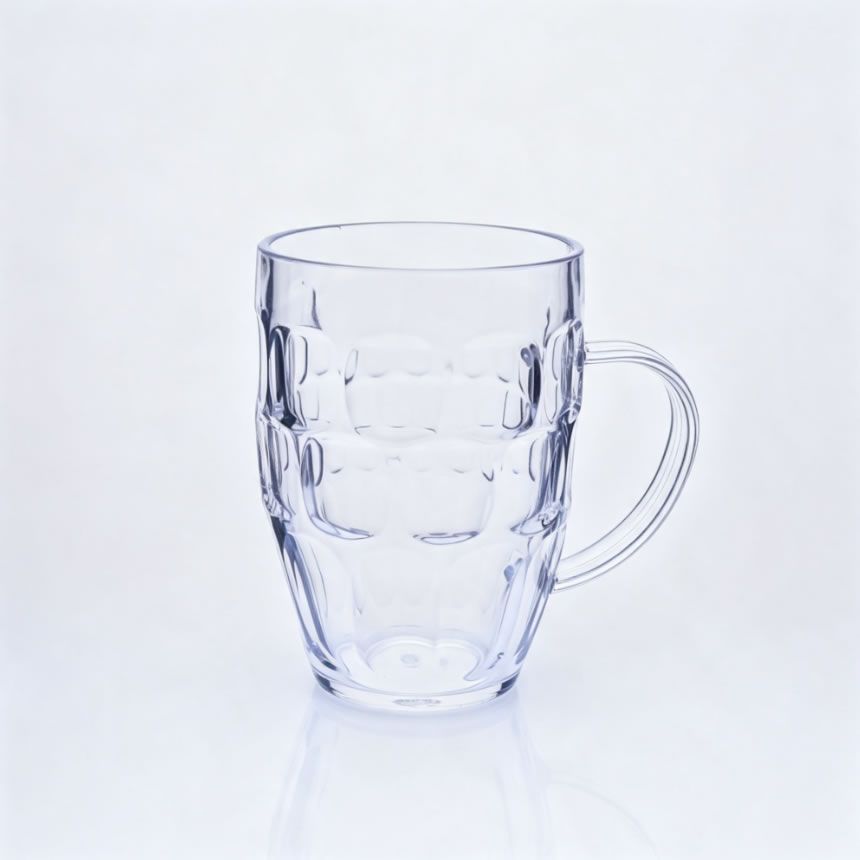
That is why unbreakable beer glasses have moved from a novelty to a standard specification for outdoor and high-volume beer service. Modern polycarbonate (PC) and acrylic beer glassware is moulded to reproduce the weight, rim feel and clarity of traditional glass — most guests only notice the difference when a glass hits the floor and nothing happens.
This guide is written for hotel F&B managers, bar operators and wholesale buyers evaluating plastic beer glasses for the first time, or replacing a supplier whose product clouded, cracked or lost its shape after a few months of commercial dishwashing.
Why Bars, Hotels and Sports Venues Are Switching to Unbreakable Beer Glasses
Beer service is the hardest test in any glassware programme. A beer glass moves faster than any other piece on the table — from the cooler to the tap, across a crowded bar, out to a terrace at peak hours, and back again. Breakage scales with that speed.
The economics are unforgiving. A venue pouring several hundred beers a day can lose a meaningful share of its glass stock every month, and every break also costs staff time, a breakage log entry and — occasionally — an injury report. On pool decks and outdoor terraces the risk is higher still, because broken glass in a wet, barefoot environment is a genuine hazard rather than an inconvenience.
Unbreakable glassware changes that equation. The purchase price per unit is higher, but the replacement rate collapses, and the safety exposure largely disappears.
What “Unbreakable” Actually Means for Beer Service
Not every plastic beer glass survives commercial service. Two materials dominate the category, and they are not interchangeable:
| Property | Polycarbonate (PC) | Polystyrene (PS) | Traditional glass |
|---|---|---|---|
| Impact resistance | Very high — resists drops onto tile and concrete | Moderate — can crack on hard impact | None |
| Clarity | Glass-like and stays clear in service | Good, may dull with heavy use | Excellent |
| Commercial dishwasher | Yes, designed for repeated cycles | Limited — check the temperature rating | Yes |
| Typical service life | Years in commercial use | Months to a year | Weeks to months |
| Best suited to | Pool decks, terraces, sports bars, high-volume service | Budget casual service and in-room use | Fine dining in controlled settings |
You will find both materials in our own beer glass range, where PC and PS are specified and priced separately. A 250 ml PS glass and a 1000 ml PC glass serve very different purposes, and a good supplier will tell you which is which instead of quoting one blended price.
6 Things to Check Before Ordering Wholesale Beer Glasses
1. Food-Grade Certification — Ask for the Document, Not the Claim
Any supplier can write “food grade” on a website. What you need before signing a contract is the third-party test report. For our drinkware this means SGS food-contact testing and RoHS compliance, requested by certificate number so you can verify what was actually tested.
Be equally precise about what a report does not cover. A food-contact test report is not an import permit, and destination markets run their own conformity schemes. Tell your supplier exactly which country the goods are shipping to and which documentation the customs authority requires, then confirm in writing which certificates travel with the order and which do not.
2. Head Retention and Rim Form
Beer is judged on its head. A glass with a poorly finished rim will kill foam on contact, and a glass moulded with a sharp internal edge gives the pour a visible seam.
Ask for a photograph of the rim from directly above and, if you are ordering at volume, a physical sample. Then run the test yourself: pour a fresh beer, wait two minutes and photograph the head. If the foam has collapsed, the problem is the glass geometry rather than the beer.
3. Chilling, Dishwashing and Thermal Shock
Beer glassware lives a harsher life than wine glassware: it goes through commercial glass-washers at higher temperatures, gets stacked, and often moves straight from a chiller to a hot terrace. Material grade determines whether it survives that.
- PC handles commercial dishwasher cycles and repeated temperature swings without crazing.
- PS is more sensitive to high-temperature washing — confirm the maximum wash temperature with your supplier before specifying it for a round-the-clock operation.
- Neither material is intended for hot beverages. These are cold-service products.
4. Weight and Balance — the “Feels Like Glass” Test
The fastest way to lose a beverage manager’s support is to hand guests a glass that feels like a disposable cup. Good PC beer glassware is deliberately weighted at the base and wall to reproduce the balance of glass, so the pour still reads as a premium serve.
Ask for the unit weight in grams and order a sample before committing to a full order. Weight consistency across the range matters too — if the 500 ml glass feels noticeably heavier or lighter than the 550 ml glass, the range will look inconsistent on the same tray.
5. Capacity Range and Menu Fit
Beer is served in defined format sizes, so your glass range should map to your menu rather than to whatever a supplier happens to stock. For reference, our own range covers 250 ml, 420 ml, 500 ml, 550 ml, 580 ml, 600 ml, 750 ml and 1000 ml.
| Serving style | Typical capacity | Notes |
|---|---|---|
| Sampler / tasting flight | 250 ml | Small and high-turnover; ideal for breweries and flights |
| Bottle beer (330 ml) | 420–500 ml | Leaves head space; the workhorse size for most bars |
| Draft lager and pilsner | 500–580 ml | Standard European draft serve |
| Wheat beer and craft IPA | 500–600 ml | A wider bowl is preferred for aroma |
| Sharing stein / pitcher service | 750–1000 ml | Beer gardens, sports venues and club service |
Matching capacities to your actual menu reduces both stock-keeping complexity and over-pouring.
6. MOQ and OEM Flexibility
For a direct manufacturer, around 500 pieces per model is a typical minimum order quantity. Custom branding — logo printing, custom colour and custom packaging — is normally available at the same MOQ, which means a venue can order its own house glass without committing to a full container of a single design.
Ask three questions before you accept a quotation: whether the MOQ applies per model or per order, whether tooling already exists for the shape you want, and how the OEM lead time compares with the standard lead time for stock items.
The Real Cost Comparison: Plastic vs Glass Over 12 Months
The purchase price per unit is the least useful number in this decision. Replacement rate is what drives the budget line.
| Cost factor | Traditional glass | PC / acrylic |
|---|---|---|
| Unit purchase price | Lower | Higher |
| Breakage in outdoor or high-volume service | High | Effectively nil in normal service |
| Replacement spend over 12 months | A multiple of the original purchase | Basic inventory top-up only |
| Staff time | Sweeping, breakage logs, injury paperwork | Minimal |
| Guest safety exposure | Real — glass on pool decks and terraces | Largely eliminated |
| Stock consistency | Sizes can go out of stock | Consistent moulded sizes |
For the wider material comparison including wine service, see our guide to hotel drinkware materials; for stemware specifically, see unbreakable wine glasses for hotels. Pitcher and carafe service is covered in our water pitcher buyer’s guide, and dessert service in our ice cream cup guide.
Common Buying Mistakes (And How to Avoid Them)
- Buying on unit price alone. A cheaper glass that clouds, cracks or loses its rim within a season costs more than a better one that lasts years.
- Specifying a single capacity. Bars rarely pour one format. A 250 ml, 500 ml and 1000 ml combination covers most menus.
- Accepting “food grade” as a verbal claim. Ask for the certificate number and the scope of the test.
- Ignoring wash temperature. Confirm your operation’s dishwasher temperature before choosing a material.
- Skipping the sample. Photographs and specification sheets do not tell you how a glass feels in a guest’s hand.
- Assuming a certificate travels with the goods. Confirm in writing exactly which test reports are issued with the shipment.
FAQ: Buying Unbreakable Beer Glasses for Hotels and Bars
Do unbreakable beer glasses affect the taste or the head of the beer?
No. PC and PS are non-porous and inert in cold beverage service. Head retention depends on the rim finish and the cleanliness of the glass rather than on the material, which is why rim geometry is worth asking about explicitly.
Are plastic beer glasses dishwasher safe?
Quality polycarbonate grades are designed for repeated commercial dishwasher cycles. Polystyrene is more heat-sensitive, so confirm the maximum wash temperature before specifying PS for a round-the-clock operation.
What certifications should a hotel require from a beer glass supplier?
At minimum, third-party food-contact test reports such as SGS, plus RoHS compliance, requested by certificate number before signing. Check separately which certificates your destination market requires for import, as that is a different question from food-contact safety.
What is the typical wholesale MOQ for PC beer glasses?
Around 500 pieces per model from a direct manufacturer. OEM branding such as logo printing or custom colour is normally available at the same MOQ.
Can I mix capacities in a single order?
Yes, and it is usually the right approach. A mixed order across 250 ml, 500 ml and 1000 ml covers most bar programmes without over-stocking any single size.
The Bottom Line for Hotel Procurement
Unbreakable beer glasses are not a compromise on the guest experience — they remove a recurring cost and a recurring safety risk from high-volume service. The decision comes down to three things: the right material grade (PC for heavy commercial use, PS for lighter and more cost-sensitive service), a capacity range that maps to your menu, and a supplier who will put the certification scope in writing.
Benyang Supplies manufactures PC and acrylic drinkware for hotels, bars and foodservice in Yongkang, Zhejiang, and ships from Ningbo and Shanghai. Browse the full unbreakable beer glass range, or request a bulk quote with your target capacities, quantity and destination market.