Unbreakable Fruit Plates & Platters for Hotels: Diameter, Rim and Dome as Buffet Maths
A fruit plate is the cheapest piece of theatre in a hotel. It costs less than a single
night’s linen to buy, it never appears on a menu, and it is the one object on a buffet that does the
selling by itself — guests judge the freshness of an entire breakfast operation by whether the fruit
display looks abundant or picked over. That is a strange thing to say about a piece of moulded polystyrene,
but it is exactly why the geometry of the plate matters more than its finish.
Two plates of the same diameter can present completely different amounts of fruit. Diameter sets the
footprint; the rim sets how much of that footprint is usable; the wall height sets how high fruit can be
piled without rolling; and if a cover is fitted, the dome height sets the ceiling. Get those four numbers
wrong and the display either looks thin, or spills, or will not fit the cold room. This guide walks through
the four dimensions, then through the plate families actually in production, and finishes with the
specification lines that keep a shipment out of a claim. The size run in this range runs from small
side plates up to full buffet anchors —
BY-8051 to BY-8055 at Φ15 cm through to
BY-8301 and BY-8501 at Φ35 cm
— so almost every step below applies at more than one size.
Diameter Is Not Size — It Is Usable Display Area
Buyers pick a fruit plate the way they pick a pizza: by diameter. That is the wrong number to
start from, because the diameter you read on a specification sheet is the diameter of the whole moulding,
not the area a guest can actually see fruit in. Two effects eat into it before a single piece of fruit
lands on the plate.
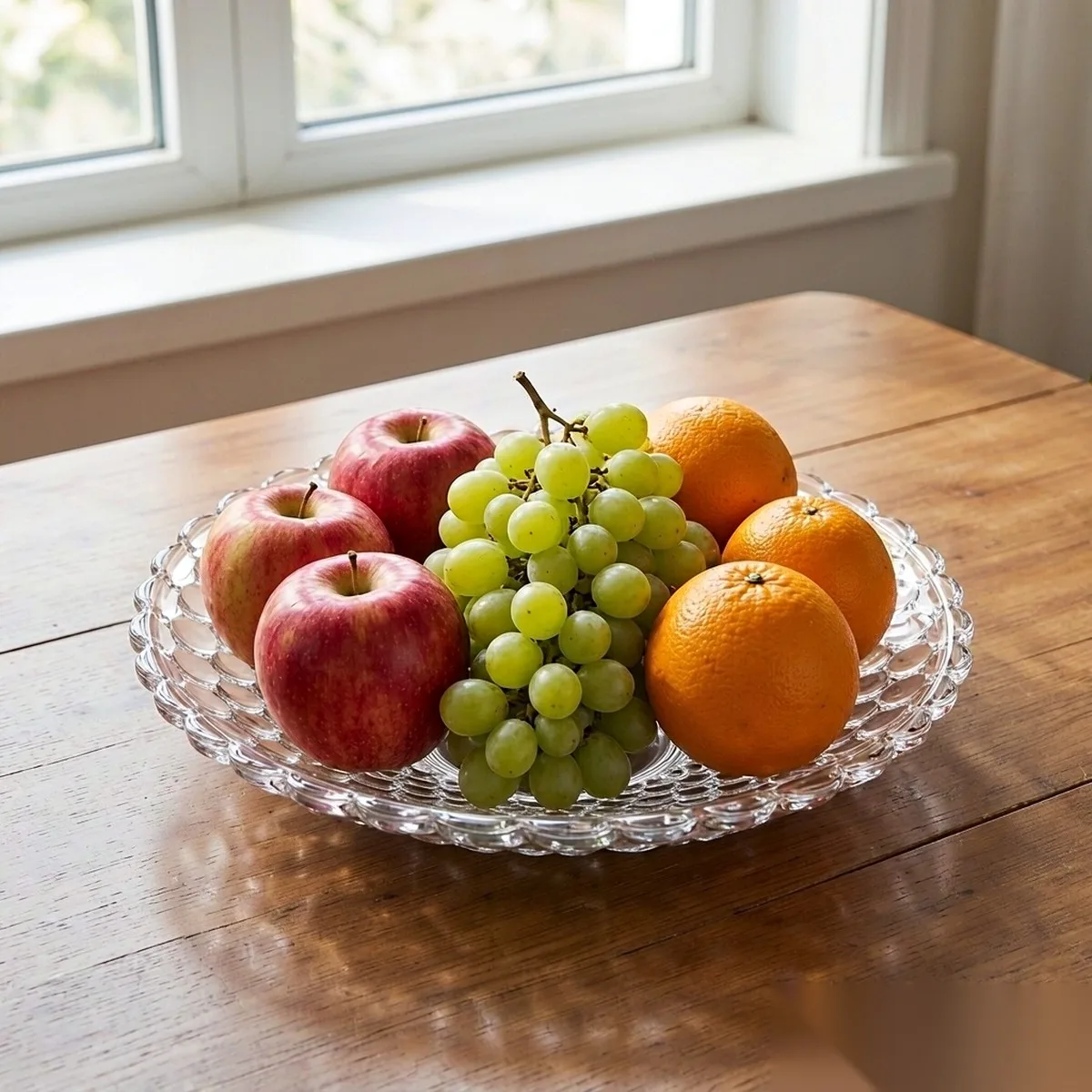
The rim. Most decorative plates in this category carry a sculpted rim — a scallop,
a petal, a beaded band, a diamond quilt. That rim is what makes the plate read as premium, and it is also
dead space: nothing sits on it. On a heavily sculpted 35 cm plate the plain field in the middle can easily
be 4–6 cm narrower than the outer measurement, which is a 25–30 per cent loss of usable area
before you begin. The narrower the plate, the worse the proportional loss, which is why small decorative
plates always look emptier than their diameter suggests.
The rise. A plate with a pronounced upward curve at the edge holds fruit in but also
lifts the visible edge of the pile, so the guest sees the outer ring of fruit rather than the top of the
mound. A flatter plate presents more fruit surface but needs a taller pile to look full, and a taller pile
rolls.
The practical rule: specify fruit plates by the plain interior measurement, not the outer
diameter. Ask the supplier for the flat field dimension, and if the answer is vague, take it from
the sample with a tape measure. It takes ten seconds and it is the difference between a display that looks
generous and one that looks like the kitchen ran out. The plain round family
(BY-8051 to BY-8055, and the equivalent
runs BY-810x /
BY-820x /
BY-840x) gives you the largest flat field
per centimetre of outer diameter, which is why it is the right starting point.
| Outer diameter | Typical sculpted rim | Working flat field | What it actually serves |
|---|---|---|---|
| Φ15 cm | about 2.5 cm | Φ10 cm | A single garnish station, a fruit cup, a side of berries. Not a buffet display plate. |
| Φ20 cm | about 3 cm | Φ14 cm | Two to three fruits, sliced and fanned. Works on a small table for two, or as a pastry base. |
| Φ25 cm | about 3.5 cm | Φ18 cm | The smallest plate that genuinely reads as a fruit display. Good on a room-service tray or an in-room amenity. |
| Φ30 cm | about 4 cm | Φ22 cm | The hotel workhorse. A whole-fruit pile for four, or a sliced display for eight covers. |
| Φ35 cm | about 5 cm | Φ25 cm | The buffet anchor. Whole-fruit mound for a breakfast line; the size guests photograph. |
| Φ36 cm+ | about 5 cm | Φ26 cm+ | Banquet and event staging. Reaches visual abundance with fewer pieces, which is the point. |
Flat-field figures are measured on our own mouldings (BY-8xxx / BY-3xxx series) and will vary a few millimetres between shapes. Ask for the interior dimension when you quote.
The Four Numbers That Decide How a Display Reads
Once you stop treating a fruit plate as a round object and start treating it as a shallow
container with a decorative edge, four measurements do almost all the work. They are worth writing onto the
enquiry, because a supplier quoting only a diameter is quoting half a product.
1. Flat field diameter. Covered above. This sets how much fruit is visible at once, and
therefore how often the kitchen has to top up during service. A rule of thumb that holds up in practice:
one top-up per hour per buffet station for a properly loaded Φ30–35 cm plate; twice that frequency
on anything under Φ25 cm.
2. Wall height. The upward lip at the plate’s edge. Under about 2 cm, whole apples and
oranges roll off the moment a tray is tilted, which happens constantly in a busy pass. Above about 4 cm the
plate starts to hide its own contents from a standing guest, which is counterproductive because the point of
the piece is display. The comfortable band for buffet work is 3–4 cm, and it is why a
shallow serving bowl often does the job better than a flat platter in a self-service line.
3. Base footprint. How wide the plate stands. A wide brim on a narrow foot tips; a
deeply domed underside rocks on a trolley. For anything that will be carried rather than left on a table,
check the base width against the top diameter — a plate whose foot is under about half its top will
feel unstable in a full tray of fruit, which is exactly when it gets dropped.
4. Overall stacked height. Seldom specified and always regretted. A sculpted rim that
nests beautifully with its own size may sit badly against the next size up, and a stack of mismatched
plates in a cupboard takes more space than the shelf allocated to it. If storage is tight, ask for two
sizes rather than four, and check that the rim profile is genuinely stackable rather than merely similar.
| Number | Typical value in this range | Wrong on the low side | Wrong on the high side |
|---|---|---|---|
| Flat field diameter | Φ10–26 cm depending on size | Display looks thin; constant refills; guests read it as a poor breakfast | Wasted moulding material and carton volume for no visible gain |
| Wall height | 2–4 cm (most mouldings sit near 3 cm) | Fruit rolls off on a tilted tray; more floor waste than plate waste | Hides the fruit from a standing guest; defeats the point of a display plate |
| Base footprint | roughly half of top diameter or more | Plate tips when carried loaded; the most common cause of a dropped display | Stable but bulky; costs storage and carton space |
| Stacked height | nested, one family per shelf | Grinds against the next size; rim chips on the contact line | A two-size cupboard becomes a four-size cupboard |
These are the four numbers worth putting in writing. Everything else about a fruit plate is a preference; these are the ones that show up as operational problems.
Why Polystyrene Owns This Category
Most of this range is moulded in PS (polystyrene), with a single PC group and one mixed
plate-and-cover set. That is not a corner cut — it is the correct engineering choice, and understanding
why saves buyers from over-specifying.
A fruit plate is a static piece. It sits on a buffet, a table or a trolley. It is not
carried across a crowded floor like a tumbler, it is not filled with ice like a beer glass, and it is rarely
handled by a guest at all. Impact resistance, the property that makes PC valuable in drinkware, is therefore
mostly idle in a fruit display. What the plate needs instead is stiffness — enough
rigidity that a 35 cm disc does not sag under a pile of oranges — and optical clarity, so the fruit
reads as clean and the plate disappears into the display.
PS delivers both, at a lower unit cost and with better light transmission than an impact-modified
material, which is why the whole range leans on it. The PC group in this category (the
BY-8701 / BY-8702 pair) is there for the rooms and venues that
genuinely punish their tableware — pool decks, outdoor terraces, buffet lines on a rolling trolley
where the plate will be knocked. Same shape, tougher resin, higher price. That is the whole decision.
| Service situation | Correct resin | Why |
|---|---|---|
| Breakfast and lunch buffet, static station | PS | Stiff, clear, cheapest per unit for the largest diameters. Nothing in the duty cycle needs impact resistance. |
| In-room amenity or room-service tray | PS | Small diameters, light loads, and the plate rarely leaves the room intact enough to matter. Clarity carries the value. |
| Banquet and event staging | PS | Display-duty only; the plates are placed and cleared, not handled by guests. Buy the size that fills the table. |
| Pool deck, terrace, outdoor buffet | PC | Knocked, carried, sometimes dropped on tile. Impact resistance stops being idle and starts earning its price. |
| Rolling trolley service through a busy pass | PC | The plate is in motion next to a moving crowd. This is the case where a PS plate actually fails. |
| Mixed plate-and-cover set | PC cover + PS plate | The dome is thin-walled and gets set down hard; the base is static. Specifying them separately is correct, not a compromise. |
Correct resin here means correct for the duty cycle, not the most expensive one available. For most hotel fruit service, that answer is PS.
The Plate Families You Will Actually Be Offered
The category looks like an endless shelf of round shapes. It is not. There are five families
in regular production, and each one is solving a different display problem.
Plain round plates. A smooth field, usually with a modest rolled edge, in a size run
(Φ20 / 25 / 30 / 35 / 36 cm). This is the default and the right answer for most hotels, because a plain
field is the only one that presents maximum usable area. If you buy one shape for the whole property, buy
this one — the full run is in the
plate and platter category, and the
BY-8501–BY-8505 and
BY-860x series cover the largest diameters.
Sculpted-rim plates. Petal, lotus, scallop and diamond-quilt rims. The rim is the
product. These plates exist to make a display look designed rather than assembled, and they are what a hotel
buys when the fruit station is in a photographed dining room. Accept the loss of flat field as the price of
the look, and buy one size larger than you otherwise would. The named sub-families are worth browsing
separately because the rim profiles differ a great deal in how much field they consume:
diamond,
lotus flower,
beaded and
sword pattern — for example
BY-3011A, BY-3011B and
BY-3011C in the sword pattern run, or
BY-8301–BY-8305 and the A-suffix
BY-830xA variants.
Shaped plates. Leaf, shell and asymmetric forms — the
leaf-shape BY-8712 and the shell-form
BY-8701 / BY-8702 pair. These are staging pieces. They hold less
fruit per unit of table space than a round plate of the same span, and they are bought for banquets, lobby
features and photography. Do not equip a buffet line with them; do put one in the middle of a round table.
Plates with a stand. A plate lifted on a moulded foot or a separate base. Height is the
whole point: a raised plate brings the display up to standing eye level on a buffet, where a flat plate on a
low table is viewed from above and reads as a collection of shapes rather than a mound of fruit. The trade
is stability — a taller plate is a tipped-over plate if the foot is narrow and the load is heavy.
Check the foot, and see the standing range under
plates with a stand.
Plates with a cover or dome. A base plate plus a transparent dome, in matched size runs
from a 6 inch dome on a 15 cm plate up to a 14 inch dome on a 35 cm plate — the
covered display range, from
BY-9255 + BY-8X05A at the small end up through
BY-9253 + BY-8X03 and
BY-9251 + BY-8X01 at the 14 inch size. This is the family that
changes how a kitchen works rather than how a table looks, and it gets its own section below.
The Domed Cover Is a Food-Safety and Labour Decision
An uncovered fruit display is exposed from the moment it is set out. In an open buffet that
means handling, breathing, and the occasional guest hand; in a refrigerated case it means the plate is
contributing nothing to humidity control. A domed cover solves all of that, and then introduces its own
geometry problem, which is the part buyers underestimate.
The dome sets the pile height, not the plate. A 17 cm dome on a 31.5 cm base is generous
— you can build a proper whole-fruit mound. A shallow dome on a wide plate limits the display to a
single layer. Measure the clear internal height, not the external one, and compare it against how high your
kitchen actually piles fruit. If the pile height exceeds the dome, the cover is not protecting the display,
it is resting on it — and a dome resting on fruit is a dome that gets knocked off.
Match the sizes as a set. Covers in this range are sold in matched pairs (a 14 inch dome
with a 35 cm plate, 12 inch with 30 cm, and so on down to 6 inch with 15 cm). Buying a dome that is nominally
the right size but from a different moulding usually leaves a gap at the rim, which is the same as having no
cover for the purpose of flies and dust, and worse than no cover for the purpose of the guest noticing.
Ventilation matters on warm displays. A sealed dome over cut fruit in a warm room traps
moisture and the cut faces dull and cloud within the hour. If your fruit station holds covered plates at
room temperature, look for a dome with a vent or a knob that lifts slightly, and treat the dome as climate
control rather than a lid.
Where the cover sits in the stack. Domes do not nest with plates; they invert. A property
running covered displays across four sizes is storing four plates and four domes, and the domes consume far
more vertical space per unit than the plates do. Plan the back-of-house shelf before you standardise on a
covered format across every station.
How a Fruit Plate Actually Fails
Fruit plates are replaced for reasons that have almost nothing to do with a dramatic break.
Appliance-by-appliance, this is where the failures come from.
| Failure | What it looks like | What causes it | How to prevent it |
|---|---|---|---|
| Fogging / dulling | The plate that was glass-clear in the catalogue looks hazy after a few months | Residual rinse-aid film plus hard-water scale building on a surface that is wiped, never scrubbed | Specify a rinse temperature and a soft-dry cycle; keep plates out of the hottest rack position; wash on a shorter programme with less rinse-aid |
| Stress cracks at the rim | Fine hairline cracks radiating from the scallop tips or the quilt corners | Scored rim profiles concentrate stress; the crack starts at the sharpest decorative point | Rinse immediately after service before fruit acids dry on the rim; stack only within one size family |
| Tipping when carried | A loaded plate goes over on the way from the pass to the station | Narrow base against a wide, heavily loaded top; the centre of gravity sits above the foot | Measure the foot; prefer a plate with a base at roughly half the top diameter or more; do not carry a plate over full |
| Scuff marks and hazing | A milky cloud on the part of the plate that touches the shelf or the trolley | Grit between stacked plates, and sliding rather than lifting when they are separated | A felt or rubber mat on the storage shelf; train staff to separate plates by lifting, not sliding |
| Dome loss, not plate loss | Plates outlive their covers; the set goes out of service unequal | Domes are thin-walled, invert-stored and set down hard; they break first | Buy covers as spares at the time of order — they are the consumable half of a covered set |
| Yellowing | A warm cast that develops across the whole plate, most visible on a white tablecloth | Prolonged heat exposure — a plate left in a hot trolley, near a heat lamp, or in direct sun on a terrace | Keep display plates out of heat-lamp fields and off the top of a hot servery; rotate stock rather than rotating the same plates for years |
None of these are material failures. They are handling and specification failures, and every one of them is cheaper to prevent than to replace.
Buffet Maths: What a Plate Actually Costs You
The unit price on a fruit plate quotation is a small number, and it is the least useful number
in the decision. Three others matter more: how many pieces you need to fill a table, how much cold-room
space the set occupies when it is not in service, and what fraction of it is still in service a year from
now.
Worked example on real carton data from this range. The plain round plates pack tightly — the
Φ30 cm size ships 50 per carton in a 60 × 30.5 × 40.5 cm box, which is about 74 litres of
freight for a stack of plates that nests. The Φ35 cm size ships 40 per carton in a 27 × 27 ×
52 cm box, about 38 litres — a smaller carton holding fewer pieces, because a larger plate cannot nest
as deep. The practical lesson: the freight cost per plate roughly doubles between the smallest and
the largest size in a family, and it does so for a reason that has nothing to do with the plastic.
The table below turns those numbers into what a buyer actually budgets. It uses the pack and carton
figures from our own range, so the shape of the answer is real even if your quantities differ.
| Model group | Size | Pcs / carton | Carton volume | Litres per 100 pcs |
|---|---|---|---|---|
| BY-805x plain round | Φ15 cm | 160 | 47 × 31 × 34 cm ≈ 50 L | about 31 L |
| BY-805x plain round | Φ20 cm | 86 | 40 × 40 × 30 cm ≈ 48 L | about 56 L |
| BY-805x plain round | Φ25 cm | 70 | 49 × 25 × 44 cm ≈ 54 L | about 77 L |
| BY-805x plain round | Φ30 cm | 50 | 60 × 30.5 × 40.5 cm ≈ 74 L | about 148 L |
| BY-805x plain round | Φ35 cm | 40 | 27 × 27 × 52 cm ≈ 38 L | about 95 L |
| BY-3011A sword pattern | Φ35 cm | 21 | 37 × 37 × 37 cm ≈ 51 L | about 241 L |
| BY-8712 leaf shape | Φ29.7 cm | 50 | 56 × 28 × 37 cm ≈ 58 L | about 116 L |
| BY-9251 + BY-8X01 set | 14 in dome + 35 cm plate | set-packed | matched pair | — |
Volumes are computed from the carton dimensions in our own specification sheets and rounded. The patterned and shaped plates cost dramatically more freight per piece than the plain round ones — that is the price of the rim, and it should be in your landed cost, not buried in your unit price.
Two consequences worth acting on. First, if your volumes are large, the freight difference
between a sculpted plate and a plain one can exceed the price difference between the two products —
quote both properly before you decide the look is worth it. Second, and more usefully, the largest
plate is not the most expensive to ship per piece. A Φ35 cm plain plate comes in at roughly a
third of the freight volume of a Φ25 cm sculpted one, per hundred pieces. When a property wants a
generous-looking display on a budget, going up a size in a plain moulding is often cheaper in landed cost
than going decorative at a smaller size.
Put It in Writing: Seven Lines for a Fruit Plate Order
Fruit plate claims are rarely about quality. They are about a set arriving that does not
match what the buyer pictured, which is almost always because the enquiry described the look and not the
geometry. These seven lines take ten minutes to write and remove most of the ambiguity.
| Line | What to write | Why it matters |
|---|---|---|
| 1. Flat field diameter | The interior usable dimension, per size, not just the outer diameter | This is the number that decides how the display reads. Outer diameter alone is half the product. |
| 2. Wall height | The upward lip in centimetres, per size | Too low and fruit rolls off a tilted tray; too high and the display hides itself from a standing guest. |
| 3. Resin, per component | PS or PC, named separately for the plate and for the cover if the item is a set | A covered set is genuinely two materials. A single blanket resin line is where specifications go wrong. |
| 4. Colour and clarity | Clear, or a specified tint, with a sample reference | Tints shift between production runs. A reference sample is the only reliable control. |
| 5. Cover clear height | The internal height under the dome, not the external measurement | Sets the maximum pile the display can carry before the cover rests on fruit. |
| 6. Packing and carton | Pieces per carton, carton dimensions, and whether plates nest or ship flat | Freight volume per piece varies threefold across this range. It belongs in the quotation. |
| 7. Certification scope | Food-contact test report and RoHS, requested by certificate number, plus the destination market | A food-contact report is not an import permit. Name the country and confirm which certificates travel with the goods. |
Seven lines, one page. A supplier who answers all seven is a supplier who has read the enquiry.
Next Step: Measure the Display, Then Buy the Plate
Fruit plates are unglamorous and they are decided almost entirely by four numbers: flat field
diameter, wall height, base footprint and — if covered — clear internal dome height. Everything
else is preference. A hotel that specifies those four values gets a display that looks abundant, holds its
fruit through a busy service, and stacks into the shelf it actually has.
Benyang supplies food-grade PS and PC fruit plates, platters and domed display sets, moulded in our own
works in Yongkang, Zhejiang and loaded out through Ningbo and Shanghai, in sizes from Φ15 cm to
Φ36 cm across plain, sculpted, shaped and covered families. Plates and covers are moulded in matched
size runs so the set fits. Send us the display you are building and the table or case it has to fit, and we
will come back with the size run and the resin split. You can browse the
fruit plate and platter range, see how the
resins compare in our
hotel tableware material breakdown,
or read the guides for
bowls and plates,
water pitchers and
cups and tumblers. Our
factory profile explains how we work, and you can
send us your specification at any time.
Fruit Plate Questions from Hotel Buyers
Do PS fruit plates look as good as acrylic or glass?
For a display plate, yes. PS has excellent light transmission, and because the plate sits flat and glassy under fruit, the material reads as clean and disappears into the display. The difference between PS and a more expensive resin shows up in impact resistance, not in how the plate looks on a buffet — which is why this whole range leans on PS and only the outdoor and carried-service pieces step up to PC.
What is the largest fruit plate you would put on a standard buffet table?
A Φ35 cm plate is the practical ceiling for a single station, and it is the size most hotels standardise on. Beyond about Φ36 cm the plate starts to dominate the table and becomes awkward to carry when loaded. If you need to cover more table, two Φ30 cm plates usually read better than one oversized one, because the eye registers two full displays rather than one shallow one.
Do I need a covered display, or is an open plate fine?
It depends what the plate is doing. A plate that is set out and cleared within the hour at a busy buffet is fine uncovered. A plate that holds a display through a long service, sits near a guest walkway, or is used in a refrigerated case gains real value from a dome — and the dome also means the kitchen can build the display in advance rather than at the last minute. If you go covered, buy spare domes: they are the half of the set that fails first.
Are these plates dishwasher safe?
Yes, they are made for commercial washing. The two rules that keep them clear are to avoid the hottest rack position and to keep rinse-aid dosing under control — a hazy plate is nearly always a filming problem rather than a material problem, and it is reversible. Wash on a shorter programme where the plate is only lightly soiled, and never let fruit acids dry onto a sculpted rim before the plate reaches the machine.
Can I order a mix of sizes and get my logo on them?
Yes, and a mix is usually the right answer — two sizes, not four, so the storage stays manageable. Branding is straightforward on a plain round moulding because no new tooling is needed for it; a custom tint or a bespoke printed rim on a sculpted plate is a different conversation and worth costing separately. The factory minimum runs to 500 pieces per model, whether the shape is a stock line or one you have branded.
What certifications should I ask for?
Request the food-contact test report and RoHS compliance by certificate number, so you can confirm exactly which product and which test date the document covers. Then state your destination market explicitly and ask in writing which certificates ship with the order and which do not, because import conformity is a separate question from food-contact safety.