Unbreakable Bowls & Plates for Hotels: A Wholesale Buyer’s Guide to PC & PS Serving Ware
Bowls and plates are the largest single line on a hotel’s tableware replacement sheet, and the line nobody quotes properly. They are bought in the same order as cutlery and glassware, replaced a few at a time, and rarely audited — which is exactly why breakage stays invisible until a manager adds up twelve months of one-off purchases.
This guide covers what to check before placing a wholesale order for plastic bowls, plates and serving platters: why the correct material changes with the shape of the piece, how to compare packing quantities without a calculator, and where the real cost gap sits between plastic and ceramic over a full year.
Why Hotels, Buffets and Catering Operations Switch to Plastic Serving Ware
Ceramic breaks in a predictable pattern. A plate leaves the stack, gets loaded, returned to a dish rack and stacked again — several times per service. The failure is not a dramatic smash on the floor; it is a hairline crack from the rim taking the weight of the stack, a chip on the edge of the wash, and then a hygiene decision to pull it from service.
Three operation types see the fastest payback on plastic:
- Buffet and all-day dining — bowls and plates are re-set dozens of times per service and stacked wet. Breakage compounds quietly.
- Banquet, catering and event work — serving ware is packed, transported and unpacked constantly, and breaks far more in transit than in service.
- Poolside, terrace and outdoor dining — hard surfaces, wind, and no tolerance for ceramic shards where guests walk barefoot.
The second-order benefit is weight. A stack of twelve ceramic plates is a manual handling problem; the same stack in polycarbonate is light enough for one person to carry, which changes how fast a table can be cleared.
The Material Follows the Shape — Not the Price
The most common specification error is treating “plastic serving ware” as a single material and ordering the whole table in it. Our own range does not work that way. Read across 73 bowls, plates and platters and one rule explains the material of every piece: does the item have to carry a stack, or does it only have to look good?
| Material | What it is right for | Typical wall | Impact | Heat / dishwasher |
|---|---|---|---|---|
| PS (Polystyrene) | Shallow, low-wall decorative pieces and display plates — fruit plates and platters, beaded and motif patterns, flat underplates | Thin, moulded flat | Moderate — fine on the table, can crack under a direct hit on a rim | Cooler or gentle cycle; thin-wall PS can distort in a high-temperature sanitising wash |
| PC (Polycarbonate) | Deep, load-bearing and lifted pieces — salad bowls, square plates, gastronorm pans, sauce dishes, food covers, tongs | Thicker, with a formed rim | Excellent — deforms rather than shatters, and survives being stacked and dropped | Commercial dishwasher to roughly 90 °C |
| PC body + PS cover / lid | Combination builds where a transparent dome sits over a lighter base | Mixed by part | Depends on which part takes the hit — specify the material per part, not per SKU | Confirm the wash temperature per part before ordering |
| Ceramic and soda-lime glass | Only where breakage is genuinely acceptable and the floor is carpeted | Heavy | Poor — shatters into fragments | Yes |
The practical rule: buy PC for anything that carries weight, gets stacked, or leaves the table, and PS for anything that only has to sit flat and look right. A 36 cm fruit platter holding a display of sliced fruit is a static, shallow piece — PS does that job at the lowest unit cost and with the highest optical clarity. A salad bowl at the end of a buffet line is loaded, lifted, stacked and washed hot — that piece has to be PC.
If you want the underlying chemistry behind that split, see our guide to polycarbonate vs acrylic vs glass. The same handling rule runs through the rest of the range: our bar supplies and condiment sets guides apply it to tools and tabletop accessories, and the drinkware guides cover wine glasses, beer glasses, water pitchers and ice cream cups.
7 Things to Check Before Ordering Wholesale Bowls and Plates
1. Food-Contact Certification — Ask for the Document, Not the Claim
Every piece in this category holds food directly, and most of it is washed at high temperature, so this is the one specification you should never take on trust. Ask for third-party food-contact test reports such as SGS, plus RoHS compliance, requested by certificate number, and confirm the report names the same material and colour you are ordering. A supplier who cannot produce a certificate number is a supplier you should not put on a hotel tender.
Be equally clear about the limit of what you are buying. A food-contact test report is not an import permit. Tell your supplier which country the goods ship to and confirm in writing which certificates travel with the order.
2. Wall Thickness and Rim Form — Where Breakage Actually Starts
Two bowls of identical diameter can differ by half a millimetre of wall and fail completely differently. The rim is the structural weak point: a rounded, thickened rim spreads the load of a stack, while a thin sharp rim concentrates it and cracks first. Ask specifically whether the rim is reinforced, and inspect a sample by pressing two pieces rim-to-rim — a well-formed rim will not deform under thumb pressure.
Deep pieces also need a moulded foot. A bowl with a flat base and no foot ring wears its bottom edge against the shelf, loses clarity in the wash, and develops a scratch haze in the band where the food sits.
3. Capacity, Depth and Portion Control
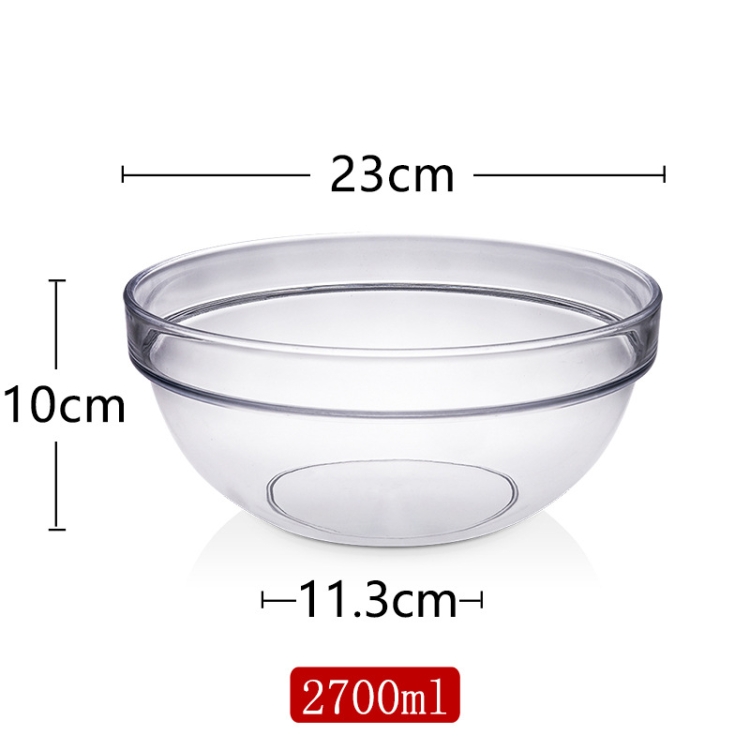
Diameter alone tells you nothing about what a bowl holds. A wide shallow piece and a narrow deep one can share a nominal size and differ by 40 % in capacity. Order by diameter, depth and volume together, and before you commit, test the actual portion — a salad bowl that looks generous on a spec sheet can come up short against your standard serving weight.
The full range is grouped under bowls, plates and serving ware, with the main families listed here. The patterns in our catalogue are sold as size ladders, so the individual models to order against are:
- Salad and serving bowls — salad bowls. Standard ladder BY-9151, BY-9152, BY-9153, BY-9154; large formats BY-8457 / BY-8458 and the 36.7 cm serving bowl BY-8459.
- Angled-profile bowls — beveled rim bowls. BY-9051 (19.7 cm top) and BY-9052, BY-9053, BY-9054.
- Lotus bowls — lotus bowls. BY-9150A, BY-9150B, BY-9150C, BY-9150D.
- Sauce and dipping dishes — seasoning and dip bowls. BY-9021, BY-9022, BY-9023.
- Square plates — square plates. BY-8466 (42 × 30 cm), BY-8467, BY-8468, BY-8469, BY-8470 (26.8 × 20.6 cm).
- Cake covers and food domes — food covers and cake domes. BY-9251 (14 inch), BY-9252, BY-9253, BY-9254, BY-9255 (6 inch).
- Food tongs for buffet stations — food tongs. 9 inch blue, 9 inch reinforced, 12 inch reinforced.
- Fruit plates and platters — BY-805X platter family (Φ35 to 15 cm), plus the display patterns covered below.
| Group | What it is for | Sizes in our range | Material |
|---|---|---|---|
| Salad bowls & serving bowls | Buffet lines, family-style service, table centrepieces | Φ14.2 cm to 36.7 cm; angled-profile bowls at 13.6 / 15.5 / 17.1 cm top | PC / PS |
| Sauce and dipping dishes | Condiment, sushi and dumpling service; side dips | Φ14 / 16 / 18 cm | PC |
| Lotus bowls | Snack and dry-goods service, lobbies, tea service | Φ14 / 17 / 20 / 23 cm | PC |
| Square plates | Buffet display, banqueting, plated service | 26.8 × 20.6 to 42 × 30 cm, 4.4–6.3 cm deep | PC / PET |
| Cake covers and food domes | Patisserie and buffet display, dust and fly protection | Φ6 / 8 / 10 / 12 / 14 inch | PC / PS |
| Fruit plates and platters | Fruit displays, dessert tables, banqueting centrepieces | Φ15 cm to 36 cm, plus 6–14 inch cover sets | PS |
| Food tongs | Buffet and self-service stations | 9 inch (22–23 cm) and 12 inch (30.5 cm) | PC |
4. Nesting and Stack Height — a Storage Decision
Nesting is the specification that decides whether the range works in your store room. Too little taper and twenty bowls take a shelf; too much and the stack jams and cracks when staff pull a piece free. The figure to ask for is the nested height of a stack of ten, not the diameter. Our catalogue lists packing quantity per carton for every SKU precisely so you can convert that into shelf space before ordering — for example 40 pieces per carton on the largest salad bowl and cake cover sizes, against 280 pieces on the smallest 15 cm patterns.
5. Wash Temperature and Warp Resistance
Ask for the maximum continuous wash temperature, not the melting point. A piece that survives one hot wash and distorts on the thirtieth is not dishwasher safe. Polycarbonate handles a commercial dishwasher to roughly 90 °C; thin-wall polypropylene and some PS pieces need a cooler or gentler cycle. If your operation runs a high-temperature sanitising wash, that single line in the spec sheet should decide your material choice before price does.
Also confirm whether the piece is top-rack or full-rack. Deep bowls trap water upside down and need a rack that lets them drain.
6. Weight, Balance and the “Feels Like Ceramic” Test
Guests notice weight. A plate that looks like ceramic and flexes when lifted reads as cheap regardless of how long it lasts, and a bowl that slides on a polished table will be sent back. Ask for the unit weight of a mid-size plate and check a sample by resting it on a bare table and pressing the rim — a stable piece does not rock and does not skate.
Crystal-look and beaded patterns in PS carry a cut facet that reads well under restaurant lighting; that is a presentation decision, and it does not change the handling rule. If the piece is going to be carried, keep it in PC.
7. MOQ, Packing Quantity and Custom Range
Our minimum order is 500 pcs per model, and OEM work — logo printing, custom colour, custom packaging — carries the same MOQ. The working detail is that most patterns here are sold as a size family rather than a single SKU: a platter pattern typically runs across five diameters and a bowl range across four. Mixing sizes inside one pattern is normally the cheaper way to reach MOQ than buying one size deep, and it gives a venue a coherent table instead of one odd-sized plate.
The platter families sit under fruit plates and platters, and the stacked and covered formats under fruit plates with food cover and fruit plates with stand — the stand bases are orderable separately as fruit plate stand bases, and display builds under multi-tier fruit stands. Pattern-specific pages cover crystal, diamond, lotus flower, beaded, leaf shape and sword pattern designs, plus petal formats. For catering and stall setups, see camping and stall use and gastronorm pans.
| Pattern family | Size ladder | Packing (per carton) |
|---|---|---|
| Fruit plates & platters (PS) | ||
| Crystal pattern (BY-810X / BY-810XA) | Φ35 / 30 / 25 / 20 / 15 cm | 60 / 60 / 100 / 180 / 280 |
| Diamond pattern (BY-820X & BY-840X) | Φ35 / 30 / 25 / 20 / 15 cm | 50 / 60 / 100 / 180 / 280 |
| Beaded pattern (BY-860X) | Φ36 / 30 / 25 cm | 30 / 60 / 80 |
| Lotus flower pattern (BY-850X) | Φ35 / 30 / 25 / 20 / 15 cm | 40 / 60 / 80 / 100 / 180 |
| Sword pattern (BY-3011A/B/C) | Φ35 / 30 / 25 cm | 21 / 30 / 30 |
| Leaf shape (BY-8712) | Φ29.7 cm | 50 |
| Platter family (BY-805X) | Φ35 / 30 / 25 / 20 / 15 cm | 40 / 50 / 70 / 86 / 160 |
| Bowls (PC) | ||
| Salad bowl — standard (BY-915X) | Φ14.2 / 17 / 20 / 23 cm | 138 / 84 / 60 / 40 |
| Salad bowl — large (BY-8458 / 8457 / 8459) | 30 / 25.5 cm; 36.7 cm serving bowl | 60 / 35 |
| Lotus bowl (BY-9150A–D) | Φ14 / 17 / 20 / 23 cm | 138 / 84 / 60 / 40 |
| Square plate (BY-846X / 8470) | 26.8×20.6 / 30.5×24 / 32.5×26.5 / 36.2×28 / 42×30 cm | 80 / 50 / 50 / 50 / 40 |
| Fruit plate + cover sets | ||
| Cover + plate, with base (BY-925X + BY-8X0XA) | 6 / 8 / 10 / 12 / 14 inch cover | Ask per combination |
| Cover + plate, no base (BY-925X + BY-8X0X) | 8 / 10 / 12 / 14 inch cover | Ask per combination |
The Real Cost Comparison: Plastic vs Ceramic Over 12 Months
The purchase price is the smaller half of the decision. The figures below use one mid-size restaurant plate, 1,200 pieces in service, replaced over twelve months. Treat the breakage rates as the assumptions to test against your own operation rather than as fixed values.
| Line | Ceramic | Polycarbonate (PC) | Polystyrene (PS) |
|---|---|---|---|
| Unit cost, mid-size plate | Higher per piece | Comparable to ceramic | Lower than ceramic |
| Breakage rate in service | Baseline | Near zero — deforms instead of shattering | Very low on static pieces; higher if handled |
| Replacement purchases, 12 months | Ongoing, in small batches | Minimal, aside from losses | Minimal on display use |
| Cleaning and handling cost | Heavier stacks, more labour, chip risk | Lighter stacks, faster clearing | Lighter stacks, faster clearing |
| Guest-safety incident risk | Sharp fragments on the floor | None — no shatter | None — no shatter |
| Suitability by piece type | Best on display where breakage is acceptable | Anything carried, stacked or washed hot | Static display plates and platters |
Read the table by column, not by row. If your operation is a carpeted fine-dining room where a dropped plate is a rare event, ceramic can still be the rational choice and the cost gap will be small. If your operation re-sets hundreds of covers a day, runs banquets, or serves by a pool, the replacement line is where the money goes and the plastic stack pays for itself well inside a year.
Five Buying Mistakes (And How to Avoid Them)
- Ordering one material for the whole table. The correct split runs through the range: PS for shallow decorative pieces, PC for deep and lifted ones. Forcing one material either overpays for the display plates or under-specifies the bowls.
- Buying a single size instead of a pattern family. Most patterns here exist as a five-step ladder. One size at depth rarely reaches a sensible carton economy; a mixed ladder inside one pattern does, and it looks deliberate on the table.
- Comparing diameter and assuming capacity. A shallow 30 cm piece and a deep 25 cm piece are not interchangeable. Always order against the portion you actually serve.
- Ignoring the wash temperature. The most common after-sale failure in this category is distortion in a high-temperature sanitising cycle. Confirm the maximum continuous temperature in writing for the specific material, not the range.
- Skipping the sample stack. Before a full container, ask for a nested stack and a filled piece at your real serving weight. Twenty minutes of testing catches a taper or capacity problem that reading a spec sheet never will.
FAQ: Buying Bowls, Plates and Platters for Hotels
Are polycarbonate bowls and plates really unbreakable?
No plastic is literally unbreakable, and any supplier telling you otherwise is overclaiming. Polycarbonate deforms under impact instead of shattering — under a hard enough hit it will bend, scuff or crack. What it does not do is produce sharp fragments the way ceramic and glass do, which is the reason hotels use it.
Which is better for hotel use, PC or PS?
They do different jobs. PC (polycarbonate) suits deep, load-bearing pieces that are carried, stacked and washed hot: salad bowls, square plates, gastronorm pans, sauce dishes, food covers. PS (polystyrene) suits shallow decorative pieces that stay on the table: fruit plates and platters, beaded and motif patterns, flat underplates. PS gives the highest optical clarity at the lowest unit cost; PC gives impact strength and heat resistance.
What is the minimum order quantity for wholesale bowls and plates?
500 pcs per model. OEM work — logo printing, custom colour and custom packaging — carries the same 500 pcs minimum. Where a pattern exists as a size family, sizes can normally be mixed within one pattern to reach the minimum.
Can these bowls and plates go in a commercial dishwasher?
Polycarbonate pieces are designed for commercial dishwashing up to roughly 90 °C. Thin-wall PS and polypropylene pieces need a cooler or gentler cycle. Always confirm the maximum continuous wash temperature for the specific material and wall thickness before ordering, and ask whether the piece is specified for a full rack or a top rack only.
How long does production take?
Standard production runs 7–15 days. OEM orders with custom printing, colour or packaging run around 30 days. Shipment is normally arranged from Ningbo or Shanghai. Timing is confirmed against the confirmed order, not the enquiry.
What certificates travel with a bowls and plates order?
Third-party food-contact test reports such as SGS, plus RoHS compliance, can be requested by certificate number and should be confirmed in writing against the exact material and colour you order. A food-contact test report is not an import permit. Tell us which country the goods are shipping to and confirm in writing which certificates travel with the order.
The Bottom Line for Hotel Procurement
Order bowls and plates by shape and handling load, not by a single material name. Keep shallow display pieces in PS where the clarity is highest and the unit cost is lowest, and put anything deep, stacked or washed hot into PC. Then check the three figures that decide the real cost — packing quantity per carton, nested stack height, and maximum wash temperature — before you commit to a container.
Browse the full range in our bowls, plates and serving ware collection, or start from the pattern families: fruit plates and platters, salad bowls, square plates and cake covers and food domes. For a specification check against a specific menu or venue, send us the item list through Contact Us and we will confirm material, capacity and packing against the real product data. You can also read more about how we produce before you order.
Benyang Supplies — unbreakable PC and acrylic drinkware and tableware for hotels, bars and catering. Yongkang, Zhejiang. WhatsApp +86 182 1705 1082.