Unbreakable Cups & Tumblers for Hotels: A Wholesale Buyer’s Guide to PC & Acrylic Drinkware
A 120-room hotel does not lose money on glassware because the glasses are expensive. It loses
money because they break — in the guest bathroom, on the buffet counter, beside the pool — and every
break pulls cleaning staff away from the room they were servicing, adds a safety hazard on a tiled floor, and
needs replacing within the same week. Ductile plastic drinkware has moved from “the cheap option” to the
default specification in mid-market and upper-mid-market hotels across South East Asia and the Gulf, and the
reason is not the purchase price. It is the twelve-month cost of owning a glass.
This guide is written for purchasing managers and F&B operators who already know they want plastic, and
now need to decide which plastic cup for which part of the property. The short version: the
service zone decides the material, the volume decides the mould, and the surface finish decides how many
hours a week your stewarding team spends on them.
A Drinkware Order Is Really a Map of the Building
The breakage pattern in a hotel is remarkably predictable, and it is almost never at the table
where a guest is being served. It happens in the unglamorous places: the guest bathroom shelf, the dishwash
rack, the buffet stacking trolley, the poolside tray. Those are exactly the places where a tempered glass
tumbler gives you nothing in return for its fragility.
- Guest bathrooms. A toothbrush cup gets knocked into a basin or a tiled floor at least once
a month in a busy property. In glass, that is a shard hunt and a room out of service for twenty minutes. - Buffet and banquet service. Water tumblers are stacked, trolleyed, and washed several times a
day. Chipped rims are the leading reason a glass is quietly pulled from circulation. - Poolside and terrace. Bare feet plus broken glass is the single worst safety scenario on a
hotel property, and the one that insurance teams care about most. - Back-of-house volume. A property turning over 300 rooms and three outlets will wash
thousands of drinking vessels a week. Every rim chip and every crack is a replacement line item.
Polycarbonate and acrylic drinkware removes the entire category of loss. The cups do not shatter, they survive
the drop that would end a glass, and they can be specified in volumes that map cleanly onto your existing
beverage menu. The trade-off is that you have to choose the right grade, because “plastic cup” covers a
very wide range of performance.
Three Resins, Three Different Failure Modes
Three transparent resins account for almost all hotel-grade drinkware, and they fail in three
different ways: PC flexes, PS cracks, and AS/SAN sits between the two. They look similar in a photograph and
behave very differently in service, so the commonest specification mistake is choosing on appearance and only
discovering the material on the third week of a busy season. A fourth line in the table below matters just as
much: moulds offered as “PS / PC” exist in two resins under one shape, which is precisely why the
resin has to be named on the order.
| Material | Impact behaviour | Clarity | Best suited to | Watch out for |
|---|---|---|---|---|
| PC — Polycarbonate | Highest impact resistance; flexes instead of cracking | Good, slightly warmer tone than glass | Guest rooms, buffet, poolside, anywhere the cup is carried and dropped | Higher unit cost than PS; buy from a food-contact grade supplier |
| PS — Polystyrene | Rigid and clear, but brittle under impact | Excellent, closest to glass | Static tabletop service, juice and dessert presentation, displayed beverage | Avoid for high-traffic buffet lines and ice-heavy service |
| AS / SAN — Acrylonitrile styrene | Middle ground; better toughness than PS, clearer than PC | Very high | Bathroom tumblers, guest amenities, where appearance matters | Slightly narrower range than PC or PS in stock moulds |
| “PS / PC” dual spec | Varies by moulding run — confirm which you will receive | Varies | Items where you want a low-cost tier and a premium tier of the same shape | Ask in writing which resin the production order will use |
Confirm the resin in writing on the order, not just on the sample you were shown.
Match the Cup to the Service Zone
Instead of ordering one tumbler for the whole property, walk the building. Each zone has a
different failure mode, a different volume, and a different guest expectation. Splitting the order by zone costs
you almost nothing in unit price — the moulds overlap heavily — and it removes most of the breakage and
replacement churn you are trying to solve.
Guest Rooms: The Cup Nobody Specifies
Bathroom tumblers and bedside water cups are usually the last line of a purchasing brief, which is
odd, because they are the cups guests handle with wet hands, in a tiled room, while half asleep. The standard
hotel bathroom tumbler sits between 250 ml and 280 ml, and polycarbonate is the sensible default
because the failure mode here is a drop, not a scratch.
Colour matters more than most buyers expect. Amber, smoke and tea tones read as “spa” or
“boutique”, clear reads as “standard”, and smoked grey hides hard-water film better than
either. If your rooms have a set palette, specify the tumbler against it rather than accepting whatever clear
stock is in the warehouse.
- Classic slim bathroom tumbler, 250–280 ml: BY-9221,
BY-9222, BY-8019 - Established three-tone house tumbler in clear, tea, grey and amber:
BY-8018 — see the full bathroom
tumbler range - Glass-clear option where the bathroom scheme is chrome and white:
BY-9224 in AS
Breakfast Buffet and Lobby: Volume and Stacking
The buffet counter is the highest-throughput drinking vessel in the building. A single breakfast
service can consume three or four cups per cover, and the cups are then stacked in trolleys, washed, and returned
to the line within the same shift. Two variables decide whether this works: the volume, so guests
and staff do not refill constantly, and the stacking height, so your back-of-house storage does
not become the bottleneck.
For juice, water and iced tea at the buffet, 350–500 ml is the working range. This is also
the zone where a ribbed or frosted finish earns its keep: vertical flutes and a satin surface break up the
light so refill splashes and hard-water marks are far less visible between washes than they are on a perfectly
smooth wall.
- Straight-sided buffet tumblers, 390 ml and 200 ml:
BY-8018B, BY-8018C - Frosted satin tumblers in three volumes, 210 / 270 / 300 ml:
BY-8015, BY-8016,
BY-8017 — full frosted
range - More vertical options: ribbed and striped tumblers
Restaurant Tables: Looking Like Glass
À la carte service is where plastic gets judged. A guest who has paid for a set menu looks at the
water tumbler before the food arrives, and a plain thin-walled plastic cup reads as cost-cutting. The answer is
not to go back to glass — it is to use a moulded pattern that throws light the way cut glass does.
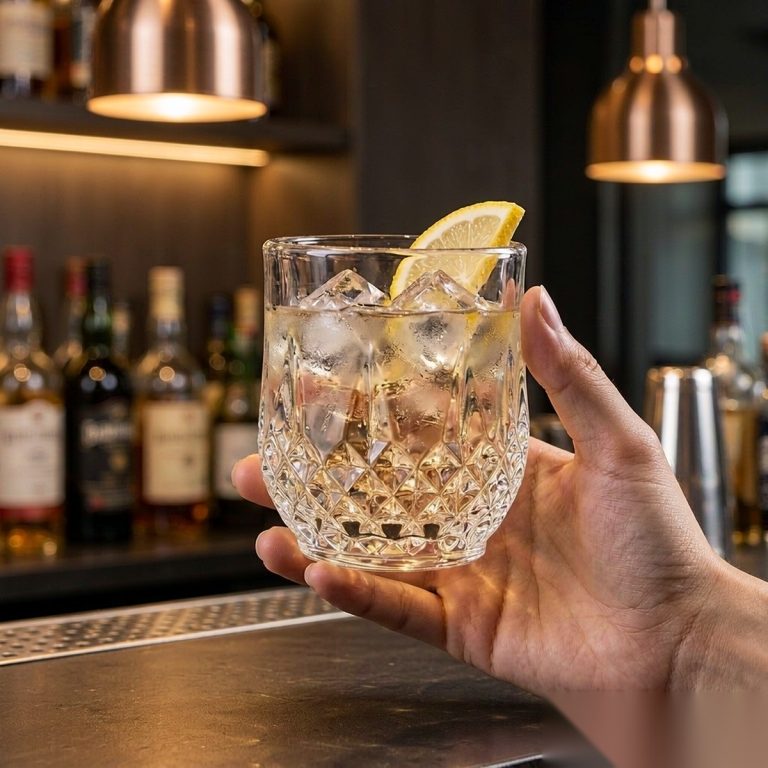
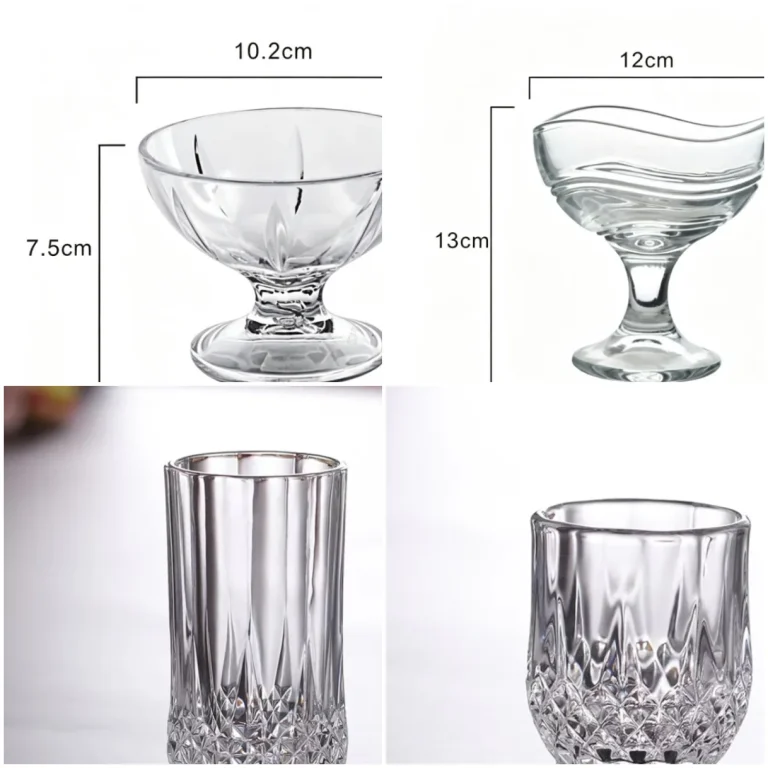
Faceted and embossed moulds — octagonal walls, diamond quilting, bamboo-joint banding, dotted relief
— all produce specular highlights from a candle or a pendant lamp, which is what actually creates the
“crystal” impression. A 250–400 ml goblet or tumbler covers water, soft drinks and
house wine by the glass. Weight matters too: a cup that feels too light in the hand signals cheapness
regardless of how it looks.
- Diamond-faceted tumblers, 220–510 ml: BY-8021C,
BY-8021B, BY-8022B,
BY-8021A — full diamond
range - Octagonal walled tumblers, 200–570 ml: BY-9201,
BY-9304C, BY-9304B — full
octagonal range - Bamboo-joint banded tumblers, 230–650 ml: BY-8020C,
BY-8020B, BY-8020A — full
bamboo-joint range - Dotted relief tumblers, 220–350 ml: BY-9309C,
BY-9309B, BY-9309A — full
polka-dot range - Angular faceted cups with a straight aesthetic: BY-9211,
BY-9212, BY-9213 — see
pentagonal glass
Bars, Juice Bars and Bubble Tea: Cold Shock and Ice
Ice is the stress test. A tumbler that sits under a chilled dispenser filled with cubed ice, and is
then stacked while still cold, is being asked to tolerate a thermal and a mechanical load at the same time. This
is where polystyrene quietly fails: it looks identical to polycarbonate on a shelf, and it is the mould that
returns with hairline cracks after a season of cold service.
For poured drinks without ice, PS is perfectly acceptable and gives you the clearest wall at the lowest unit
cost. For anything shaken over ice, served with a full cube fill, or moved between a chiller and a bar top, specify
PC. The bar and beverage cup range runs from
50 ml spirit measures to 500 ml long drinks, and most moulds are offered in both
resins — which is exactly why the resin has to be named on the order.
- PC long drinks, 320–450 ml: BY-6623,
BY-9335, BY-8046 - PS tier for static presentation, 300–400 ml: BY-9332,
BY-9340 - Small-format measures from 50 ml: BY-6621
- Beer service is specified separately — see our
wholesale beer glass guide and the
beer glass range, up to
BY-8069 at 1,000 ml
Poolside and Outdoor: Grip, Sun and Drops
Outdoor service concentrates every risk at once: wet hands, hard paving, direct sun and guests
carrying three things at a time. Volume goes up here — 480–650 ml is normal for iced
water and soft drinks — and a patterned or banded wall gives a genuinely better grip than a smooth one when
fingers are wet.
Specify polycarbonate for anything that leaves the building envelope, and choose a mould with a defined waist
or banding so a hand has something to close on. Deep-capacity tumblers in the range include
BY-8020B at 500 ml and BY-8020A at 650 ml.
How Surface Finish Turns Into Labour Hours
Buyers tend to discuss finish as a design question. Operationally it is a labour question. The
mould pattern you choose determines how long each cup takes to wash, how many fit in a rack, and how much of a
marking you will still see six months in.
| Finish | Grip with wet hands | Cleaning effort | Scratch visibility | Guest impression |
|---|---|---|---|---|
| Smooth / plain | Lower — the wall is slick | Lowest — nothing traps film | Highest — every scuff reads | Clean but basic |
| Ribbed / striped | Good — vertical bands give purchase | Moderate — brush the flutes | Low | Familiar, café-grade |
| Faceted (octagonal, pentagonal, diamond) | Very good — flat planes meet the palm | High — more edges to rinse | Very low — facets scatter marks | Reads as cut glass |
| Dotted / polka relief | Good | High — recesses hold film if not racked upright | Very low | Boutique, retro |
| Frosted / satin | Moderate | Low — uniform surface hides water marks | Low — hides fine scuffing | Soft, hotel-standard |
| Bamboo-joint banded | Good — the band is a natural grip line | Moderate | Low | Distinctive, easy to brand |
Rule of thumb: the more relief on the wall, the better the grip and the longer the wash cycle.
One practical consequence: heavily faceted moulds reward a proper rack over a flat tray. If your
stewarding team dries cups upside down on a cloth, a patterned wall will hold water in the recesses and show
tide-marks. Racked upright and air-dried, the same cup comes out looking new for far longer than a plain one.
The Purchase Brief: Eight Lines to Fill In
A cup order goes wrong in the gap between what you asked for and what was written down. What
follows is the eight-line brief we ask buyers to complete before a production slot is booked. It is not a generic
sourcing checklist — every line exists because it has caused a claim, a rework, or a rejected container at
some point.
Name the Resin on the Order
Most moulds in this programme exist in both PS and PC, and the two are indistinguishable on a
shelf or in a photograph. “Same as the sample” is not a specification — samples are drawn from
a different run and often a different resin. Write the resin and the model number into the purchase order, and
have the supplier confirm both lines back in the order acknowledgement.
Certification References and Destination Market
Every supplier will tell you their cups are food safe. The useful question is which third-party
report covers the resin, and whether it is the same resin your production order will use. Request the SGS
food-contact report and the RoHS declaration by certificate number, check that the certificate describes the
resin you are actually buying, and have that reference written into the order confirmation.
Two boundaries are worth setting out before you brief a customs broker. First, a food-contact test report
does not authorise an import — it evidences the resin, nothing more. Tell your supplier the destination
country when you request the quotation, and ask which documents will physically travel with the container.
Second, if the destination operates its own conformity scheme, that scheme sits alongside food-contact testing
rather than being covered by it, and it has to be named in the enquiry. Our standard paperwork is an SGS
food-contact report on the moulded article plus RoHS compliance; anything beyond that is quoted and scheduled
separately, so nobody is working from an assumption.
Rim Feel on the Production Sample
Run a thumb along the rim. A correctly finished mould is smooth and uniform all the way round; a
poor one has a faint moulding seam that guests notice on the second sip. On plastic drinkware the rim is also the
thinnest section of the wall, so it is where a low-grade mould fails first — a rim that already feels sharp
on delivery will chip before the season ends. Check it on the production sample, not the showroom piece.
Stack Height Against Your Actual Shelf
Ask how many units stack safely, and measure that against your real shelf height before you commit
a season’s stock. Straight-sided and tapered moulds stack very differently, and the carton quantity tells you the
other half of the story — a 350 ml tumbler at 180 pieces per carton occupies a very different footprint in
your store than the same volume at 72. Carton dimensions are quoted in the specification table of every product
on this site for exactly this reason.
Carton Yield per Cubic Metre
Packing quantity is quoted per model and ranges widely across a range of this size, from around
50 pieces up to 300 pieces per carton depending on volume and wall thickness. It drives freight, warehousing and
how you break a pallet for a single outlet. When you compare two suppliers on unit price, compare them at the
same carton yield or the cheaper quote may simply be shipping fewer cups per cubic metre.
Tint Drift Between Production Runs
If you are specifying tints — amber, smoke, tea, or a house colour — order the full
requirement in one batch where you can, and ask for a retained sample. Transparent tints are the one specification
where a second production run can be a visible shade off, and a bathroom tray holding two slightly different
ambers looks worse than either on its own.
Stock Lead Time vs OEM Lead Time
Minimum order quantity across this range is 500 pieces per model, which applies
equally to stock colours and to OEM work — logo printing, a custom colour, or custom packaging. Standard
stock orders ship in 7–15 days; OEM runs are typically around 30 days.
That gap is worth planning around: if a new outlet opens in six weeks, place the OEM requirement as a separate
line from the top-up stock order.
Landed Cost, Not List Price
Two quotes at the same unit price can differ by a factor of three in cups per carton, and that
difference lands on your freight invoice rather than the supplier’s. Price the order at delivered cost per cup
— unit price, carton yield, cubic volume and inland delivery together — before you compare two
suppliers at all. The model number and its packing quantity are printed on every product page in this range so
the figure can be assembled without waiting for a quotation.
Volume Bands and What They Pour
The table below maps the volumes in this range to the service they normally support. It is a
starting point for a specification sheet, not a rule — what matters is that the volume you choose is driven
by the menu and the refill cycle, not by what happens to be in stock.
| Volume band | Service it usually supports | Example models |
|---|---|---|
| 50–90 ml | Spirit measures, espresso, tasting flights, sauce service | BY-6621, BY-9204 |
| 150–200 ml | Guest-room water glass, tea service, side water | BY-9331, BY-9201, BY-8018C |
| 210–280 ml | Bathroom tumbler, juice at breakfast, dessert pairing | BY-8015, BY-8016, BY-9221 |
| 300–350 ml | House water tumbler, soft drinks, buffet juice | BY-9309A, BY-8020C, BY-8017 |
| 370–450 ml | Long drinks, iced tea, casual dining water | BY-8018B, BY-9304C, BY-6623 |
| 480–600 ml | Poolside iced water, draught-adjacent service, banqueting | BY-8020B, BY-9304B, BY-9338 |
| 650–1,000 ml | Beer service, shared table water, large-format iced drinks | BY-8020A, BY-8069 |
Browse the complete range: cups & tumblers.
What Twelve Months of Ownership Actually Costs
The purchase price of a glass tumbler is lower than a polycarbonate one. The ownership cost is
not. The table below models a single busy outlet running 100 water tumblers, which is a realistic figure for a
hotel with one restaurant and a lobby bar.
| Line item (per year, 100 tumblers) | Tempered glass | PC / acrylic |
|---|---|---|
| Initial purchase | Lower | Higher |
| Breakage and replacement | High — ongoing monthly | Minimal after the first order |
| Chipped stock pulled from service | Frequent | Rare |
| Staff time on breakage clean-up | Recurring, unplanned | Almost nil |
| Safety incidents and room downtime | Real risk, highest poolside | Effectively removed |
| Guaranteed colour and shape continuity | Batch-dependent | Stable, reorderable by model |
Indicative only — model it against your own covers and your own replacement rate.
In practice, the crossover for a mid-volume property lands inside the first year, and the gap
widens every year after that as glass stock is repeatedly topped up. The case is even stronger if you count the
operational cost of a broken glass rather than just the replacement unit: twenty minutes of a housekeeper’s shift
and one room out of rotation is a far larger number than the price of the tumbler.
Six Ways a Cup Order Goes Wrong
- One mould for the whole building. Bathrooms, buffets, dining rooms and pools have
different failure modes. Splitting the order by zone usually costs nothing and removes most of your churn. - Resin left unstated. Many moulds exist in both PS and PC, and the two look identical on
delivery. Name the resin and the model number, and get both confirmed in writing. - Choosing on clarity alone. The clearest wall is usually PS, which is the grade that fails
under ice. Pick the material from the service condition, then choose the pattern. - Specifying from a photograph. Every textured mould flattens to a similar silhouette
online. Facet depth, band width and relief height only read in the hand, so judge surface finish from a physical
sample before the production slot is booked. - Skipping the rim check. Rim finish is the first thing to fail and the most visible to a
guest. Inspect it on the production sample, not the showroom sample. - Splitting a tinted requirement across two runs. Transparent tints drift between
production runs. Order the season’s requirement together and keep a retained sample for the next one.
Buyer Questions on Cups and Tumblers
PC or PS for hotel cups — which one should I specify?
PC (polycarbonate) is the tougher of the two and flexes instead of cracking, so it suits guest rooms, buffet service and poolside use where the cup is carried and dropped. PS (polystyrene) is more rigid and gives the clearest wall, which makes it ideal for static tabletop presentation, juice and dessert, but it is not the right choice for ice-heavy service or high-traffic buffet lines.
How should cups be washed and racked in a hotel kitchen?
Both PC and PS drinkware in this range are built for repeated commercial washing, and the more heavily patterned moulds are best racked upright and air-dried so water does not collect in the recesses. Always confirm the wash temperature with your supplier for the specific model you order.
What happens to PS cups in iced drink service?
For ice-heavy service, choose polycarbonate. It handles the combined thermal and mechanical load of a full cube fill in a chilled tumbler, whereas polystyrene can develop hairline cracks over a season of cold service even though it looks identical on a shelf. If a mould is offered in both resins, name the resin you want on the order.
Can we brand the cups with our own logo and colour?
Yes. Logo printing, custom colour and custom packaging are all available, at the same 500-piece minimum per model as stock orders. OEM production runs are typically around 30 days against 7–15 days for stock, so plan OEM lines ahead of an opening date.
What is the smallest order you accept per model?
The minimum order quantity is 500 pieces per model, for stock colours as well as OEM work. Confirm the production resin, the model number and the packing quantity in writing before the order is placed.
Next Step: Your Zone-by-Zone Specification
Choose the material from the service condition, the volume from the menu, and the surface finish
from the wash cycle — then split the order by zone rather than buying one tumbler for the whole property.
That sequence resolves almost every specification argument before it reaches a supplier, and it is the reason a
zone-by-zone specification sheet outlasts a single-property standard.
Benyang supplies unbreakable PC and acrylic cups and tumblers direct from our factory in Yongkang, Zhejiang,
shipping through Ningbo and Shanghai. Full specifications, carton yields and colour options are listed on every
product page in the cups & tumblers range, and the wider
drinkware programme is covered in our
materials comparison,
water pitcher and
bar supplies guides.
Send us your room count, outlet mix and the volumes you are working to, and we will come back with a zone-by-zone
specification. Contact us — or read more
about our factory and quality process.