Aluminium Pans, Grills and Warmers for Hotels: What One Piece Is on This Line
Four Lines on a Table, and Only One of Them Is a Choice
The specification table on this range is short. It has one column of attribute names and one column of values, and between them they run to four lines: a product size, a material, a packing quantity, and a minimum order. Everything a buyer can compare across the sixty-seven rows of the aluminium line lives inside those four lines, and the first thing worth noticing is that one of them says the same thing almost everywhere.
Sixty-two of the sixty-seven rows give their material as aluminium alloy. Three say enamel-coated aluminium alloy and one says aluminium alloy with a three-ply stainless steel rim. So the material line varies on five rows out of sixty-seven, and on the other sixty-two it is a constant. A column that repeats itself cannot rank anything. Whatever decides which of two pots you buy, it is not going to come out of line two.
Line four is the same on every row: a minimum order of five hundred pieces. That is a single published figure across the whole range, which makes it look settled. It is the least settled number on the page, because it counts in a unit that only line three ever defines — and line three defines it ten different ways.
So this guide is about the packing column. Not the carton, which this line does not publish, and not the diameter ladder, which is the other half of the table and has been read elsewhere. It is about the one line that has to convert a five-hundred-piece order into something a warehouse can receive.
Sixty-Two Rows in One Metal
| Material as published | Rows | What it is |
|---|---|---|
| Aluminium alloy | 62 | The body of the vessel, and by far the commonest value in the range |
| Enamel-coated aluminium alloy | 3 | A coated finish over the same base metal |
| Aluminium alloy with a 3-ply stainless steel rim | 1 | The plate sets with a steel edge rather than an aluminium one |
| Food-contact silicone | 1 | The one row on this line that is not a metal at all |
The three enamel rows are worth naming because they are the whole of the visible variety on this line: Dia. 32 / 36 / 40 cm, Rim dia. 24 / 26 / 28 / 30 / 32 cm, Grill plate 33 cm. Two of them are published as the second version of a shape that also exists without the coating, and in both pairs the two versions carry the same product size string. The coating is the only difference a reader can see, and it appears in the material line and in the title rather than anywhere in the numbers.
The fourth value is the interesting one. Dia. 16 / 20 / 24 / 28 / 32 cm is the only row on this line whose material is not a metal, and it is also the only row whose packing column carries no figure at all. That is not a coincidence. It is the same fact stated twice: this row is a component of a warmer rather than a product, and both of those columns say so in their own way.
Ten Ways a Packing Column Can Count
Read all sixty-seven packing cells in order and they fall into ten groups. That is not a figure of speech; the ten groups below are mutually exclusive and account for every row.
| # | How the cell reads | Rows | Example |
|---|---|---|---|
| 1 | One number, one size. The page describes a single object, so the number is the rate for it. | 17 | 15 pcs / carton |
| 2 | One number, several sizes. The page offers a ladder of diameters and prints a single rate, which cannot be tied to any one of them. | 16 | 12 pcs / carton |
| 3 | A ladder, one value per diameter. Two lists of the same length, read position by position. | 21 | 20 / 20 / 20 / 20 / 10 / 10 / 10 pcs |
| 4 | Two counts for two components. Two rates, each labelled for a different part of the object. | 6 | Plate 30 pcs / carton; base 60 pcs / carton |
| 5 | Two cartons on one page, split by diameter. The page is one product and two shipping units. | 2 | 10 pcs / carton (32 / 34 cm); 8 pcs / carton (36 / 38 cm) |
| 6 | The unit is the set. The column counts assemblies, not pieces. | 1 | 4 sets / carton |
| 7 | The sizes are words. Large and small stand in for the diameters, and each gets its own rate. | 1 | 24 pcs / carton (large); 30 pcs / carton (small) |
| 8 | A number wrapped in a logistics note. The rate is followed by a sentence about how the two parts travel. | 1 | 30 pcs / carton, pan and stove packed separately |
| 9 | A sentence with no number at all. The row carries no figure, because the row is not ordered on its own. | 1 | Packed with the matching warmer model |
| 10 | A production note. The column describes how the cartons are made rather than how many fit. | 1 | Cartons are built to order alongside the stove model |
Group three is the one most buyers assume they are reading all the way down the line, and it is the largest single group at twenty-one rows. It is also the only group in which a number can be attached to a specific diameter without saying anything extra. Groups one and two both print a single rate, and they differ only in whether the page describes one object or several.
That distinction matters more than it looks. A rate on a single-object page is a complete answer: the row is one thing, the number is its rate, and five hundred pieces is a division. A rate on a multi-size page is not an answer at all, because the page is offering you a choice and the number refuses to make it. Sixteen rows are in that position, and they are the rows where a quotation and a delivery note can quietly disagree.
A Ladder Only Works When Both Lists Match
Group three works by position. The size cell lists diameters in order and the packing cell lists rates in order, and the two lists are the same length, so the third rate belongs to the third diameter. It is an old-fashioned way of writing a table inside a cell and it works perfectly as long as nobody edits one list without editing the other.
The clearest example on the range is Dia. 23 / 26 / 29 / 32 / 38 / 43 / 48 cm, which lists seven diameters and seven rates: 20 / 20 / 20 / 20 / 10 / 10 / 10 pcs. Take the third diameter and you get the third rate. Take the last and you get ten pieces to a carton, which is what a 48 cm plate should be expected to yield.
Now put the same reading against Rim dia. 24 / 26 / 28 / 30 / 32 cm. The size cell offers five rim diameters — Rim dia. 24 / 26 / 28 / 30 / 32 cm — and the packing cell says “10 pcs / carton”. One rate, five diameters. The row looks exactly as complete as the seafood plate row, and it is not. If the ten pieces apply to the smallest rim, the largest rim also ships ten to a carton, which is improbable; if they apply to the largest, the smallest should ship more, and the page does not say how many.
Its sibling on the same shelf, Rim dia. 24 / 26 / 28 / 30 / 32 cm, uses the identical five rim diameters and writes the ladder out in full: 10 / 10 / 10 / 8 / 8 pcs. Two rows, the same set of diameters, and one of them answers the question while the other does not. Across the range there are sixteen rows in that second position, and they include some of the most heavily ordered shapes on the list: Grill plate 19 x 27 cm (mini) / 27 x 37 cm (medium) / 30 x 40 cm (large), 18 x 25.5 cm (mini) / 25.5 x 35.5 cm (medium) / 28.5 x 38.5 cm (large), 17 x 24.5 cm (mini) / 23 x 33 cm (medium) / 26 x 36 cm (large), Dia. 29 / 33 / 37 cm, Dia. 23 / 25 / 28 cm, Dia. 24 / 28 / 32 cm.
Ten Diameters, Three Handles, Two Answers
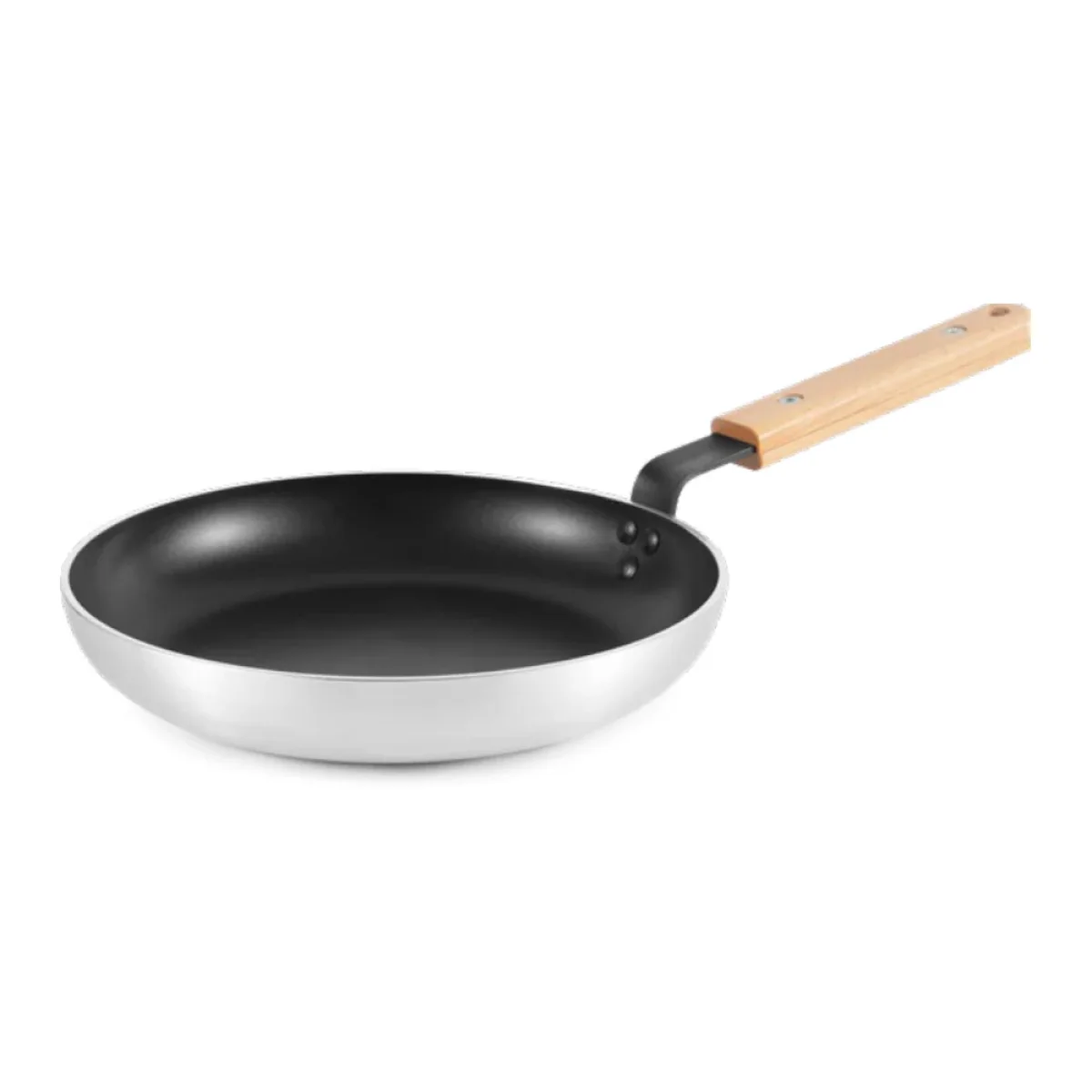
The frying pans are where the ten groups stop being a filing exercise. Three rows on this range describe the same family of pans, and they differ in exactly one published respect: the handle.
| Row | Product size as published | Packing quantity as published |
|---|---|---|
| french frying pan iron handle | Dia. 20 / 22 / 24 / 26 / 28 / 30 / 32 / 34 / 36 / 40 cm | 20 / 20 / 12 / 12 / 12 / 12 / 12 / 12 / 12 / 12 pcs |
| french frying pan steel handle | Dia. 20 / 22 / 24 / 26 / 28 / 30 / 32 / 34 / 36 / 40 cm | 20 / 20 / 12 / 12 / 12 / 12 / 12 / 12 / 12 / 12 pcs |
| heat proof wooden handle frying pan | Rim dia. 28 / 30 / 32 / 34 / 36 / 40 cm | 12 / 12 / 10 / 10 / 8 / 8 pcs |
Read the first two lines again. They are not similar; they are identical. Ten diameters, twenty pieces for each of the first two and twelve for each of the rest, and every other published field on the two pages is the same string. One pan is described as having an iron handle and one as having a steel handle, and beyond the title there is nothing on either page that would let a buyer tell which one they are reading. A quotation that names one of them and a goods-in check that names the other cannot be reconciled from the pages.
The third row is the one that says something new, and what it says is about the box rather than the pan. It starts at 28 cm instead of 20, and over the six diameters the other two rows also list, the rates diverge:
| Rim diameter | Metal handle, pieces per carton | Wooden handle, pieces per carton |
|---|---|---|
| 28 cm | 12 | 12 |
| 30 cm | 12 | 12 |
| 32 cm | 12 | 10 |
| 34 cm | 12 | 10 |
| 36 cm | 12 | 8 |
| 40 cm | 12 | 8 |
| Six cartons in total | 72 pieces | 60 pieces |
Across the same six diameters, the metal-handled pans move seventy-two pieces in six cartons and the wooden-handled ones move sixty. The handle that keeps heat out of the hand costs about a sixth of the carton yield on the sizes where both are offered, and that is the only commercial difference the line publishes between them.
It is worth being precise about what this does and does not tell you, because the obvious reading is the wrong one. It does not say the wooden handle is the worse pan. It says that on this table the only figure that moves when you change the handle is the number of pieces in a box, and that the figures which would actually decide the choice — what the pan weighs, how quickly it recovers heat, whether the handle can go through a dishwashing line, and what each version costs — are not fields on this table at all. A buyer choosing between an iron handle and a steel handle is choosing between two rows that publish nothing different, and the question that would separate them has to be asked in writing rather than looked up.
Two Components, Two Numbers, and No Ratio Between Them
Six rows break the packing cell in two, and this is the group that causes the most trouble at the order stage, because a cell with two rates in it looks twice as informative and is in fact half-finished.
| Row | First component | Second component |
|---|---|---|
| gradient color dry pot set | Plate 30 pcs / carton | base 60 pcs / carton |
| wmj 04 classic dry pot matte black | 30 pcs / carton | base 60 pcs / carton |
| line texture warmer set classic | 24 pcs / carton | base 12 pcs / carton |
| shanpin seafood hot pot with stand | Plate 10 pcs / carton | base 20 pcs / carton |
| hammered composite steel dry pot twin handles | Plate 30 pcs (9 / 10 in), 20 pcs (11 in) | base 60 pcs / carton |
| harvest plate set china red | Plate 30 pcs (9 / 10 in), 20 pcs (11 in) | base 60 pcs / carton |
Four of these rows describe one base under one plate and print the two rates separately. In Rim dia. 22 / 24 cm thirty plates and sixty bases go into a carton; in Plate dia. 38 / 43 cm; base dia. 32 cm the ratio runs the other way, ten plates to twenty bases per carton pair. Two of the six go further and add a size condition inside the first number, so that the plate rate itself depends on which rim you ordered.
What none of the six publishes is the assembly ratio. The cell tells you how many plates go into a carton and how many bases go into a carton. It never tells you how many bases a plate needs. On most of these shapes the answer is one, and it is the answer most buyers assume, but it is an assumption about the product rather than a figure from the page, and it is the number that turns a five-hundred-piece order into a five-hundred-set order or a two-hundred-and-fifty-set order. The two readings are a factor of two apart on the quantity the customer actually receives.
There is one more thing in this group worth pointing out, because it is the kind of detail that only shows up when the rows are read side by side. Dia. 24 / 27 / 32 cm pairs its first component at twenty-four with twelve bases, which is the opposite direction from the dry pot sets at thirty and sixty. The same word — base — is used on both, and in one place the base is the scarcer component and in the other it is the more plentiful. A rule of thumb learned from one row will be wrong on the other.
When the Column Stops Being a Quantity
Four rows abandon the form of a quantity altogether. Each one is doing something different, and each is worth reading as a sentence rather than as a number.
17 x 31 cm (small) / 19 x 36 cm (large) reads “30 pcs / carton, pan and stove packed separately”. The thirty is a carton rate; the clause after the comma is the part that decides how the shipment is handled. A pan and its stove travelling in separate cartons is a receiving instruction, not a packing figure, and it explains why this row answers a freight question the other grill rows do not.
Dia. 16 / 20 / 24 / 28 / 32 cm reads “Packed with the matching warmer model”. There is no figure, because there is no separate order for one. The mat is offered across five diameters — Dia. 16 / 20 / 24 / 28 / 32 cm — and every one of them travels with the warmer it fits. A buyer building a quotation from this row has nothing to build it from.
Assorted diameters to suit the warmer range reads “Cartons are built to order alongside the stove model”. This is the honest version of the same position: the cartons genuinely cannot be stated in advance because they follow the stove the pots are made to suit. It is worth contrasting with the sixteen rows in group two, which also fail to give a usable rate but give the impression of having given one.
Deep pan 42 x 31 cm, depth 5.5 cm; shallow pan 37.5 x 31 cm, depth 3.5 cm reads “4 sets / carton”, and here the unit changes rather than disappearing. Every other row on the range counts pieces; this one counts sets, and a set on this row is a deep pan and a shallow pan travelling together. Four sets is eight pans. Read as pieces, the row is out by a factor of two.
Two Cartons Under One Product Page
Two rows on the range are one product and two shipping units, and they handle it by naming the split inside the packing cell.
| Row | Product size | Packing quantity |
|---|---|---|
| wmj 08 aluminum clear broth hot pot | Dia. 32 / 34 cm and 36 / 38 cm | 10 pcs / carton (32 / 34 cm); 8 pcs / carton (36 / 38 cm) |
| wmj 01 korean aluminum wok | Dia. 24 / 28 / 32 / 36 cm and 40 cm | 10 pcs / carton (24-36 cm); 8 pcs / carton (40 cm) |
Both rows read the same way once the parentheses are followed: the smaller diameters pack ten to a carton and the largest packs eight. For Dia. 24 / 28 / 32 / 36 cm and 40 cm the break comes at 40 cm, which is the single largest size on the row; for Dia. 32 / 34 cm and 36 / 38 cm it comes between the 34 cm and the 36 cm pans.
The practical consequence is that a product page is not the same thing as a shipping unit. Order twenty of the 32 cm pot and twenty of the 36 cm pot and you have ordered two things that go into two different cartons at two different rates, from one page, under one minimum order figure. On the other sixty-five rows the page and the shipping unit are the same thing, which is why the assumption is so easy to carry over.
Five Hundred of Which Thing
Now put the minimum order against the column, row by row. The exercise is not academic: five hundred pieces is the figure printed on all sixty-seven pages, and the number of cartons it produces depends entirely on which of the ten forms the row is using.
| Row | 500 pieces in cartons | Where that number comes from |
|---|---|---|
| skewer hot pot | 42 cartons | 500 ÷ 12, rounded up. One object, one rate, one answer. |
| enamel coated shallow casserole | 50 cartons, if all five hundred are one rim | 500 ÷ 10. The arithmetic is clean; what is not published is which rim the ten belongs to, so a mixed order across the five rims has no answer at all. |
| seafood soup plate set | 50 cartons at the 43 cm plate, 25 at the 32 cm | 500 ÷ 10 and 500 ÷ 20. Only possible because the size list and the rate list are the same length. |
| gradient color dry pot set | 17 plate cartons and 9 base cartons, if a plate takes a base | Plate at 30 and base at 60. If five hundred pieces means five hundred sets the same order becomes 34 and 17. The page does not decide between the two readings. |
| artisan grill pan set deep shallow | 63 cartons, if a piece is one pan | 4 sets to a carton. If five hundred pieces means five hundred sets the order is 125 cartons, which is the difference between one lorry and three. |
| heat proof silicone mat | no figure | The row is offered across five diameters and publishes neither a rate nor a way to order it on its own. |
| interchangeable mini pots | no figure | Cartons are built to order against the stove model, which is a real answer to a different question. |
Seven rows, six different answers, and two of them are not answers. The one thing every row has in common is that the page prints the same minimum order in the same words. The one thing none of them has in common is what that minimum order refers to.
The two rows worth dwelling on are the fourth and the fifth, because both are genuinely ambiguous rather than merely incomplete. On Rim dia. 22 / 24 cm a five-hundred-piece order could reasonably mean five hundred sets, five hundred items, or five hundred plates with a base count to be agreed, and the carton count differs by a factor of two across the three. On Deep pan 42 x 31 cm, depth 5.5 cm; shallow pan 37.5 x 31 cm, depth 3.5 cm it differs by a factor of two as well, and this time the row has already told you the unit is the set, which makes the ambiguity harder to spot rather than easier.
A Delivery Note for One Order
There is a way to make all of this concrete before a purchase order is raised, and it does not need any new information from the supplier. Write the delivery note first. Take the shapes you intend to order, put them against the minimum order, and see which lines you can complete and which ones you cannot.
| Delivery-note line | Quantity | Where the number came from |
|---|---|---|
| Skewer hot pot, 16 cm | 500 pcs, 42 cartons | Published rate, single object, nothing to interpret |
| Enamel-coated shallow casserole, 28 cm rim | 500 pcs, 50 cartons | Published rate, but only valid if the whole order is that one rim |
| Seafood soup plate, 43 cm | 500 pcs, 25 cartons | Positional ladder, third-from-last diameter |
| Gradient dry pot set, 24 cm rim | left blank | Two rates and no assembly ratio; the set count cannot be stated |
| Grill pan set, deep and shallow | left blank | The unit is the set, and the piece count behind a set is not published |
| Silicone mat, 24 cm | not on the order | Travels with its warmer; there is no separate line to write |
Four of those six lines can be filled in from the product pages as they stand. Two cannot, and they cannot for two different reasons: one has too little information and the other has a unit that is defined in the title rather than the numbers. Raising the order anyway would put the blank lines into a supplier’s confirmation, which is where they stop being a note to yourself and start being a dispute.
The fix takes one message and does not need a new specification. Send the shape, the diameter, and the quantity you want in the unit you actually buy — pieces or sets, stated out loud. Ask for three things back per line: the pieces per carton at the diameter you named, the number of cartons that makes the minimum order, and, on any row with two components, how many of the second component go with one of the first. Those three answers turn the packing column from a reading exercise into an order, and they take less time to produce than the quotation they sit beside.
The Rest of the Cookware Range, and the Shelf Beside It
The cookware and chafing dish range splits into seven sub-lines: woks and frying pans, grill pans and BBQ grills, chafing stoves and alcohol warmers, soup pots and warmers, dry pots and casseroles, hot pots and plate sets and trays, mats and accessories. The rows above are spread across all seven, because the packing column is written the same way wherever they sit.
Two earlier guides take the same range from other directions. The buffet warmer guide reads what the heat does to the vessel and where the four heat routes arrive, and the heat source guide works the other way round, starting from the cooktop the kitchen already has. Both end up in the same three fields, which is why this guide takes the third line of that table rather than the first.
The same habit of reading a specification column for its unit is not unique to cookware. The cutlery guide runs the exercise on piece counts and colours, the cutlery set guide does it on set sizes and packaging words, and the water pitcher pallet guide applies it to cartons on a pallet deck. The serve size guide is the mirror image, starting from a menu rather than from a shelf.
Aluminium Cookware Order Questions from Hotel Buyers
Does the single packing figure apply to every diameter on the page?
On twenty-one rows it does not, because those pages print a ladder with one figure per diameter. On sixteen rows a single figure sits beside a list of diameters, and there the figure is a rate for the page rather than for a size. The two look identical at a glance. The way to tell them apart is to count: if the number of values in the size cell equals the number of values in the packing cell, the lists correspond; if one cell has many and the other has one, nothing corresponds.
Two rows list the same product size and the same packing quantity. Are they the same pan?
Not necessarily. The two French frying pan rows on this range publish identical size strings and identical packing strings, and they are described as having different handles. Everything a buyer can read on the two pages is the same; what separates them is what the handling is made of. Treat a matched pair that publishes nothing different as a pair that needs a question rather than a comparison.
How many pieces are in the minimum order when a row lists a plate and a base separately?
The pages do not say, and it is the first thing worth settling before an order goes out on those rows. A two-component row publishes a carton rate for each part and never publishes how many of the second part go with one of the first. That missing ratio is the difference between a five-hundred-set order and a two-hundred-and-fifty-set order, and both of them can be read out of the same sentence.
Can the packing quantity be restated per diameter before we order?
Yes, and it is a reasonable thing to ask for on any row in the sixteen that print a single rate beside a ladder of sizes. What to ask for is specific: the pieces per carton at the diameter you intend to buy, in writing, on the quotation rather than in a later message. A rate for a page is not wrong; it simply cannot be used until somebody attaches it to a size.
What should a purchase order for this range actually state?
The shape, the diameter, the number of pieces or sets with the unit written out, and the number of cartons you expect to receive. That last figure is the one that catches the ambiguity, because it forces the two sides to agree on what a piece is before anything is packed. Anything less specific leaves the definition of the unit to the packing line, which is the one place nobody re-checks it.
Also on this line: tcfs 20db single handle pizza pan, wmj 05 wooden frame square warming stove, great wall heat proof warming stove, wmj 05 15 tang warming stove, harvest plate large and small, slotted shallow grill pan glass lid, drawer type alcohol stove, ultra slim round warming stove, japanese style alcohol stove, antique style alcohol stove, taishan warming stove, pull free alcohol stove, simple eco oil stove, wmj 05 12 volcano warming stove, wmj 10 chuancheng casserole set oxidised, induction seafood soup plate, hantao warming stove, ultra slim square warming stove, bawang gold rim deep plate set, line texture warmer base, wmj 10 chuancheng casserole set sky blue, bawang gold rim shallow plate set, bawang gold rim 3 ply steel plate set, side handle aluminum wok induction, side handle shallow soup pot induction, european shallow soup pot optional steamer, kunpeng soup warmer, athens seafood pot, wmj 02 a crystal lacquer shallow soup pot, state banquet soup warmer, enamel coated aluminum dry pot, jinxiu dry pot, chili fish head casserole china red, tcfs 20zp bamboo rack set, tcfs 20 jg steel fish grill, shallow grill pan, model 3828 induction grill pan, deep grill pan side handles, yuanbao round tabletop bbq grill, aluminum cassette bbq grill set. The about page sets out how the three ranges are put together, and the contact page is where the diameters and the set quantities belong.