Unbreakable Sugar Bowls & Sugar Jars for Hotels: The Lid, the Spoon Slot and the Moisture Problem
The Only Tableware on the Table That Can Spoil Its Own Contents
Everything else in a hotel’s drinkware range holds something that improves with time out of the vessel. Water does not care whether it sits in a jug or a glass. Wine, once poured, is already on its way somewhere else. Fruit on a platter is on display, not in storage.
Sugar is the exception. A sugar bowl is not a container that happens to hold sugar; it is the thing that decides what the sugar is like three weeks later. Seal it well and the crystals pour. Seal it badly and the contents set into a block a guest cannot spoon and a steward will not stand at the table trying to break. No other line in the catalogue has that property, which is why a category that looks like eight near-identical bowls is worth reading carefully. This guide takes an eight-model range on our own sugar bowls and sugar jars, quotes only what those pages publish, and is explicit where the table stops short — because on this product it stops short at the one feature that matters most.
Sugar Is Hygroscopic Before It Is Anything Else
Table sugar is crystalline sucrose, and crystalline sucrose pulls water out of the air. That is not a packaging problem invented by suppliers; it is the material. Below roughly sixty per cent relative humidity the crystals stay loose and pour. Above it they take on moisture at the surface, grains bind to their neighbours, and the mass sets. The process is slow, which is exactly why it is dangerous commercially: nothing goes wrong on the day of delivery.
Three conditions in a real property push humidity up on a sugar bowl. The first is the room: a buffet area in a tropical market sits above the threshold for much of the year, and an air-conditioned dining room does not. The second is the wash-up, because a bowl and lid that come out of the machine with water still clinging to the inside of the lid trap that water under the dome with the sugar. The third is the spoon, and it is the one nobody watches: a wet spoon goes into the bowl and stays there between services. Those three conditions are why the rest of this guide is about a lid and a hole rather than about capacity.
What the Photographs Show That the Table Does Not
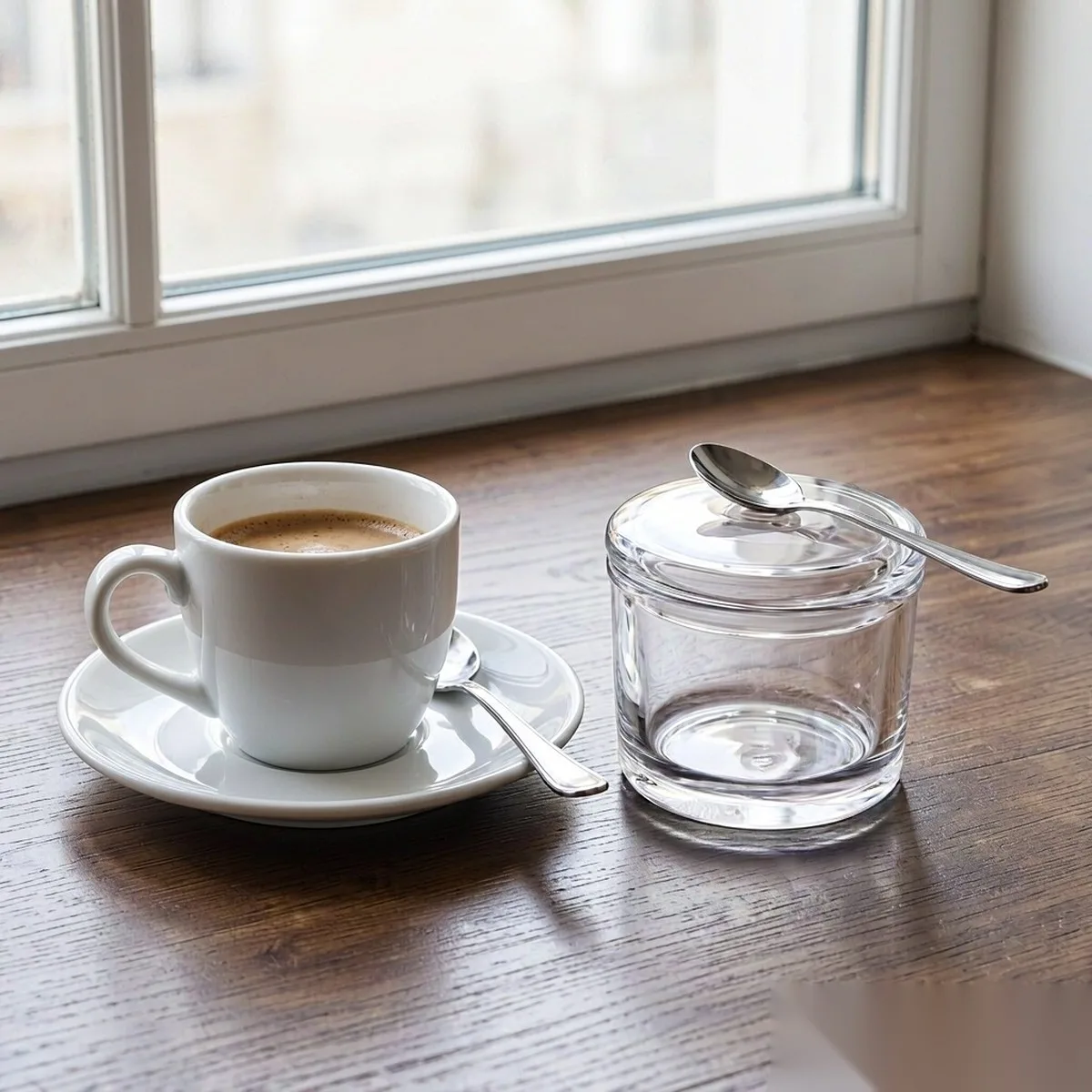
Open any of the eight product pages and two documents sit side by side: a set of studio photographs and a specification table. Read both, and a gap opens up immediately.
| What every photograph in this range shows | What the specification table states |
|---|---|
| A domed lid seated on the bowl rim | nothing — the range publishes no lid column at all |
| A slot cut through the lid, wide enough for a spoon handle | nothing |
| A spoon standing upright in that slot | nothing |
| A thick, hand-feel rim and a clear body | PS (polystyrene), and a diameter × height |
| A bowl that is either squat and wide or narrow and tall | Product Size, as a diameter and a height |
Five attributes are published across the whole range: model number, product size, material, packing quantity and carton size. Capacity is not one of them, colour is not one of them, and neither is the lid or the spoon the photographs show standing in it. That is not a complaint about the catalogue — a supplier publishes the columns buyers ask about, and buyers have historically asked about size and price. It is a warning about how this category gets ordered: a buyer who reads only the table will specify a diameter and a height, receive a box of bowls, and meet the lid arrangement for the first time on the delivery dock. Everything that follows is about closing that gap before the order rather than after it.
The Mouth Is a Spoon Measurement, Not a Volume
Diameters in this range run from seven to eleven centimetres, and it is tempting to read that as a capacity ladder: small bowl, medium bowl, big bowl. The published table gives no capacity to confirm it either way, and the more useful reading is that the mouth is a measurement of the spoon rather than of the contents. A standard teaspoon head is a little under three centimetres across, so once wall thickness is taken off a seven-centimetre outer diameter the clear opening is still close to six centimetres and the spoon itself is never the problem. The problem is the hand holding it. A server reaching into a narrow bowl with a short spoon is working in a space barely twice the width of the spoon head, and the natural response is to fill the bowl shallow so that nothing spills. The result is a bowl filled to a third because it fights the person using it.
At the wide end the arithmetic reverses. An eleven-centimetre bowl leaves roughly ten centimetres of clear opening — room for the hand and a long-handled spoon together, and room for a small sugar tong. Where the service uses cubes, or carries both white and brown, the wide models are not a size upgrade but the only geometry that works.
One practical test beats the whole table: take the spoon your service actually uses, and ask for a sample of the smallest model you are considering. If the spoon fits, sits in the slot without leaning against the sugar, and comes out with a full head, the diameter is right. If it rattles or scrapes, the service will fill the bowl shallow and you will be reordering the larger size next season.
Height Sets the Refill Interval
Heights in the range run from eight to ten and a half centimetres, and unlike diameter this one is genuinely about how much the bowl holds. It is the axis that turns a purchase decision into a labour decision.
A service round is not a fixed cost; it is a number of trips. A bowl that empties halfway through breakfast is refilled while the room is full, which means a steward crossing a busy floor with a bag of sugar at the worst possible moment. A bowl that survives a whole sitting is refilled afterwards, when the job takes seconds. The gap between the shortest and the tallest model here is two and a half centimetres of interior depth, which in a hot, humid room is the difference between one refill and three.
There is a counterweight. A taller bowl holds more for the same footprint, but the centre of gravity rises, and sugar is dense. Fill a tall narrow model to the shoulder and it becomes a tip hazard on a tray, so the sensible working level is lower than the rim — the honest way to find it is to fill the sample to two-thirds and carry the loaded tray the length of the room. The lid matters here too: a tall bowl wears a deeper dome, and a deep dome is a larger volume of still, humid air sitting over the sugar. That cuts both ways, because more headroom means more air to saturate before the sugar suffers, but a deeper recess is also harder to dry completely after the wash-up.
The Spoon Slot Is Both the Leak and the Convenience
Every model here has a slot cut through the lid, and it does two opposite jobs at once. The convenience is obvious: the spoon lives in the bowl between services instead of being carried back and forth or laid on the tablecloth, so the bowl is always ready. A bowl whose spoon was taken away by the last clean-up is a bowl the next guest will open by hand.
The leak is less obvious. The slot is the one place where the inside of the bowl is permanently connected to the room. Under a sealed dome the air inside comes to equilibrium with the sugar and stops being a problem; under a slotted dome that air is exchanged with every draught and every wash-up cycle. A sugar bowl is therefore not a sealed container and should not be judged as one — it is a slow-exchange chamber, and the design goal is to slow the exchange rather than to stop it.
Three habits follow. Dry the lid rather than merely shaking it, because water pooled in the dome is worse than the room. Keep the spoon dry, since a wet spoon is a wick. And accept that in a humid market the answer is a faster rotation rather than a tighter lid: a shallower fill, a more frequent top-up, sugar always fresh. That is also why the narrow-and-tall models are the wrong choice in the wettest rooms and the squat ones are right — a shallow layer of sugar dries and stays loose, while a deep one sets from the top down.
Why All Eight Models Are Polystyrene
Every model in this range — eight out of eight — is moulded in PS. A sugar bowl stands still: filled at the station, carried to the table once, then sitting for the service. It is not dropped, not thrown into a bus tub, not stacked wet under a tray. Polystyrene gives clarity and crisp moulded edges at the lowest cost of the transparent resins, so if nothing is going to hit the bowl, the impact resistance of polycarbonate is money spent on a property the product will never use.
Compare that with the rest of the catalogue and the rule holds. Our water pitchers are polycarbonate almost without exception, because a full jug is carried across a room and occasionally dropped. Our decanters and carafes are polycarbonate too, because they go onto trays and into racks. Our oil bottles and cruets and much of our fruit plate range are polystyrene, because they sit on a table all day. Resin follows the journey, and the journey of a sugar bowl is short and gentle enough that the catalogue can afford to reflect it.
The mechanical case is reinforced by a chemical one. Polystyrene does not absorb water, so the material itself never becomes the reservoir that ruins the sugar, and the problem stays on the surface where it can be wiped. A bowl that took on moisture inside the wall could never be dried properly, and no wash-up routine would fix it.
Eight Models, Five Diameters
Eight model numbers read like eight choices. Sorted by geometry, the range is narrower than that, and knowing the shape of the range is what stops a buyer ordering two models that are the same bowl.
| Model | Diameter × height | Packing per carton | Note |
|---|---|---|---|
| BY-9001 | Φ7 × 8 cm | 144 | smallest diameter in the range |
| BY-9001A | Φ7 × 8 cm | 144 | same geometry as BY-9001, second finish |
| BY-9005 | Φ7.5 × 8.5 cm | 144 | small, marginally taller |
| BY-9006 | Φ8.2 × 9.5 cm | 120 | narrow body, taller profile |
| BY-9002B | Φ9 × 9.3 cm | 120 | mid diameter, shortest of the 9002 group |
| BY-9002A | Φ9 × 9.5 cm | 120 | mid diameter, standard height |
| BY-9002C | Φ9 × 10.5 cm | 120 | mid diameter, tallest in the range |
| BY-9004 | Φ11 × 9.5 cm | 120 | widest bowl, best for cubes and tongs |
Eight model numbers, seven distinct sizes, five distinct mouth diameters (7, 7.5, 8.2, 9 and 11 cm) and five distinct heights (8, 8.5, 9.3, 9.5 and 10.5 cm).
Two observations follow. The three 9002 models are one diameter offered at three heights, so choosing between them is choosing a refill interval, not a look. And BY-9001 and BY-9001A share size, packing quantity, carton and every published figure: they are two finishes of one bowl, so an order listing both is an order for two colours rather than two sizes. Where a first order is being sized, the sensible spread is one narrow bowl, one mid bowl and the wide one — a self-service counter, a table service and a cube bowl.
A Cubic Metre of Sugar Bowls
Freight on this kind of order is bought by volume, not by weight, so the column that decides what a container actually costs is not the unit price but how many pieces go into a cubic metre. The range uses six different cartons for eight models, and the arithmetic spreads wider than the products do.
| Model | Diameter × height | Pieces per carton | Carton, cm | Pieces per m³ |
|---|---|---|---|---|
| BY-9004 | Φ11 × 9.5 cm | 120 | 69 × 45.5 × 49 | 780 |
| BY-9002B | Φ9 × 9.3 cm | 120 | 56.5 × 39 × 54.5 | 999 |
| BY-9002A | Φ9 × 9.5 cm | 120 | 56.5 × 39 × 54.5 | 999 |
| BY-9002C | Φ9 × 10.5 cm | 120 | 56 × 39 × 54.5 | 1,008 |
| BY-9006 | Φ8.2 × 9.5 cm | 120 | 51.5 × 35.5 × 52 | 1,262 |
| BY-9005 | Φ7.5 × 8.5 cm | 144 | 55 × 36 × 47.5 | 1,531 |
| BY-9001 | Φ7 × 8 cm | 144 | 61 × 45 × 30 | 1,749 |
| BY-9001A | Φ7 × 8 cm | 144 | 61 × 45 × 30 | 1,749 |
Pieces per cubic metre is calculated from the published packing quantity and carton dimensions. The range runs from 780 to 1,749 pieces per cubic metre, a factor of 2.24.
Two effects drive the spread. Height is the obvious one: the 9001 carton is thirty centimetres tall where the 9002 carton is fifty-four and a half, so the small bowl stacks roughly twice as densely as the mid bowl before any diameter is considered. Diameter is the subtler one: a circular bowl packs into a rectangular carton with wasted corners, and the wider the bowl the larger that waste. The eleven-centimetre model is the least efficient pack in the range at 780 pieces per cubic metre, and it is also the model that a cube service needs — which is the trade a buyer makes knowingly rather than by accident.
Mixing models costs volume. A container filled with one small model and one mid model achieves neither density, because the cartons no longer stack into a single clean block — so where the order is volume-sensitive, whole cartons of fewer models are worth more than the flexibility of a mixed pallet.
A Breakfast Shift, Counted
Abstract humidity arguments are easy to agree with and hard to act on. Counting one service makes them concrete. Take a hotel breakfast room of two hundred covers, hot and humid outside, air-conditioned inside, one sugar bowl per four-top table — around twenty-five bowls on the floor.
| What happens in one shift | How many times | What it asks of the bowl |
|---|---|---|
| A bowl is filled at the station before service | 25 | a working level that does not reach the rim |
| A guest opens the lid and takes a spoon | 60–90 | a slot wide enough that the spoon is not scraped clean each time |
| A bowl is topped up mid-service | 5–10 on a squat model, 15–20 on a tall one | height, and a lid that lifts and reseats one-handed |
| A spoon is laid down wet on the rim | 20–30 | a slot that drains rather than traps the drip |
| Bowl and lid go through the wash-up | 25 sets | a dome that dries, and a clear opening a brush can reach |
Counts are illustrative of a two-hundred-cover breakfast; they are the arithmetic a buyer can run against their own room rather than a measurement of this range.
Read the third row against the fifth and the whole product falls out. A tall model halves the mid-service top-ups and hands the saving back at the wash-up as a dome that takes longer to dry; a squat model dries in seconds and asks to be topped up while the room is full. Nothing wins both rows, which is why the right answer is a model per station rather than one bowl for the property: squat and wide at the self-service counter, taller at fixed tables where nobody wants to interrupt a guest twice.
The Sample Set: What to Do in the First Hour
Before a first order is placed, ask for one bowl from the narrow end and one from the wide end. A single hour with those two samples answers every question this guide has raised, and it costs nothing but the freight on a small parcel.
- Fit your own spoon to the mouth — not a teaspoon from the office drawer, but the spoon the service will use. It should drop in, stand in the slot without leaning on the sugar, and lift out with a full head.
- Fill it two-thirds and carry it. Sugar is heavier than it looks. Walk the sample across the room on the tray you actually use and see whether it moves.
- Wet the lid and time the dry. Rinse the dome the way the wash-up will and set it upside down on the rack. If it still holds water when the rest of the tray is dry, that water is going into the sugar on the first shift.
- Leave sugar in it for a fortnight in the room it will live in. This is the only test that measures the actual claim: a sample that stays loose in an air-conditioned dining room can set solid in a buffet area, and the room, not the bowl, decides which model you need.
- Seat the lid by feel rather than by eye. If it needs two hands and a sight line, it will be left off during a rush — and an open bowl is the worst humidity chamber of all.
FAQ: Sugar Bowls and Sugar Jars for Hotels
The specification table lists no lid. Does one ship with the bowl?
Every model in this range is photographed with a domed lid and a spoon slot, and every model ships with one. The lid is simply not a column the range publishes, which is why it is worth naming on the enquiry: lid configuration, not diameter, is the detail that catches buyers out on delivery.
How many grams of sugar will each size take?
The published table gives no capacity in millilitres or grams, so the reliable figure is a weight taken on a scale. Fill the sample to the level you actually intend to serve at, weigh the sugar, and multiply by the refills the shift needs. A published volume figure would be guesswork on a product whose working level sits deliberately below the rim.
The sugar in our current bowls sets solid in the wet season. Will these be different?
Different in the ways that can be designed for, and the same in the way that cannot. Polystyrene does not absorb water, the domed lid slows air exchange, and a squat bowl keeps the sugar in a shallow layer that dries rather than a deep one that sets from the top down. What no bowl can change is the room: where relative humidity sits above sixty per cent for months, the working answer is a shallow fill and a fast rotation rather than a tighter seal.
Is the range dishwasher-safe for hotel wash-up?
Polystyrene handles the temperature of a commercial machine and the range is moulded for that cycle. The variable is what happens afterwards: a domed lid holds water, and a lid put back on a bowl while still wet creates exactly the humid pocket the sugar cannot survive. Build the lid-drying step into the routine and the range will outlast the room.
How small can a first order be, and does a custom colour change it?
A single model starts at five hundred pieces, and that minimum does not move for a logo, a colour or branded packaging — customisation travels on the same run rather than attracting its own minimum. A standard model is quoted at seven to fifteen days, and tooling that does not yet exist pushes that towards thirty. Where a colour must match an existing scheme, ask for a sample before the run is released and keep it on file for the reorder.
The moulds for this range sit in our own factory in Yongkang, in Zhejiang province, and finished cartons go to the port at either Ningbo or Shanghai depending on the sailing booked. Five hundred pieces is the floor for one model, and that floor does not move when you add a logo or branded packaging. Photograph the sugar you serve and the spoon that goes with it, send both, and the reply will be one model number and one mouth diameter instead of a choice of eight. How the range is made is set out on the about page, and the contact page is where a first enquiry starts.
The paperwork behind these models is a food-contact test report from SGS and a RoHS declaration covering the material; each is issued against a named model, which is what allows a buyer to attach a certificate to a particular carton rather than to a claim on a page. Import rules belong to the destination country and not to the factory, so name the port in the enquiry and the documents that travel with the goods will be confirmed in writing before the order is placed.
A sugar bowl rarely travels alone. Orders that include this range usually also carry the condiment sets and cruets and the oil bottles for the same tray, the bowls and plates and the fruit platters for the buffet line, and the bar supplies for the back of house.
Where a brief covers a whole property rather than one station, four further ranges fill it out. Stemware begins with wine glasses and champagne glasses; the taps are covered by beer glasses; guest rooms by cups and tumblers; and the table itself by the water jugs and the handled versions. Where the material question needs settling before anything else, the materials comparison sets the three resins side by side, and two pieces of the same tabletop picture sit in the guide to condiment sets and the guide to bowls and plates.