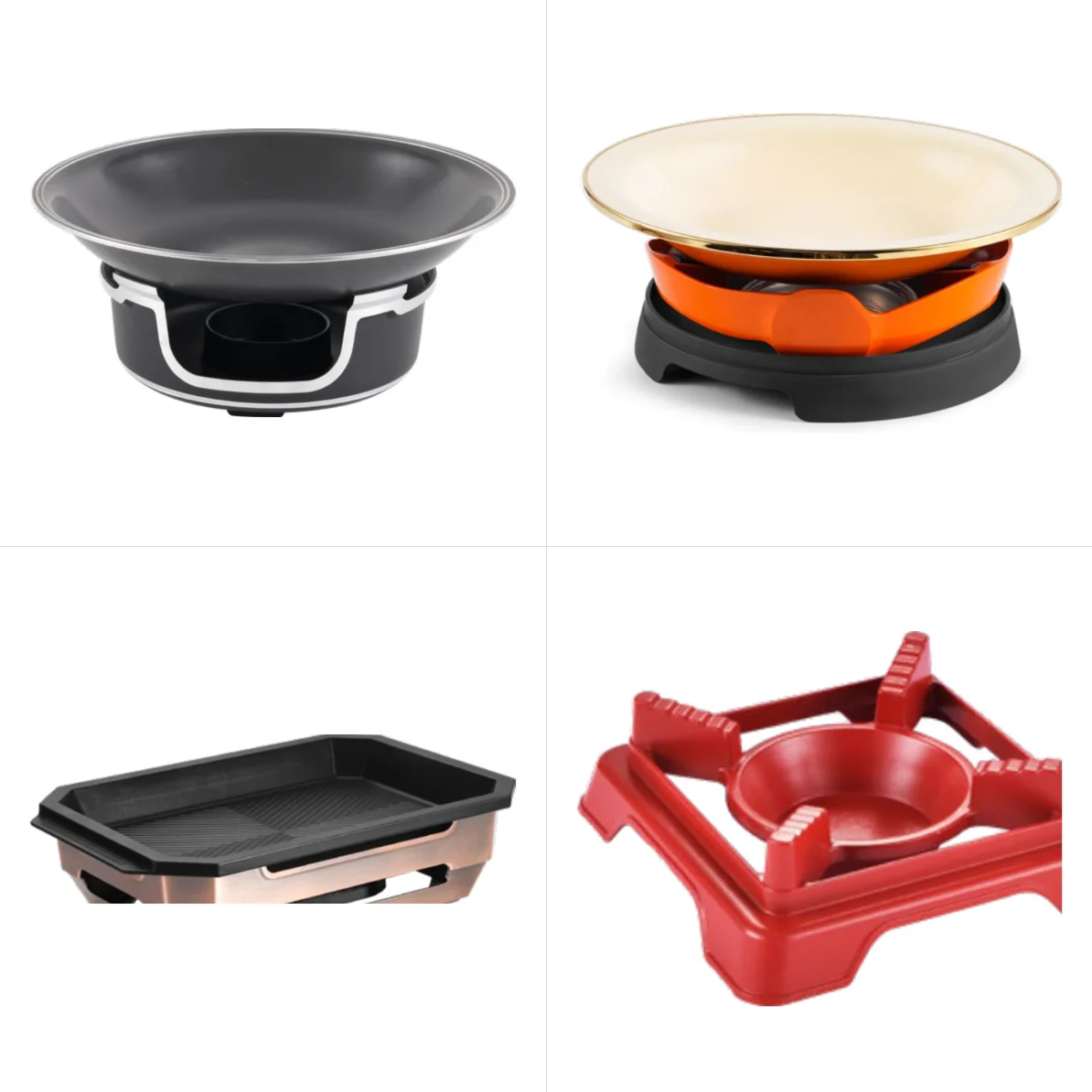
Hotel Cookware Heat Sources: Buying Pots That Match the Cooktop
A Pot Is Bought for a Cooktop, and the Specification Never Names One
Every other line in this catalogue is bought against a number. A glass is bought against a capacity, a tray against a footprint, a plate against a diameter. A pot is bought against something the catalogue does not print at all: the surface it will stand on. Read the specification table on any of the 65 rows in the cookware series and you will find the same three fields on every one of them — Product Size, Material, Packing Quantity — and not one of those three is a heat source.
That would be a minor omission if the rest of the page agreed to stay quiet about it. It does not. Eight of the sixty-five titles commit to a cooktop in the title itself. Two rows carry an induction band inside the size cell. The remaining fifty-five say nothing either way. A buyer who reads only the specification table therefore gets exactly zero information, and a buyer who reads only the titles gets an answer that is true for eight pots out of sixty-five.
This article puts the two together. It counts what the line actually claims, sets the claims against the fields, and works out what a kitchen has to state in writing if it wants a pot that will still be on the range in year three. Everything comes off the live pages: the cookware series, its seven sub-categories, and the full product shelf behind them.
Three Fields on Sixty-Five Rows, and None of Them Is a Cooktop
Start with what the specification tables can actually be asked. Across the whole cookware line the field census is unusually flat — flatter than any other range on the site:
| Field | Rows carrying it | What it settles |
|---|---|---|
| Product Size | 65 / 65 | The diameter ladder and, on some rows, the depth |
| Material | 65 / 65 | The body alloy and, on four rows, a coating |
| Packing Quantity | 65 / 65 | Cartons per model — the only freight figure anywhere on the line |
| Available Colors | 28 / 65 | Finish, and sometimes an accessory rather than a colour |
| Model Number | 16 / 65 | The factory code, where one is published |
| Capacity | 0 / 65 | Liquid volume — absent, as on the rest of the site |
| Carton Size | 0 / 65 | Freight volume — absent |
| Heat source | 0 / 65 | Not a field. Does not exist. |
Two of those zeros deserve a sentence each. Capacity is missing across most of the shelf, which is a known habit of this catalogue and one that a previous piece in this series took apart at length. Carton Size is missing from the cookware line specifically, which is a harder loss: without it you cannot compute pieces per cubic metre, so the one comparison that works on every other range on the site simply does not run here. A kitchen ordering pots has diameters and carton counts and nothing in three dimensions.
The third zero is the subject of this article. There is no heat-source field, which means there is no field in which a supplier could be asked to declare one, and no field a buyer could point at when the wrong pot arrives.
What the line does have, in place of a field, is a title. And the titles do make claims.
Eight Titles Promise Induction; Ten Pages Mention It at All
Count the word induction across the whole of the cookware line and it appears on ten of sixty-seven product pages. Eight of those ten put it in the product title, where it reads as a headline rather than a specification:
| Product | Where the word appears | What the table says instead |
|---|---|---|
| the 3828 grill pan | Title | 38 × 28 × 6 cm; aluminium alloy |
| the ribbed grill pan | Title | Dia. 29 / 33 / 37 cm; aluminium alloy |
| the seafood soup plate | Title | Medium 22 cm / large 26 cm / extra-large 32 cm |
| the side-handle wok | Title | Dia. 24 / 28 / 32 / 36 cm |
| the WMJ-01 wok | Title | Dia. 24 / 28 / 32 / 36 cm and 40 cm |
| the WMJ-02 soup pot | Title | Dia. 24 / 28 / 32 cm |
| the WMJ-02 side-handle version | Title | Dia. 24 / 26 / 28 / 30 / 32 cm |
| the WMJ-08 hot pot | Title | Dia. 32 / 34 cm and 36 / 38 cm |
| the oxidised WMJ-10 set | Size cell | Dia. 24 / 26 / 28 / 30 cm (open flame) and 32 / 34 / 36 cm (induction) |
| the sky-blue WMJ-10 set | Size cell | Dia. 24 / 26 / 28 / 30 cm (open flame) and 32 / 34 / 36 cm (induction) |
The last two rows are the only place on the entire line where a cooktop is recorded as data. They are also the only place where two cooktops are distinguished from each other: the the oxidised WMJ-10 set and its the sky-blue WMJ-10 set twin run four diameters for an open flame and three different diameters for induction, in one cell, separated by the word and. That is a real and useful distinction — it is exactly what a kitchen needs to know — and it is sitting in the size column because there is nowhere else for it to sit.
Nothing in the other eight rows is false. It is simply unverifiable from the page, which amounts to the same thing at the moment of ordering.
What the size cell can and cannot tell you
A diameter is not a compatibility statement. Two pots of identical diameter, made from the same alloy and packed in the same carton, can behave completely differently on an induction hob depending on the base construction — and the base construction is not a field either. The size cell tells you how wide the pot is. It tells you nothing about what happens when the field switches on.
This is why the eight titles matter more than they look. They are the only evidence on the page that somebody at the factory has considered the question. Treat them as a lead, not as a specification: they are strong enough to justify asking, and not strong enough to justify ordering without asking.
The Same Diameter Ladder Serves Two Different Kits
Set the titles aside and the size column turns out to be highly patterned. Pool every diameter that appears in a Product Size field across the line and the ladder is short and crowded, with three rungs carrying most of the traffic:
| Diameter | Rows quoting it | Ranges it appears in |
|---|---|---|
| 24 cm | 19 | Woks, soup pots, dry pots, casseroles, warmers |
| 28 cm | 20 | Woks, soup pots, casseroles, grill pans, plate sets |
| 32 cm | 23 | Woks, soup pots, hot pots, casseroles, warmers |
| 26 cm | 12 | Woks, soup pots, dry pots, hot pots |
| 30 cm | 13 | Woks, soup pots, dry pots, warmers |
| 34 cm | 11 | Dry pots, soup pots, hot pots, plate sets |
| 36 cm | 10 | Woks, hot pots, casseroles, plate sets |
| 40 cm | 8 | Frying pans, plate sets, woks |
| 22 cm | 4 | Seafood pot, dry-pot set, warmer |
| 27 cm | 7 | Warmers, dry pots |
Twenty-nine distinct numbers appear across the line once depths, plate rims and the inch-marked entries are counted, but the working range is narrow: 24, 28 and 32 cm account for 62 of the diameter mentions between them. A kitchen can standardise on those three and cover four of the seven sub-categories outright — the woks and frying pans, the soup pots and warmers, the dry pots and casseroles and the hot-pot and plate sets each publish all three diameters. the grill pans and tabletop grills stops at 28 cm and the the chafing stoves and warmers range, which is not really a pot range, publishes 28 cm on its own.
Which raises the trap this article exists to name. A shared ladder looks like interchangeability, and it is not. The rungs are shared because the moulds are shared; the cooktops the finished pots will meet are not shared and never were. If a hotel is running induction in the hot kitchen and gas in the banquet hall — which is the ordinary arrangement, not an exotic one — then the pots drawn from the same diameter column are going to two different places, and nothing on the page distinguishes them.
Where the ladder is not a ladder at all
Two entries show how loosely the size field is being used. the WMJ-01 wok is written as Dia. 24 / 28 / 32 / 36 cm and 40 cm — the first four numbers share the cm unit and the fifth carries its own, so a reader scanning for units meets an inconsistency in a cell that is otherwise a clean ladder. the harvest plate set goes further and mixes two unit systems in one line: Plate rim dia. 9 / 10 in (23 / 25 cm) and 11 in (28 cm). The conversions are close but not exact — nine inches is 22.86 cm, ten is 25.40, eleven is 27.94 — so the parenthetical figures are trade roundings, not measurements. They are the only two rows on the line where a buyer has to do arithmetic before comparing.
Five size cells with no number in them at all
Five rows fill the size field with a description instead of a dimension: the drawer-type stove, the pull-free stove and the eco oil stove all read Standard tabletop chafing footprint; the interchangeable mini pots reads Assorted diameters to suit the warmer range; and the WMJ-05-12 volcano stove reads Compact tabletop footprint. All five are stoves or accessories, where the interesting dimension is the one that matches a pot rather than the one that measures the shell. The wording is honest and it is also unusable for a purchase order: there is no number in it to write down. For those five, ask for a drawing.
Two Model Numbers, Four Products, and a Blank Where a Code Should Be
Cookware is the line where this catalogue is most generous with model numbers — sixteen of sixty-seven rows carry a factory code, against none at all on some other ranges — and it is also where the codes are least reliable.
| Model number | Products carrying it | What distinguishes them |
|---|---|---|
| WMJ-10 | Two pages | Oxidised finish and sky blue; identical sizes, identical packing of 12 pcs/carton |
| WMJ-02 | Two pages | the WMJ-02 soup pot at 24 / 28 / 32 cm and the WMJ-02 side-handle version at 24 / 26 / 28 / 30 / 32 cm — different ladders under one code |
| WMJ-05 | Three pages | The wooden-frame stove, the Tang stove and the volcano stove, sharing a stem |
| WMJ-02-A | One page | the WMJ-02-A lacquer pot — a lacquer finish entering the WMJ-02 family |
A shared number between two colourways of one physical pot, which is what WMJ-10 is, causes no trouble: the two pages differ only in finish and a buyer ordering either gets the size they asked for. A shared number between two different diameter ladders, which is what WMJ-02 is, is a different proposition. Write WMJ-02 on a purchase order and the reply can legitimately be either the three-diameter pot or the five-diameter pot. The fix is trivial and worth doing on every order of this line: quote the number and the diameter together, and never the number alone.
The other side of this is the blank. Fifty-one of the sixty-seven rows publish no model number, and a good number of those are one-off pieces — the Athens seafood pot, the European soup pot, the banquet soup warmer, the Kunpeng soup warmer, the Jinxiu dry pot — whose only identifier is a long descriptive title. On those pages the honest way to specify is by title plus diameter plus carton count, which happens to be three of the four fields the table actually gives you.
Sixty Cartons or Four: the Freight Question the Line Cannot Answer
Because Carton Size is absent from all sixty-five rows, freight has to be run off the packing count alone. That number is at least published everywhere, and its spread is wide enough to change a shipment:
| Packing Quantity | Examples | Why the difference exists |
|---|---|---|
| 4 sets / carton | the deep-and-shallow pan set | Two pans per set, packed as a set rather than as pieces |
| 8 pcs / carton | the TCFS-20-JG fish grill · the TCFS-20ZP rack set · the Yuanbao tabletop grill | Long or wide bodies that will not stack deep |
| 10 pcs / carton | the deep grill pan · the shallow grill pan · the lamb-rack grill · the seafood grill platter | The single most common packing on the line — 19 rows |
| 12 pcs / carton | the cassette grill set · the China-red casserole · the oxidised WMJ-10 set · the enamel dry pot | The second most common — 11 rows; casseroles and grill sets |
| 30 pcs / carton | the TCFS-20XF dry pot · the WMJ-04 dry pot · the Athens seafood pot | Dry pots and shallow pots, which nest — 9 rows |
| 60 pcs / carton | the antique-style alcohol stove · the ultra-slim round stove · the ultra-slim square stove | Flat stoves, which stack without limit — 3 rows |
| 120 pcs / carton | the WMJ-05-12 volcano stove | The smallest shell in the whole line, and the only row at this count |
Four to one hundred and twenty is a thirty-fold spread in the packing column, and it is carried entirely by the shape of the object. A flat stove is a disc, so sixty fit where ten grill pans will not. That much is intuitive. What is not intuitive is that a kitchen standardising on one supplier, one alloy and one diameter ladder can still find its freight cost varying by an order of magnitude across the order — and with no carton dimension published, the only way to find out how much of a container the shipment will take is to ask for the carton measurements separately.
Two counts hold more than half the line between them: nineteen rows pack at ten pieces and eleven at twelve, so thirty of the sixty-five products ship in cartons of a size a single person lifts. The long tail at the top is where the planning happens. Ask for them as a table, in centimetres, per model. Without them the line cannot be compared to anything, and the usual fallback — comparing list prices — compares the wrong thing.
What to Put in Writing Before the Pots Are Ordered
Given a line with no heat-source field, the order document has to carry what the catalogue does not. These are the clauses that do the work; the first three are the ones that get omitted, and the first is the one that matters most.
- Name the cooktop, not just the pot. Induction, open flame, electric ceramic, or a mix — and if it is a mix, say which models go where. A single line listing every hob in the building is the most useful thing a buyer can send.
- Ask for the base construction in writing. The alloy is published on all sixty-five rows and the base is published on none. If the pot is going onto induction, ask what the base is made of and how it is bonded, and get the answer as a document rather than as a reply in a chat thread.
- State the diameter and the model number together. Where a code is shared between two ladders, as WMJ-02 is, the number alone is ambiguous and the diameter alone is not specific enough to order.
- Quote the carton count per model. It is published everywhere and it is the only freight figure that exists on this line.
- Ask for carton dimensions as a separate table. They are not on the pages and there is no way to derive them.
- Confirm the accessory, where there is one. Several rows list a lid, a steamer or a stand as optional and record it in the colour field — the WMJ-08 hot pot reads Lid optional; standard version without lid, and the lamb-rack grill reads Wooden base optional. An optional accessory in a colour column is easy to miss and expensive to discover on arrival.
- Set the quantity against the carton, not the pot. With a minimum order of 500 pieces per model and packing counts running from 4 to 120, the same minimum is anywhere from five cartons to a pallet and then some. Work out which before the price is compared.
Reading the Range by What the Heat Has to Do
There is a second way to read this line that does not depend on the missing field, and for a hotel it is often the more useful one. Sort the seven sub-categories by what the heat is for, rather than by what the pot is shaped like:
| Job | Sub-category | Typical range | What the buyer has to settle |
|---|---|---|---|
| Searing and grilling | the grill pans and tabletop grills | 15 pages | Tabletop grills and fish grills; several are sets with a cassette or a rack |
| Frying and tossing | the woks and frying pans | 8 pages | Handle material is the variable — iron, steel, wood or a side handle |
| Slow cooking and braising | the dry pots and casseroles | 8 pages | Enamelled or bare alloy; plate-and-base sets pack separately |
| Soup and holding | the soup pots and warmers | 7 pages | Diameter ladder is the widest on the line; several accept a steamer |
| Table service and hot pot | the hot-pot and plate sets | 14 pages | Plate sets and warmers travel as two cartons at different counts |
| Heat under the food, not around it | the chafing stoves and warmers | 13 pages | Alcohol, oil or gel; where the burner lives is often the whole product |
| Everything that is not a pot | the trays and mats | 2 pages | Mats and accessories, sold to complete an order rather than to start one |
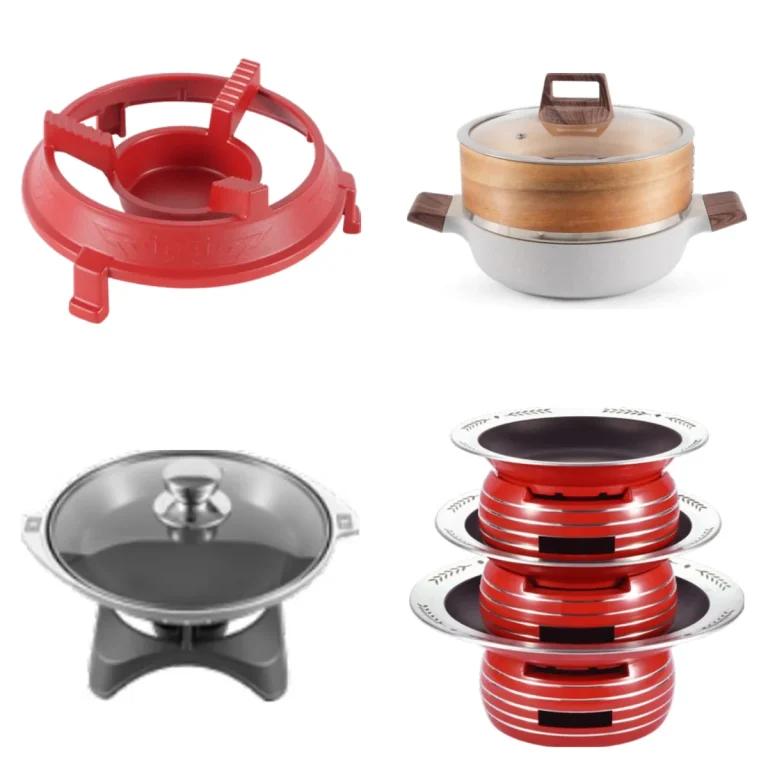
The sixth row is the one worth pausing on. Thirteen products in the chafing stoves and warmers are not cookware in the usual sense at all — they are the thing that makes something else hot: alcohol stoves, oil stoves, warming stoves and the bases that go under them. For those, the interesting question is not which hob they suit, because they are the hob. It is what fuel they take and how much of it, and that question is not a field either. the antique-style alcohol stove, the Japanese-style alcohol stove and the flat stoves around them publish a footprint and a carton count and leave the burner unstated.
Where the two halves of the range have to meet
A banquet operation ends up running both halves at once. The pots in the soup pots and warmers and the dry pots and casseroles go on the range; the warmers in the hot-pot and plate sets and the stoves in the chafing stoves and warmers hold the same food at the table. The join between them is a diameter, and it is the one join the line does handle properly: the line-texture warmer base reads To suit 24 / 27 / 32 cm warmers, which is a compatibility statement written as a size, and it is exactly what the rest of the line is missing. the Hantao warming stove and the classic line-texture warmer set publish the same 24 / 27 / 32 cm set. If every other row on this line stated its cooktop the way these rows state their diameter, the article you are reading would not need to exist.
A Worked Order: Induction Kitchen, Gas Banquet Hall
Here is the exercise in full, because it shows how much of the work happens off the page. Take a hotel with an induction hob in the hot kitchen and a gas range in the banquet hall, ordering across four sub-categories. The right-hand column is what the catalogue supplies; the middle column is what has to come from somewhere else.
| What is wanted | What the page gives | What has to be asked |
|---|---|---|
| A 32 cm wok for the induction hob | the WMJ-01 wok at 24 / 28 / 32 / 36 cm and 40 cm | Which of the five diameters is induction-rated, and the base construction |
| A 28 cm soup pot for the gas range | the WMJ-02 soup pot at 24 / 28 / 32 cm | Whether the same code covers a gas-suitable pot |
| A casserole for both | the oxidised WMJ-10 set at 24 / 26 / 28 / 30 cm (open flame) and 32 / 34 / 36 cm (induction) | Nothing — this is the one row that is complete |
| A grill pan for the induction hob | the ribbed grill pan at Dia. 29 / 33 / 37 cm | Whether all three diameters share the same base |
| A fish grill for the gas range | the TCFS-20-JG fish grill at 35 × 24 × 4.5 cm (small) / 39 × 26 × 4.5 cm (large) | Whether the code covers both sizes or only one |
| A warmer base to hold a 32 cm pot | the line-texture warmer base | Nothing on diameter; fuel type is still unstated |
| Carton planning for the whole order | Four packing counts between 8 and 30 pcs | Carton dimensions, which do not exist on the line |
Seven lines, one of which is fully answered by the page. That ratio is not a criticism of the pots, which are ordinary commercial aluminium and are sold that way across the industry. It is a criticism of the habit of treating a specification table as if it were a specification. The table is a parts list. The specification is the conversation you have before the order.
Where the Cookware Line Sits in the Rest of the Catalogue
This is the second piece in the series about the cookware side of the business, and the only one so far that treats the range as a heating problem rather than a serving problem. The earlier the cookware survey counted its way through the same sixty-five rows from the shape end and found the packing counts, the duplicated field values and the aluminium monoculture. That piece and this one are designed to be read as a pair: one tells you what is on the shelf, this one tells you what the shelf will not answer.
The rest of the series stays on the drinkware side, where the fields behave differently. the materials comparison covers resin choice; wine glasses, champagne glasses and beer glasses take the three stemware and glass families one at a time; cups and tumblers and handled pitchers work through the cup and jug ranges; bowls and plates handles the plates and bowls; and the three-range comparison puts three of them side by side on a single order. Where the task in hand is the drinks list rather than the shelf, serving sizes for a beverage list runs the same discipline over serving sizes. the cutlery and tableware series sits alongside the cookware line as the other externally sourced range, and the same rule applies there: quote the code and the size together.
On paperwork, the useful habit is to quote the reference number rather than the brand. Two certificates sit behind these ranges: SGS for food-contact testing and RoHS for material compliance. Their worth is that each carries a number, and a number is what lets you attach a document to a particular consignment. Two limits are worth saying out loud at the quoting stage. A test report is not an import permit, so the destination market belongs in the same message. And it says nothing about which hob a pot suits — that is a separate question with a separate answer, and it has to be asked of the factory directly.
Are these cookware products suitable for induction hobs?
Some are described as induction-ready in the product title, and two pages record an induction diameter band inside the size field. The specification tables themselves carry no heat-source field at all, so the page is a starting point rather than a confirmation. Tell the supplier which hob the pot is going onto and ask for the base construction in writing before the order is placed.
Why is there no heat source listed on the specification table?
It is not a field on this range. The tables publish Product Size, Material and Packing Quantity on all 65 rows, plus Available Colors on 28 and Model Number on 16. Everything else — capacity, carton size, base construction and heat source — is absent. The one row that does record a cooktop writes it inside the size cell, where it is easy to overlook.
Can I get carton dimensions for the cookware range?
Not from the product pages, because Carton Size is empty on all 65 rows. Packing Quantity is published everywhere and runs from 4 sets per carton to 120 pieces per carton, so it is possible to work out how many cartons an order needs without knowing how large each one is. Ask for a centimetre table per model if freight is being planned.
Two different pots share the model number WMJ-02. Which one am I ordering?
Both are real, and they are not the same pot. One publishes a 24 / 28 / 32 cm ladder and the other a 24 / 26 / 28 / 30 / 32 cm ladder. Write the model number and the diameter together on the order and there is no ambiguity. The same advice applies wherever a code is shared between colourways, as WMJ-10 is.
Do these pots come with lids, steamers or stands?
Sometimes, and the page records it in the colour field rather than anywhere more obvious. A hot pot lists a lid as optional, a soup pot lists a steamer, and a grill platter lists a wooden base — all three under Available Colors. If the accessory matters, quote it explicitly on the order instead of assuming it travels with the pot.
What to Send With the Enquiry
A first message about cookware is useful when it carries the four things this line cannot answer for itself: the cooktop each pot will meet, the base construction you are asking to be confirmed, the diameter alongside the model number, and the carton dimensions. Everything else — alloy, sizes, packing counts, finishes — is already on the pages and can be quoted straight back. A first enquiry begins at the contact page, and how the range is put together covers how the range is put together. Goods from stock move in one to two weeks; anything requiring a fresh mould should be planned against a month.