Sixteen Ounces Is 480 Millilitres: Whose Measure Is on the Page
A buyer in Manchester sends an enquiry for a sixteen-ounce beer glass. A buyer in Singapore sends one for five hundred millilitres. Both believe they have described the same object, and both are right only if the supplier is reading the same ounce they are. Sixteen US fluid ounces is 473 millilitres. Sixteen ounces at the thirty-millilitre convention that bars use is 480. And the most common figure on a drinkware page — 500 — is neither: it is 16.9 ounces, five and a half per cent larger than the number the enquiry asked for.
None of that is a trick. It is what happens when a capacity figure travels between three languages that all call themselves ounces, and between two ways of counting what is in a glass: the volume the vessel holds when it is full to the rim, and the volume a guest is actually served. The first is a property of the mould. The second is a property of the drink. Only one of them appears in a catalogue, and it is usually the first.
This piece sorts the two apart. Every figure below comes from this catalogue’s own product rows, read one at a time: 665 models, of which 187 carry a capacity figure at all.
Two Offers That Look Identical
Put three glasses side by side on a bench and fill them to the brim: one at 473 ml, one at 480, one at 500. They are within a thumbnail of each other. Now pour a 473 ml serve into each, which is what a kitchen does when the recipe card says sixteen ounces.
The first is full to the rim and impossible to carry. The second has 7 ml of headroom, which reads as a full glass. The third has 27 ml of headroom, which reads as a glass that has been sitting on the pass for a minute. Same drink, same cost, three different impressions — and the only thing that changed is which ounce the specification was written in.
| What the paper says | Millilitres | Headroom over a 473 ml serve |
|---|---|---|
| 16 US fl oz | 473 | 0 ml — full to the rim |
| 16 oz, bar convention | 480 | 7 ml — reads as full |
| Half a litre | 500 | 27 ml — reads as short |
The 500 ml figure is not a mistake, and it is the right size for a European half-litre serve and for a soft drink with ice. It is simply a different promise. When two quotations are compared on the words “16 oz” while one side is quoting 480 and the other 500, the 22 ml difference is invisible on the page and permanent in the dining room.
What the Fifty-Two Numbers Are Built From
Of 665 product rows, 187 publish a capacity. One hundred and eighty-six are in millilitres; the single exception, a two-litre jug, is the only row on the site that breaks the unit and writes 2.0 L. Those 186 rows use 52 distinct values between 50 ml and 2000 ml — a spread wide enough that the numbers are clearly not a single ladder but three, laid on top of each other.
The first ladder is an ounce grid. Twenty-two values, 66 rows, and every one of them is an exact multiple of thirty: 90, 120, 150, 180, 210, 270, 300, 330, 390, 420, 450, 480, 510, 570, 600, 630, 750, 900, 1200, 1350, 1500, 1800. Divide each by thirty and a whole number of ounces falls out. Compared with the true US fluid ounce of 29.5735 ml, every one of those 66 rows sits 1.44 per cent large — which is exactly the error you get when an ounce is treated as thirty millilitres, as it is behind most bars.
| On the page | Ounces at 30 ml | True 16 oz would be | Rows |
|---|---|---|---|
| 300 ml | 10 | 295.7 ml | 7 |
| 420 ml | 14 | 414.0 ml | 3 |
| 480 ml | 16 | 473.2 ml | 1 |
| 600 ml | 20 | 591.5 ml | 5 |
| 1500 ml | 50 | 1478.7 ml | 13 |
The second ladder is the metric one, and it is the bigger of the two: eighteen values and 101 rows in steps of fifty, from 50 ml upwards, with 1100, 1500 and 2000 among the heaviest hitters on the site. These are volumes chosen as round litres and half-litres rather than as round ounces, which is why the same 500 ml glass is comfortable for a half-litre of lager and disappointing for a sixteen-ounce pour.
The third is a residue: twelve values and nineteen rows in plain tens that belong to neither grid — 140, 170, 220, 230, 280, 310, 320, 340, 370, 380, 410, 580. These are what a capacity looks like when it has been measured off a mould rather than specified for a menu. They are not wrong; nobody designed them to be round.
Read together, the three ladders say something useful about how to compare a quotation with a page. A figure that divides by thirty is an imperial figure wearing metric clothes. A figure that divides by fifty is a metric figure. A figure that divides by neither is an engineering figure. Two suppliers quoting “500 ml” are comparable. One quoting 480 and one quoting 500 are not, even though the difference is one word.
Beer Is the Only Drink Where the Glass Is the Measure
For every other drink the vessel is a container. For beer in a pub it is the legal quantity: a customer orders a pint, not a glass. That makes the imperial pint — 568.26 ml — the single most consequential number in this catalogue’s beer line, and it is the one number the line does not contain.
The beer glass shelf runs thirteen models, and all thirteen publish a capacity. The ladder reads 250, 420, 420, 500, 500, 500, 550, 550, 580, 600, 600, 750, 1000. Four of those sizes stand within 20 ml of a pint. None of them is a pint.
| Capacity | Of a 568.26 ml pint | What it actually serves |
|---|---|---|
| 500 ml | 0.880 | Twelve per cent short — a half-litre, not a pint |
| 550 ml | 0.968 | 18 ml short; usable only as a short pour |
| 570 ml | 1.003 | A pint to the rim, with nowhere for the head to go |
| 580 ml | 1.021 | 12 ml of head — about a centimetre on this diameter |
| 600 ml | 1.056 | A pint plus 32 ml — the first size that pours properly |
The arithmetic of head is where this becomes practical. A pint drawn with a decent collar needs somewhere between twenty and forty millilitres above the liquid line, and rather more on a wide rim. The 580 ml model leaves twelve; the 600 ml models leave thirty-two, which is the difference between a glass that photographs well and one that survives a busy bar. The 570 ml octagonal tumbler sits exactly on the pint and is the right vessel for a table-served beer or a cider where the head is not the point.
The same logic runs the other way at the small end. A 330 ml bottle poured into a 330 ml glass is a pour with no collar at all, which is why the bar line’s 330 ml cup is paired in practice with a 350 or a 370. The 250 ml glass is a half, not a beer.
With Wine the Bottle Is the Measure and the Glass Is Only a Vessel
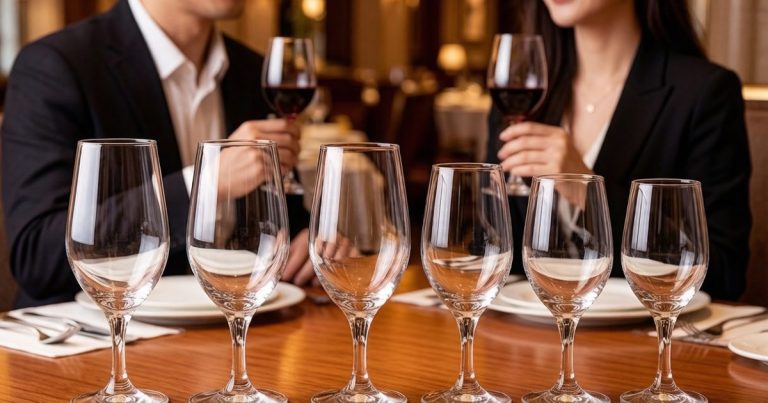
Wine reverses the relationship. Nobody orders “a 175”; they order a glass, and the house decides how much goes in it. The bottle is the fixed unit, the glass is chosen for the nose and the hand, and the two numbers are deliberately unrelated.
A standard 750 ml bottle is the whole arithmetic. At a 125 ml pour it gives six glasses exactly. At 150 it gives five exactly. At the 175 ml measure that most European wine lists now use, it gives 4.29 — which is to say four full glasses and a fifth that is 50 ml short. Three bottles at 175 ml yield 12.86 serves, so the twelfth glass of the evening is a 150.
| Pour | Glasses per 750 ml | Three bottles give |
|---|---|---|
| 125 ml | 6.00 | 18 clean pours |
| 150 ml | 5.00 | 15 clean pours |
| 175 ml | 4.29 | 12 pours, then a 150 |
| 200 ml | 3.75 | 11 pours, then a 150 |
| 250 ml | 3.00 | 9 clean pours |
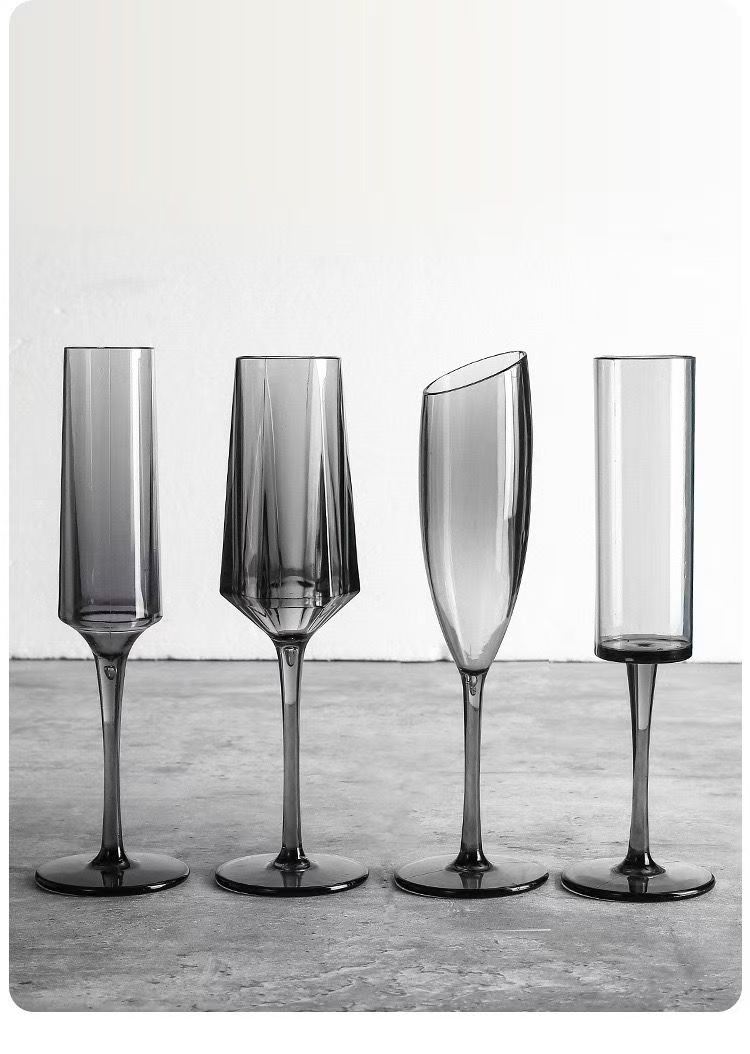
Because the bottle is fixed, the glass is free to be big. The stemware shelf publishes twelve capacities across thirty-five models, and the ones it publishes run 140, 150, 170, 250, 280, 330, 380, 550, 600 and 630 ml. A 125 ml pour in the 630 ml bowl fills a fifth of it, which is not a short measure but a decision about where the wine meets air. A 175 ml pour in the 250 ml glass fills seventy per cent of it, which is a different decision about a different list.
The practical consequence is that a wine glass cannot be bought from the pour alone. The pour sets the bottle yield and the margin; the bowl sets the service style; and the only number that connects them is the ratio, which no page prints. Ask for the ratio and you will get a sensible answer. Ask for “a 175 ml glass” and you will get a glass whose capacity happens to be 175, which is a tumbler.
Soft Drinks: the Can Is the Measure and the Ice Takes Its Share
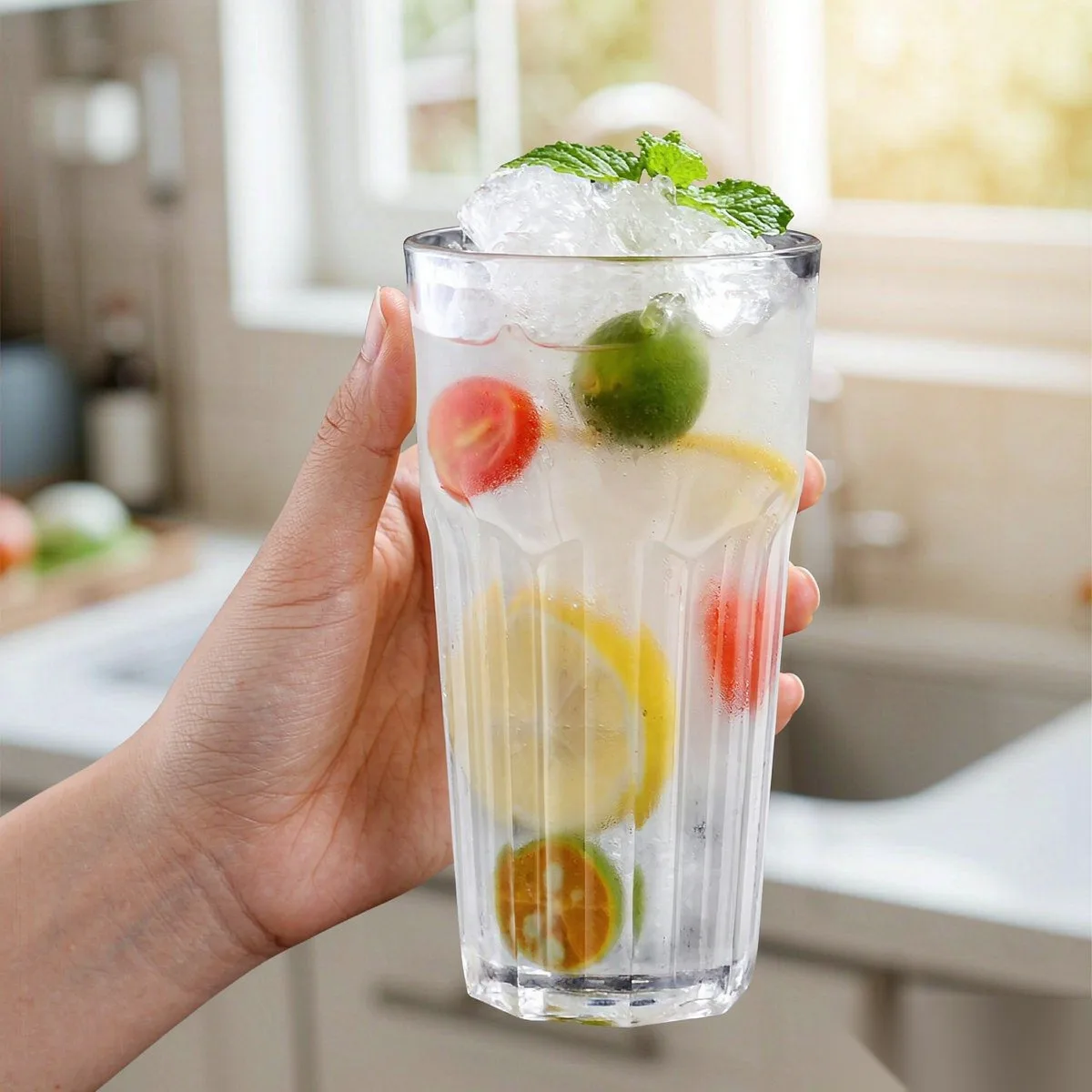
Between the fixed measures of beer and wine sits the drink that causes most of the reordering in a hotel: the soft drink, the juice, the iced tea, the cocktail. Here the drink arrives in a can or a bottle of known volume, and the glass has to absorb that volume plus the ice plus a little air, and still look generous.
The arithmetic is not difficult, but it is rarely done. A three-centimetre ice cube displaces twenty-seven millilitres; four of them displace a little over a hundred once they settle below the line. A glass filled to eighty per cent of its capacity is the usual working fill in a bar — higher for a highball, lower for anything carried across a room.
- A 500 ml tumbler works out at 400 ml of working fill. A 330 ml can plus three cubes needs 405. It fits, barely, and it spills on the way to the terrace.
- A 600 ml glass gives 480 ml of working fill. The same can plus four cubes takes 430, which leaves fifty millilitres of air and a drink that can be carried.
- A 330 ml glass filled with the can that matches it has no room for ice at all. It is a glass for a bottle served cold, not for a mixed drink.
This is where the half-litre ladder earns its place. 500 ml is the smallest size that can take a standard can with ice, and it is why that figure appears on nine rows across four different shapes. It is also why the same number turns up on a 500 ml jug and on a 500 ml textured tumbler that serve completely different purposes: the number is a working envelope, not a description.
Spirits: the Measure Is Twenty-Five Millilitres, and the Page Says Nothing
A litre of spirit at a 25 ml measure is forty drinks. At 35 ml it is 28.6. At a 50 ml double it is twenty. The range between the smallest and the largest legal measure on the same bottle is a factor of two, and it is decided by the glass only in the sense that the glass has to be big enough to hold the measure plus a mixer plus ice.
Which makes the shot glass the strangest category on the site. Two models, and neither publishes a capacity. The smaller gives a size of Φ2.8 × 6 cm and the pair gives 4.5 × 7.5 cm and 4 × 6.4 cm. A 25 ml spirit measure is the one thing a shot glass exists to hold, and it is the one thing the row leaves out — while the smallest published capacity on the whole site, 50 ml, belongs to a bar and milk-tea cup rather than to the spirit line.
The rest of the bar shelf is better documented than the name suggests. The twenty-four bar and milk-tea cups all publish a capacity, from 50 to 500 ml, and the octagonal family publishes all eight, from 90 to 570. The same body is sold as a mouthwash cup at 250 ml, where the number that matters is the top and bottom diameter rather than the volume, because it has to sit in a bracket. One shape, three uses, and the useful figure changes with the use.
Where the Number Is Complete, and Where It Is Missing
Capacity coverage across the catalogue is not uniform, and the pattern is worth knowing before two lines are compared on the basis of what their pages say.
| Shelf | Rows with a capacity |
|---|---|
| Beer glass | 13 of 13 |
| Bar and milk-tea cups | 24 of 24 |
| Octagonal glasses | 8 of 8 |
| Full-handle premium jugs | 33 of 34 |
| Juice and water jugs | 17 of 19 |
| Champagne and wine glasses | 12 of 35 |
| Decanters | 6 of 12 |
| Oil and vinegar bottles | 0 of 17 |
| Sugar bowls | 0 of 8 |
| Shot glasses | 0 of 2 |
| Ice buckets | 0 of 2 |
| Cutlery | 0 of 162 |
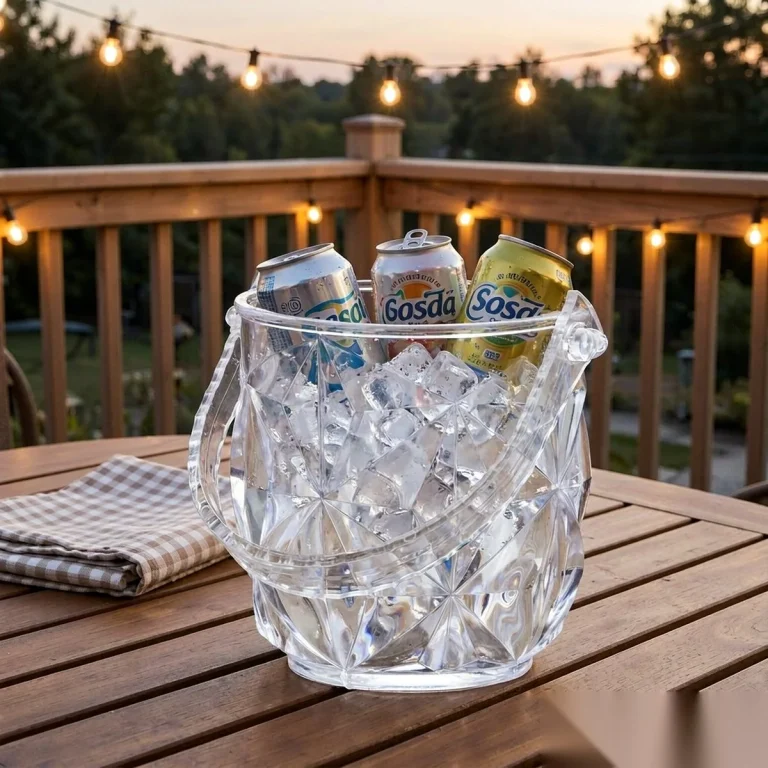
Two things follow. First, the count of 187 out of 665 is not a quality score; it is mostly a statement about which lines were built to a menu and which were built to a drawing. Second, a category can be perfectly documented and still not answer the question you brought. The sugar bowls publish a diameter and a height and nothing else, which is the right pair for a lid clearance and the wrong pair for how many sachets fit; the ice buckets publish a diameter and a height and no volume, which is what the scoops and the buckets have in common with the shot glasses.
There are also two rows that are documentation curiosities rather than choices. One squeezy-bottle page carries four capacities in a single field — 180, 300, 400 and 550 ml — because the four models share one page and no size field. And the only litre figure in the catalogue belongs to a 2.0 L jug, which is the largest vessel on the site and the one that needed a different unit.
One Line of the Enquiry, Rewritten
All of this collapses into a single habit: describe the drink the glass has to serve, and let the capacity follow. The same order placed two ways reads like this.
| Before | After |
|---|---|
| 500 ml beer glass, 500 pieces, FOB. | A glass that serves a 568 ml pint with a 30 ml collar: brim figure 600 ml, working fill around 480 ml, and the brim measured or calculated stated on the quotation. 500 pieces. |
The second version cannot be answered with the wrong glass, because it contains the measure being served, the head that has to fit above it, and the brim figure that will be checked on arrival. It also makes the unit explicit, which is the whole point: a supplier who is told “600 ml” will ship 600 ml, and a supplier who is told “a pint glass” will ship whichever of the three pint-adjacent sizes is in stock.
Three numbers are enough for most orders: what the drink measures, how much head or ice has to sit above it, and the brim figure you will accept. The pour-to-capacity ratio in wine, the quarter-litre of a soft drink and the twenty-five millilitres of a spirit are all versions of the same three.
If the glass has to fit something that already exists — a glasswasher rack, a store-room shelf, a carton count — send those dimensions with the capacity and the answer can be a specific model rather than a range. The menu-to-size mapping covers which band suits which list; this piece covers what the number in the band means.
Where a comparison is genuinely close, the catalogue’s own documentation becomes part of the comparison: a line that publishes a capacity on every row can be shortlisted on paper, and a line that does not has to be shortlisted on a sample. That is a difference in how much you can know before the container leaves, and it is worth asking about directly rather than inferring from the size of the catalogue.
Questions That Arrive With the First Sample
Is a 500 ml glass a pint?
No. An imperial pint is 568.26 ml, so a 500 ml glass is 0.88 of a pint — twelve per cent short. The nearest figures on this catalogue are 570 ml, which is a pint to the rim, and 600 ml, which is a pint with room for a collar. Serving a 500 ml glass as a pint is a conversation with a customer rather than a measurement.
Where does 480 ml come from when the trade says sixteen ounces?
Sixteen multiplied by thirty. Bars have long treated an ounce as thirty millilitres because it divides cleanly into 25 and 50 ml measures, and the error against the true US fluid ounce is 1.44 per cent. On this catalogue, 66 rows across 22 values sit on that grid, which is why 480 and 600 exist alongside 500 and 550.
Does the published capacity include the ice?
No. A capacity figure is the volume of the vessel, not the volume of the drink. Four three-centimetre cubes take a little over a hundred millilitres of it, and a bar working fill of eighty per cent takes another fifth before the ice is counted — which is why the same can needs a 600 ml glass to be comfortable and a 500 ml glass only to be possible.
How many glasses will one bottle of wine fill?
It depends entirely on the pour, and the arithmetic is exact at two of the five common measures: a 750 ml bottle gives six glasses at 125 ml and five at 150 ml. At 175 ml it gives 4.29, so four full glasses and a short fifth; at 250 ml, exactly three. Buy the glass for the pour you have already written on the list, not for the pour you might adopt later.
Which lines publish a capacity on every row?
Beer glasses, bar and milk-tea cups and octagonal glasses do; the jugs are close, at 33 of 34 and 17 of 19. The stemware line publishes twelve across thirty-five models and the shot glasses publish none, so a shortlist built only from what is written down will be biased towards the lines that document themselves most fully.