
The Glasswasher Counts Racks: Converting Pieces Into Hours at the Wash Station
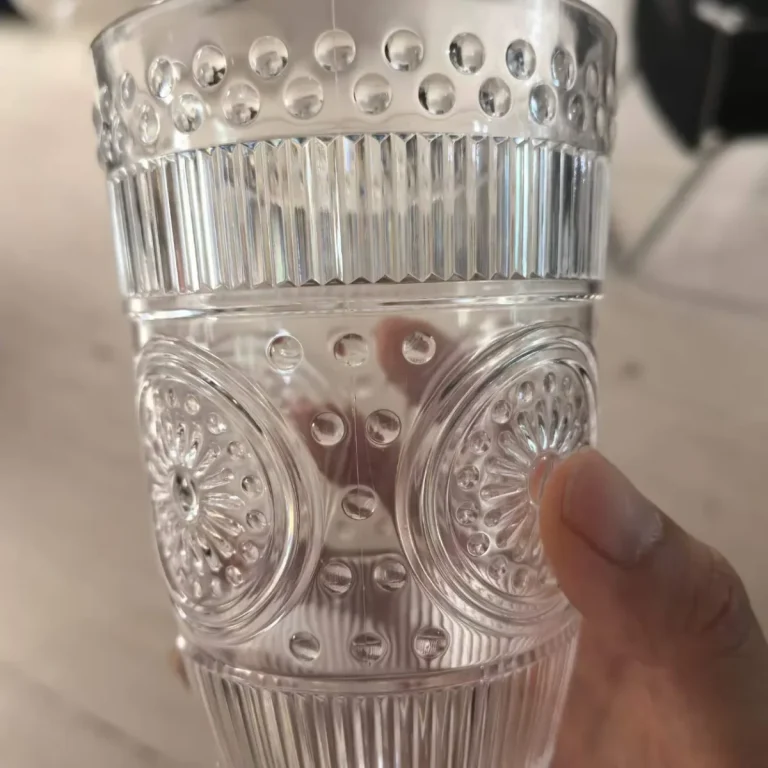
At ten past eleven on a Saturday night the last guest leaves, and nine hundred glasses are standing on every flat surface the banquet team could find. Nobody in the building is thinking about the order they placed four months earlier. They are thinking about the glasswash: one rack in, one rack out, two minutes at a time.
The figure that decides whether that kitchen is ready for Sunday breakfast is not how many glasses the hotel owns. It is how many the machine can return in an hour. That figure is printed nowhere, yet it follows directly from two numbers that appear on almost every cup in this catalogue — the width across the widest point and the height. What follows is that calculation, run across all hundred and seven pieces in the cup and tumbler range, with the assumptions stated rather than buried.
Three Counts, and the One Nobody Prints
A five-hundred-piece order lives in three separate arithmetic systems, and each of them belongs to a different room in the building.
- The buyer counts pieces. Five hundred is the unit of price, of deposit and of the invoice.
- The forwarder counts cartons. Pieces per carton turns into cubic metres, and cubic metres turn into money.
- The wash station counts racks. A rack is neither a piece nor a carton; it is whatever the machine can hold in one two-minute cycle.
The first two are on the page. Open any product and you will find a packing quantity and, on most models, a carton size. The third is absent — not because anyone is hiding it, but because the catalogue is written by people who sell glassware, and a rack belongs to a machine they did not sell you.
This gap is worth closing before you order, because only the rack figure moves while the hotel is open. A carton sits in a store room. A rack cycles all night.
What the Catalogue Says About Washing (Nothing)
All 665 product pages on this site were read for this article. The word rack appears twice: once in a bamboo rack set and once in a lamb rack grill. The word wash appears in exactly five titles, and all five are mouthwash cups. There is no wash temperature anywhere, no dishwasher statement, no rack specification, no cycle time.
What does exist, on the drinkware range, is geometry. Of the 107 cup pages, every single one carries a product size, 106 carry a packing quantity and 104 carry a carton size. So the machine-side question cannot be answered from the page at all, while the geometry-side question can be answered completely — for anyone willing to unpack the way those sizes are written.
Seven Ways to Write the Same Two Numbers
Those 107 size cells use seven different notations, and they disagree about which number comes first.
| Notation | Example on the page | Rows | What the first number is |
|---|---|---|---|
| Bare pair | 7.3 × 7.1 cm |
47 | diameter |
| D prefix | D8.9 × 12.7 cm |
25 | diameter |
| Phi prefix | Φ8.5 × 9 cm |
15 | outer diameter |
| Full letters | H16.7 × T11.3 × D11.3 × B8.1 cm |
8 | height |
| Height first | H23 × 4.5 × 7 cm |
7 | height |
| Top or bottom plus height | Top 4.5 × Bottom 7 × Height 24.3 cm |
4 | rim, with the base named separately |
| Digits plus a letter halfway through | 11.2 × 7.2 × H13 cm |
2 | diameter |
Read the wrong convention and the error is not cosmetic. Take BY-9915, whose cell reads H24.4 × 4.5 × 7.3 cm. The first number is a height, and the widest horizontal dimension is 7.3 cm. A dimension table imported into a spreadsheet will treat 24.4 as the diameter, and the difference between 7.3 cm and 24.4 cm is the difference between forty-nine items per rack and one.
The eight fully labelled rows are worse in a subtler way. H16.7 × T11.3 × D11.3 × B8.1 cm gives three horizontal figures — top, a “D” that repeats the top, and bottom. Only one of them has to clear the compartment, and the page does not say which. One row, BY-9342, reads 10.8 × H13 cm and cannot be parsed mechanically at all: a person reads it in a second, a spreadsheet cannot read it once.
This is not a complaint about housekeeping. It is a warning about automation. Any buyer who builds a wash-capacity model from a product export will be wrong on at least fifteen of these rows unless the letters are read first.
The Arithmetic, Written Out With Its Assumptions
Only one calculation is needed, and it is small enough to do on paper.
Take a rack floor of 40 × 40 cm, the common footprint of an under-counter machine. Allow one centimetre of air between items, so each item occupies a square of its own diameter plus one. The count per side is the rack width divided by that square, rounded down; the count per rack is that number squared. A two-minute cycle gives thirty cycles an hour, so items returned per hour are simply thirty times the rack count.
Run the same figure on a 50 × 50 cm floor and the counts rise by roughly half again. Every number in the next section is worth redoing with your own machine’s figures; what does not change is the ratio between one glass and another, because the rack width and the cycle time cancel out of a comparison.
One per Rack to Forty-Nine per Rack
Applied to the 106 parseable cups, the whole range collapses into seven rack sizes.
| Per 40 cm rack | Rows | Per 50 cm rack | Returned per hour at two minutes |
|---|---|---|---|
| 49 | 5 | 81 | 1,470 |
| 36 | 7 | 64 | 1,080 |
| 25 | 21 | 49 | 750 |
| 16 | 54 | 25 | 480 |
| 9 | 16 | 16 | 270 |
| 4 | 1 | 9 | 120 |
| 1 | 2 | 4 | 30 |
The two extremes are worth holding in the mind together. BY-6621 measures 4.4 cm across and stands 5.6 cm tall: a fifty-millilitre bar and milk tea cup — the rest of that family is covered in the bar cup guide — that returns forty-nine at a time. BY-9911A measures 24 cm across: a wide-bowled coupe from the champagne range that returns one. Both are polycarbonate, both are sold as unbreakable, and in the wash they are not the same kind of object at all.
The middle of the range is where most hotels live. Over half the catalogue — fifty-four of 106 rows — sits at sixteen per rack, which is the quiet default of commercial drinkware: a glass somewhere between seven and eight centimetres wide.
Same Volume, Four Times the Space
Capacity does not predict any of this. Group the range by published volume and the footprint spreads out inside each group.
| Published volume | Widths in that group | Per rack, narrowest to widest | Models |
|---|---|---|---|
| 150 ml | 6.0 · 7.0 · 9.4 cm | 25 → 9 | BY-6622 · BY-9917 · BY-9330C |
| 250 ml | 5.0 – 7.7 cm | 36 → 16 | BY-8019 · BY-9912E · BY-8058 |
| 300 ml | 7.3 · 11.5 · 12.5 cm | 16 → 4 | BY-8017 · BY-9330B · BY-9332 |
| 350 ml | 8.0 – 12.0 cm | 16 → 9 | BY-9330A · BY-9313S |
| 500 ml | 7.9 – 9.2 cm | 16 → 9 | BY-9338 · BY-8068 |
| 600 ml | 6.7 – 8.9 cm | 25 → 16 | BY-1748 · BY-8068 |
The three-hundred-millilitre row is the clearest case in the range. BY-8017 holds 300 ml in a body 7.3 cm across; BY-9332 holds the same 300 ml in a body 12.5 cm across and 17.5 cm tall. Same volume on the menu, four times the rack time. Nothing in the shop-front photograph prepares a buyer for that difference.
Anyone who has already worked through matching a menu to a capacity band will recognise the pattern from the other side: capacity is the buyer’s unit, geometry is the operator’s. Where the two collide, the operator pays. The tumbler guide deals with the shapes themselves; this piece follows only the two measurements that survive into the machine.
The Tall Ones Have to Lie Down
Diameter settles how many fit; height settles whether they can be inverted at all. Twenty-four of the 106 pieces stand 18 cm or taller, eight reach 24 cm, and the tallest — 9921b at 25.5 cm — is taller than many under-counter cabinets are deep.
The champagne guide treats bowl shape as a question of how long the bubbles last; at the wash station the bowl is simply a footprint, and a wide one. A rack that holds tumblers mouth-down over pegs will not take a 25 cm flute: the item has to lie flat, be stacked in a tall rack, or go through a separate wash route. Lying flat cuts the count per rack by more than half, because the footprint is no longer the rim but the whole length of the stem. This is the one place where a taller machine, not a better glass, solves the problem — and it is a machine purchase, so it belongs in the same conversation as the rack standard.
The practical instruction is to ask your machine supplier two things in writing before the order goes out: the internal clearance above the rack, and the usable footprint of the rack they supply. Those two figures, plus the width and height off our page, are enough to reproduce every number in this article for your own kitchen.
Nine Hundred Glasses After the Toast
Return to the Saturday night. Three hundred covers, three glasses each, nine hundred pieces to come back.
| Rack size | Racks for 900 | Machine time | What the room does meanwhile |
|---|---|---|---|
| 49 | 19 | 38 minutes | one operator, second machine free |
| 25 | 36 | 72 minutes | one operator, tight turnaround |
| 16 | 57 | 114 minutes | two operators, breakfast delayed |
| 9 | 100 | 200 minutes | a second shift, or hand washing |
These are machine times only. Counting, stacking, polishing and returning to the shelf all sit outside them, and the polishing step in particular is where a wide-bowled glass earns its reputation for slow work. But the comparison holds: the same banquet, the same nine hundred glasses, and two hours of difference between one glass choice and another.
This is also the point where the rack hour meets the stock figure. A par level sized from daily burn and wash turnaround assumes the machine can actually turn the stock over. If the rack returns 480 an hour and the banquet needs 900, the difference is covered by owning more glasses — or by choosing glasses that come back faster.
What Five Hundred Pieces Costs in Rack Time
The minimum order here is five hundred pieces per model, and that number turns into time as soon as the goods arrive, because the cheapest way to inspect a delivery is to run it through the machine that will wash it for the next five years.
At sixteen per rack, five hundred pieces is thirty-two racks and sixty-four minutes of machine time. At forty-nine per rack it is eleven racks and twenty-two minutes. One of those inspections fits into a morning; the other needs the machine emptied first. Both are five hundred pieces, and the difference is entirely geometric.
The same arithmetic explains a common misunderstanding about storage. Cartons are counted by cubic space on a shelf, and a dense cup packs beautifully into a small carton. But a small carton does not imply a small rack load: BY-6621 ships two hundred pieces to a carton and returns forty-nine to a rack, while a wide coupe can ship seventy-two to a carton and return one.
Two Lists: For the Machine, For the Order
Everything above reduces to two short lists, and they travel to two different suppliers.
Ask the machine supplier for: the internal clearance above the rack; the footprint of the rack they supply, in centimetres; the cycle length in minutes, rinse included. Nothing else on the specification sheet changes the arithmetic.
Write on the order: the resin, by name; the widest horizontal dimension, in centimetres, and which measurement that is; the height; and the colour if colour matters to the venue. On the drinkware range the colour field is populated on only eight of the 107 cup pages, so a venue that standardises on a tint is relying on a line that is usually blank — worth saying in writing rather than assuming.
Two documents travel with these goods: an SGS food-contact test report and a RoHS statement, each carrying its own reference number so a buyer can trace precisely what was tested. Neither of them describes behaviour inside a wash cabinet, and no supplier’s certificate will, because the cabinet is not part of the supply chain. That is why the four lines above belong on the order rather than in a brochure.
Send the rack standard and the model numbers under consideration to our sales desk and the figures will be run for your own machine; more about the works and the range sits on the company page. Tooling is cut and run at our works in Yongkang, Zhejiang; containers leave through Ningbo and Shanghai. A standard model leaves in seven to fifteen days and a run that needs new moulding runs closer to thirty, which matters here for one reason: if the rack arithmetic forces a change of model, the change costs a production slot, not a shelf swap.
Questions Buyers Ask About Rack Capacity
How many hotel glasses fit in a forty-centimetre rack?
Between one and forty-nine, across this range, on a one-centimetre gap and a two-minute cycle. Sixteen is the most common answer, covering more than half the cups we make.
Does a wider glass always mean fewer per rack?
Yes, and faster than intuition suggests, because the count falls with the square of the width. Moving from 7.3 cm to 12.5 cm does not lose a third of the load; it loses three quarters of it.
Does any page give a wash temperature?
Because it belongs to the machine and the operator, not to the glassware. What the page can give you is geometry, and geometry is the half of the calculation you cannot measure once the goods are in a container.
Can tall champagne flutes go through a rack?
Not inverted over pegs. Above roughly 18 cm the item usually lies flat or needs a tall rack, and either route reduces the count per rack. Check the cabinet clearance before choosing a 25 cm stem.
What single line protects the calculation?
The widest horizontal dimension, written in centimetres and labelled, on the order and on the packing list. Without a label, the seven notations in this catalogue will be read seven different ways by seven different people.
All 49 buyer guides, grouped by product family, are indexed on the guides page.