Embossed & Patterned Drinkware for Hotels: How Moulded Relief Changes Durability, Grip and Wash Cycles
Ask two suppliers for “a patterned tumbler” and you will get two objects that
photograph almost identically and behave nothing alike in service. The difference is not the design
language and it is not the resin. It is what the relief does to the wall.
Every raised or recessed pattern on an injection-moulded cup is a local change in wall thickness.
A beaded band is a ring of thicker material. A rosette is a thickened disc. A flute is a thin rib. Those
local variations decide how the cup flexes when it is dropped, how much purchase a wet hand gets on it,
how it nests on a shelf, where water pools after washing, and which part of the vessel gives first after
a season of commercial use. Buying patterned drinkware is therefore a structural decision dressed up as
a design decision — and this guide reads the structure.
It is written for procurement teams and F&B operators who have already chosen plastic and are now
choosing a pattern. The order of the argument below is deliberate: read the relief first, because it
narrows the mould, the resin and the volume far more than any aesthetic preference will.
A Moulded Pattern Is a Wall-Thickness Map
Inside the mould, plastic flows from the gate and fills the cavity. Where the cavity is
deeper, the material has further to travel and cools against a colder surface; where the cavity is
shallow, it freezes sooner. A pattern cut into the mould therefore produces a wall that is not
one thickness. It is a map: ridges, bands and bosses are locally thicker and locally stiffer, and the
smooth fields between them are thinner and more compliant.
That single fact explains nearly every practical difference between a plain tumbler and a patterned
one. It is why a heavily embossed cup usually feels more substantial than a smooth cup of the same
nominal volume. It is also why the same pattern behaves differently in two resins, and why a pattern
that looks delicate on a product page can be the toughest mould in the catalogue.
| Pattern family | What the relief does to the wall | Structural consequence |
|---|---|---|
| Beaded / dotted band | A horizontal ring of raised dots or beads near the rim | Stiffens the rim region, which is the thinnest and most chip-prone section. The band also gives a natural finger stop. |
| Vertical flutes / ribs | Thin parallel columns running up the wall | Behaves like corrugation: much higher resistance to ovalising when squeezed, at very little added weight. |
| Rosette / medallion boss | A thickened disc in the middle of the wall | Creates a rigid panel and a wide contact face. Where it meets the thin field around it is the first place a hard drop shows stress. |
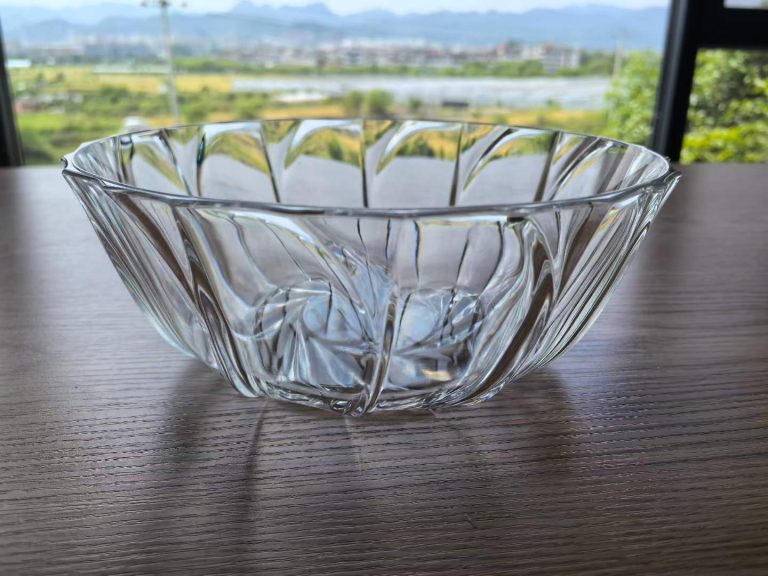
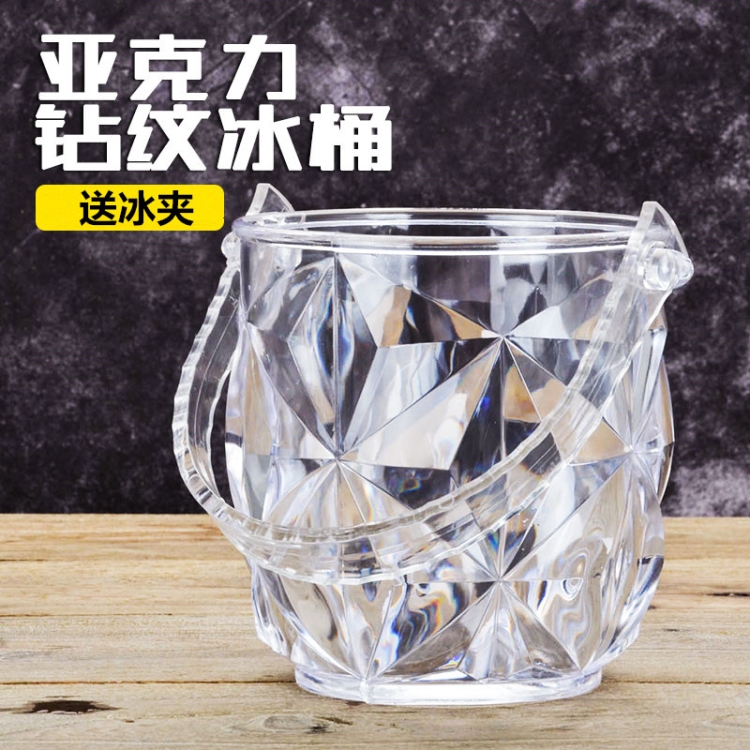
| Faceted planes (octagon, pentagon, diamond quilting) | Flat planes meeting at distinct edges | Edges act as structural ridges and scatter light; planes meet the palm flat, which reads as weight in the hand. |
| Honeycomb / cellular relief | A tiled array of small raised cells across the whole wall | The most evenly distributed stiffness of any family here — no single weak field. Also the hardest to dry by hand. |
| Smooth / plain wall | Uniform section, no relief | Lightest and cheapest per unit, lowest grip when wet, and the surface on which every scuff and water mark shows. |
Every pattern sold as decoration is doing at least one of these four jobs: stiffening a thin region, adding grip, hiding marks, or controlling how the cups nest.
Where a Patterned Cup Actually Fails
Plain drinkware fails in predictable places: the rim chips, the base cracks, the wall
scratches. A patterned mould redistributes those failures, and the new failure points are surprisingly
consistent once you know what to look for.
- The transition line. The boundary between a raised boss or band and the thin field
beside it is a step change in stiffness. Under a hard impact the two regions flex by different amounts,
and this is where hairline stress first appears — usually on the rosette edge or the last bead of a
band. It almost never shows on delivery. It shows after a few weeks of dishwashing and stacking. - The rim, unless the pattern protects it. An unrelieved rim is the thinnest section
of any cup. A beaded or banded mould that runs close to the rim acts as a stiffening hoop and the rim
survives knocks that would chip a plain cup. A pattern that stops well below the rim leaves the rim
exposed — which is why two patterned cups of similar height can have very different rim lifetimes. - Recessed detail, from the wash side. Relief is not a durability problem, it is a
drying problem. Water sits in the recesses, and in hard-water areas it leaves mineral film exactly in the
pattern. That is a cosmetic failure rather than a structural one, but it is the reason operators conclude
that “patterned cups look old faster” when the cup itself is fine. - Stacking contact points. Patterned cups rarely nest the way straight-sided ones do,
because the relief interferes. This sounds like a drawback and is often an advantage: the interference
keeps surfaces apart, so the wall does not scuff against itself, and the stack does not lock together.
None of these are reasons to avoid pattern. They are reasons to specify the pattern against the
service condition rather than against the photograph.
Grip, Stacking and Drying: The Three Operational Numbers
Three measurable behaviours decide how a patterned cup performs on a shift. None of them
appear on a product page, and all three can be checked on a sample in under five minutes.
| Behaviour | What the relief does | How to test it on a sample | Practical consequence |
|---|---|---|---|
| Grip with wet hands | Raised bands, beads and facets give a finger something to close on; a smooth wall becomes slick the moment it is wet | Wet the cup under a tap and lift it with soapy hands. Repeat with a plain cup of the same shape. | Matters most on the buffet line and in poolside service, where a dropped cup means broken crockery plus a slip hazard |
| Stacking interference | Relief contacts relief, so the stack is held apart rather than face-to-face | Stack ten and lift the whole column. Note the height against your actual shelf, and whether the bottom cup releases cleanly. | A patterned stack is taller for the same count but scuffs less and unlocks more easily. Measure the shelf before committing a season’s stock. |
| Drying and film | Recesses hold water; broad smooth fields drain and dry evenly | Wash and air-dry a patterned cup and a plain cup upside down on a cloth. Inspect the pattern areas after an hour. | Fine detailing rewards racking upright and air-drying. Flat-tray drying inverts the advantage and produces tide-marks. |
All three checks are free, and all three are more informative than a product photograph.
The Pattern Taxonomy You Will Actually Be Offered
Across the current range, patterned drinkware falls into a handful of families. They are
worth knowing by name because the family, not the colour, is what you are specifying. Two families in
particular are worth separating carefully, because they are frequently confused.
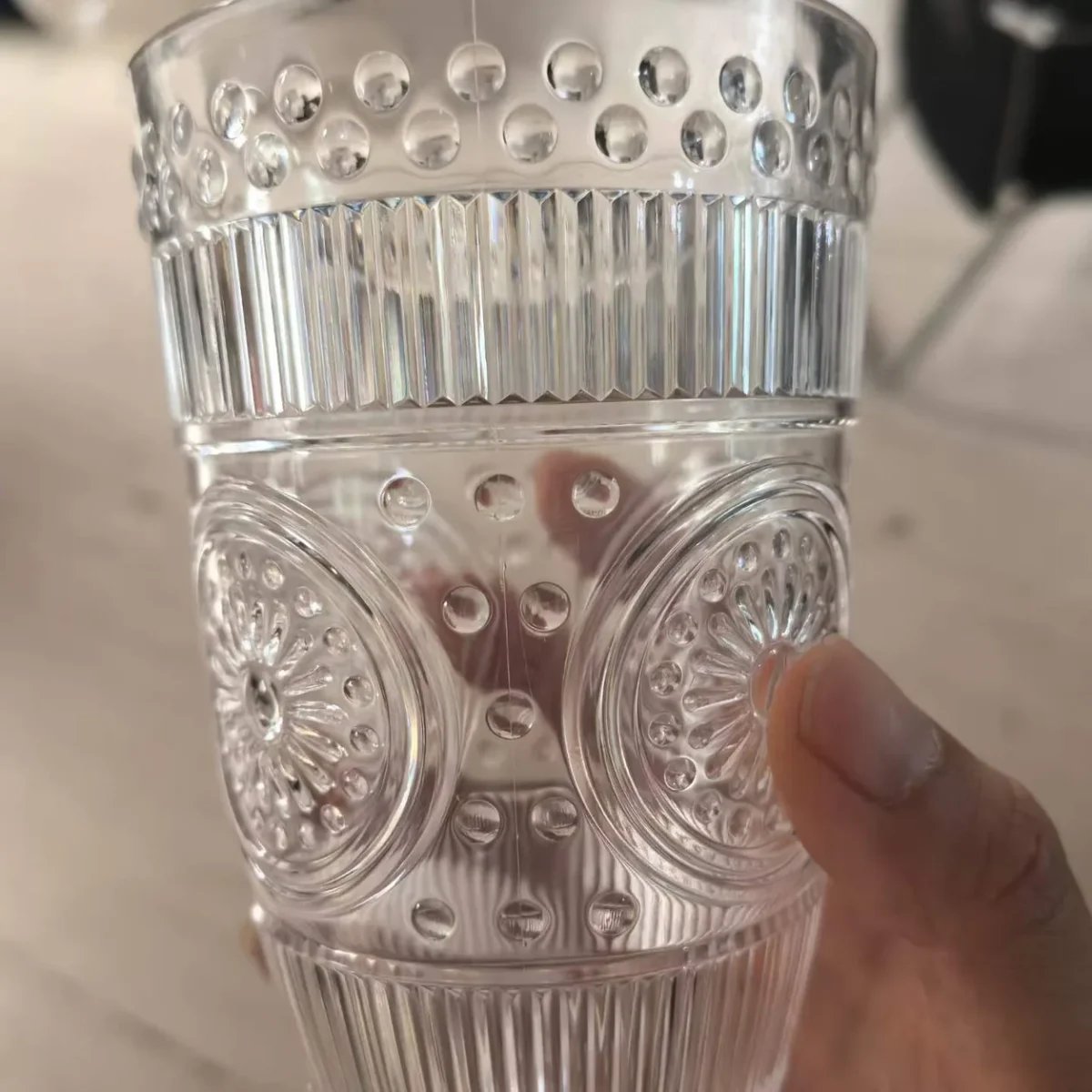
Retro embossed. The classic composite pattern: a beaded ring near the rim, a band of
vertical flutes, and a large rosette or sunflower medallion in the middle of the wall. It reads as
1930s pressed glass and it is the most structurally interesting pattern in the range, because it stacks
three different relief types on one cup — a stiffening hoop, a corrugated band and a rigid boss. In
service it behaves remarkably well: the hoop protects the rim, the flutes resist ovalising, and the
rosette gives the thumb a natural rest. Its one requirement is drying discipline, because that medallion
holds water.
Honeycomb and cellular relief. A tiled array of small raised cells covering the whole
wall. This is the inverse approach to the retro pattern: instead of concentrating stiffness in three
places, it distributes it evenly across the entire body. The result is the most uniform strength profile
of any family here and a very good grip surface, but the most demanding to dry by hand and the most
visible when hard-water film builds up.
Faceted geometries are the second largest family in current production, and it runs
from a 210 ml juice tumbler up to a 510 ml long drink on the diamond-quilted moulds
(BY-8021D, BY-8022C,
BY-8021C, BY-8022B,
BY-8021B, BY-8021A), and from 90 ml to
570 ml on the octagonal walls (BY-9204,
BY-9201, BY-9304E,
BY-9304C, BY-9304B). The octagonal
moulds reward a second look because most of them are offered in both polystyrene and polycarbonate, which
makes them the clearest illustration of the point in the next section. Flat-walled angular cups in the same
family include BY-9211, BY-9212 and
BY-9213.
Banded and dotted classics are the third family. Bamboo-joint banding
(BY-8020D at 230 ml up to BY-8020A at
650 ml) puts a single bold horizontal band on an otherwise plain wall — structurally the simplest
relief here, and the easiest surface to carry a logo. Fine striping
(BY-8018C, BY-8018,
BY-8018B) and dotted relief
(BY-9309C, BY-9309B,
BY-9309A) behave the same way at a smaller scale.
A fourth family is worth separating out because it is often confused with the others: frosted and satin
surfaces (BY-8015, BY-8016,
BY-8017) are not relief at all. The texture is in the surface finish, so
the wall stays uniform and the cup gains the scuff-hiding of a pattern without any of the drying penalty.
If you want the operational benefit and none of the maintenance, this is the family to look at.
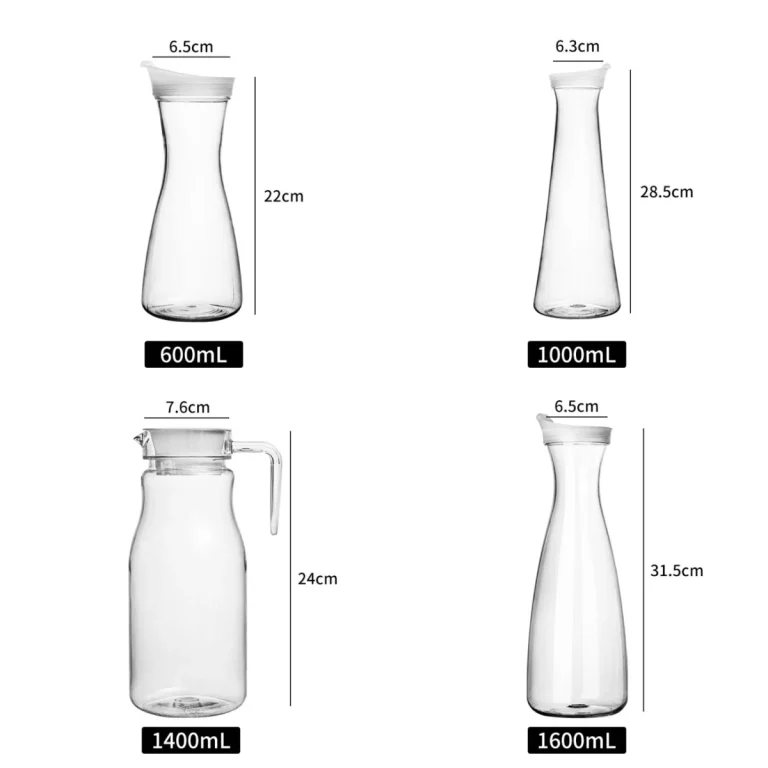
The matching lidded pitcher deserves a note of its own. A large covered jug built on
the same embossed pattern gives a single beverage station a consistent look, and the stainless lid with a
built-in infuser turns it into a cold-brew or fruit-infusion vessel as well as a water jug. If you are
specifying a patterned tabletop, the pitcher is the piece that ties the set together — and it is
also the piece where wall thickness matters most, because a full jug is heavy and it gets carried. Covered
formats are in the water pitcher range.
Matching Relief to Resin
The same pattern in two resins is not the same cup. Polycarbonate flexes under impact, so
relief in PC behaves like corrugation on a compliant material: the pattern absorbs and spreads the load.
Polystyrene is stiffer and more brittle, so the same relief gives you a crisper, clearer wall but
concentrates stress at the transition lines rather than spreading it.
The practical rule is short. If the cup will be carried, dropped, iced heavily or taken outdoors,
specify the pattern in polycarbonate — the relief works with the material. If the piece is
displayed rather than handled, a static tabletop item where the whole point is the sharpest possible
detail and the clearest wall, polystyrene reproduces fine relief better and costs less. Where a mould is
offered as “PS / PC”, the two are indistinguishable on a shelf, so which resin you are buying
has to be stated explicitly rather than inferred from the sample.
One consequence catches buyers out: a finely detailed pattern in polycarbonate will look marginally
softer in the detail than the same pattern in polystyrene, because the tougher material fills the mould
slightly less sharply at the finest points. That is a real trade, not a defect — you are exchanging
the last five per cent of detail crispness for a cup that survives being knocked off a table.
Three Checks on the Sample, Before the Production Slot Is Booked
Patterned drinkware cannot be judged from a screen. Relief depth, edge softness and the
consistency of a repeated motif only read in the hand, and showroom samples are drawn from a different
run than your production order. These three checks are the ones that have actually decided orders.
Run a thumb around the rim and along every raised edge
On a good mould the top edge is even all the way round with no perceptible seam, and the same is true
of every place the relief terminates. On a patterned cup, pay particular attention to where a bead, flute
or medallion meets the wall: those are the points where a worn or poorly polished mould leaves a ridge,
and where a guest notices roughness on the second sip. Ask for the check to be repeated on the
production sample. A rough rim on delivery is a rim that fails early, and on a patterned mould a
failing rim usually means the whole cup is retired rather than repurposed.
Look at the pattern in raking light, not straight on
Hold the cup so the light runs across the wall at a shallow angle. This is the only way to see whether
a repeated motif is evenly formed — whether every bead on the band is the same height, whether the
flutes are the same depth, whether the rosette is centred. Under direct light, every pattern flattens to a
silhouette and inconsistencies vanish. Substantial orders have been rejected on this check alone, and it
takes ten seconds.
Fill it, chill it, and drop it
Fill the cup with iced water, leave it ten minutes, then drop it from counter height onto the kind of
surface it will actually meet — tile, stone or timber. Watch where it fails, if it fails. A pattern
that stiffens the rim will survive a rim-first landing; a pattern that concentrates thickness in the
middle may fail at the transition line instead. Run the same test on the plain wall version of the same
volume and compare. This is the single most informative test available before you commit to a container,
and it costs one cup.
What Twelve Months of Patterned Service Looks Like
Patterned drinkware is usually bought for how it looks and justified on how long it lasts.
The two are not automatic. The pattern affects the second one in specific, predictable ways.
| What degrades | Plain wall | Patterned wall | What to do about it |
|---|---|---|---|
| Rim chipping | Exposed rim; chips readily | Protected where a bead or band runs near the rim; unimproved where the pattern stops low | Check how close the topmost relief sits to the rim before ordering |
| Wall scuffing in the stack | Cup faces cup; scuffs accumulate | Relief holds surfaces apart, so the contact area is much smaller | Usually not worth acting on — this is where pattern wins |
| Visible water film | Uniform; film reads as haze | Collects in recesses; reads as speckling, which looks worse than haze | Rack upright and air-dry; keep the rinse water soft |
| Stress cracking | Concentrated at base and rim | Can migrate to relief transition lines under hard impact | Specify polycarbonate for anywhere the cup is carried or dropped |
| Pattern legibility | Not applicable | Fine motifs soften with repeated hot washing over a long service life | For logo-critical work, prefer a bold band over fine detail |
Indicative comparison only. Model it against your own wash temperature and replacement rate.
The pattern is not a cosmetic add-on to a durable product; it is part of what makes the
product durable. The cups worth specifying are the ones where the relief was designed as structure —
a hoop that protects the rim, ribs that hold the wall round, a boss that gives the thumb somewhere to
sit — rather than a motif applied to a plain mould for appearance alone. Both exist on the market,
and they are priced similarly.
The Brief That Writes Itself
Sit down with a sample and the pattern vocabulary above, and the specification almost writes
itself. Read across these lines in order and each one eliminates a family.
| Line on the brief | Why it decides the mould |
|---|---|
| Is the cup carried or placed? | Carried means drops, so the pattern must spread impact. Placed means you can optimise for detail and clarity. |
| Is ice involved? | Ice adds a thermal load on top of the mechanical one. This is the line that chooses polycarbonate over polystyrene. |
| How many hours between washes? | High turnover means the pattern must survive heat cycles. Bold relief holds up better than fine detail. |
| Who dries them, and how? | Racked and air-dried, recessed detail is free. Dried on a flat cloth, recessed detail becomes a cosmetic liability. |
| Does the pattern carry a logo? | A band carries print cleanly; a busy all-over relief competes with it. Choose one to be the subject. |
| What does the cup stand next to? | A patterned range should share one visual language. Mixing three relief families on one counter looks like three purchases. |
| What is the shelf and carton footprint? | Patterned cups stack taller for the same count. Confirm the stacking height and the carton yield before the season’s stock is committed. |
| What is the delivered cost per cup? | Compare at the same carton yield. A cheaper unit price at fewer cups per cubic metre is not cheaper. |
The entry threshold is 500 pieces per model, and a patterned stock order clears it on the same terms as branded work.
Next Step: Read the Relief, Then Choose the Volume
Start from the pattern, because it eliminates more of the range than volume or colour will.
Decide whether the cup is carried or placed, whether ice is involved and how it is dried — those
three answers point at one relief family and one resin. Then pick the volume from the menu, confirm the
stack height against your shelf, and price it as delivered cost per cup rather than list price.
Benyang moulds unbreakable PC and acrylic drinkware in-house at our factory in Yongkang, Zhejiang,
exporting through Ningbo and Shanghai, with embossed, faceted, banded and lidded formats in regular
production. Individual product pages carry the full specification, the packing quantity and the colour
list for each model. Tell us the service condition and the volumes you are planning for, and we will come
back with a pattern and resin recommendation rather than a catalogue. You can browse the
full cups and glasses collection, compare materials
across our drinkware materials
guide, or read the buyer’s guides for
cups and tumblers,
bowls and plates and
water pitchers. You can also
read more about our factory or
send us your specification.
Buyer Questions on Patterned and Embossed Drinkware
Does an embossed pattern make a plastic cup weaker or stronger?
It depends where the relief is. Relief near the rim acts as a stiffening hoop and protects the thinnest section, and vertical flutes resist the wall ovalising under a squeeze, so both make the cup tougher in normal service. What a pattern does not do is remove the transition lines between thick relief and thin wall, and those boundaries are where a hard impact shows stress first. A well-designed pattern in polycarbonate is tougher than the plain equivalent; a decorative motif applied to a brittle resin is not.
How do I read a pattern mould before I commit to an order?
Hold the sample in raking light rather than direct light – relief depth, edge softness and whether every repeat of the motif is the same height only read at a shallow angle. Then wet the cup and lift it with soapy hands to judge grip, stack ten and lift the column to judge nesting height, and wash one to see where water sits. All three checks together take under five minutes and tell you more than a product photograph ever will.
Our kitchen dries cups on a flat cloth and the pattern goes cloudy. What is happening?
That is mineral film, not wear. Water drains out of a plain wall evenly but collects in the recesses of a patterned one, so in a hard-water area the dissolved solids deposit exactly inside the relief and read as speckling rather than haze. Rack the cups upright so they drain from the base, and the same cups come out of the wash looking new for far longer. If your rinse water is very hard, a softener on the final rinse removes the problem entirely.
Should patterned cups be polycarbonate or polystyrene?
Polycarbonate wherever the cup is carried, dropped, iced heavily or used outdoors, because the material flexes and the relief works with it to spread the load. Polystyrene where the cup is placed rather than handled, since the stiffer resin reproduces fine relief more sharply and gives the clearest wall at a lower unit cost. Where a mould is offered in both resins the two look identical on a shelf, so the resin has to be written into the purchase order rather than assumed from the sample.
Can we put a logo on a patterned cup?
Yes, and the pattern usually helps – a horizontal band is a natural field for print and gives the logo a straight baseline. The one combination to avoid is a busy all-over relief competing with fine print, because at typical viewing distance the two read as noise. If the branding is the point, choose a banded or fluted mould and keep the mark simple. Branding, custom tinting and bespoke packaging are all quoted at 500 pieces per model – the same threshold as an unbranded order – with tooling-led work typically landing around 30 days against 7 to 15 for stock.