Water Pitchers for Hotels: The Model Number Is a Grammar
A Jug Order Begins With Nine Characters
The number is the first thing anyone types. It goes into the enquiry, onto the quotation, into the purchase order and finally onto the carton label, and by that point nobody has looked at the jug itself for weeks. So it is worth asking an awkward question early: what does the number on a water pitcher actually promise?
Across the four sub-series that make up the pitcher shelf there are ninety-four rows on the shelf, and every one of them carries a code of the same shape: a two-letter prefix, four or five digits, then usually one more letter, and sometimes a dash and another digit. Read casually it looks like a serial number with a size coded into it. Read carefully it behaves like a small grammar, with three parts that each do a different job — and only one of the three is a number.
This piece takes that grammar apart, part by part, using nothing but the specification rows that sit under each jug. It is written for the buyer who has to write the code down once and live with the result for a season.
The Digits Name the Mould, and the Mould Sets the Diameter
Strip the prefix and the letters away and what is left is a mould identity. That matters because on this shelf the mould, not the capacity, is what fixes the body diameter — and the body diameter is what decides how the jug reads on a table.
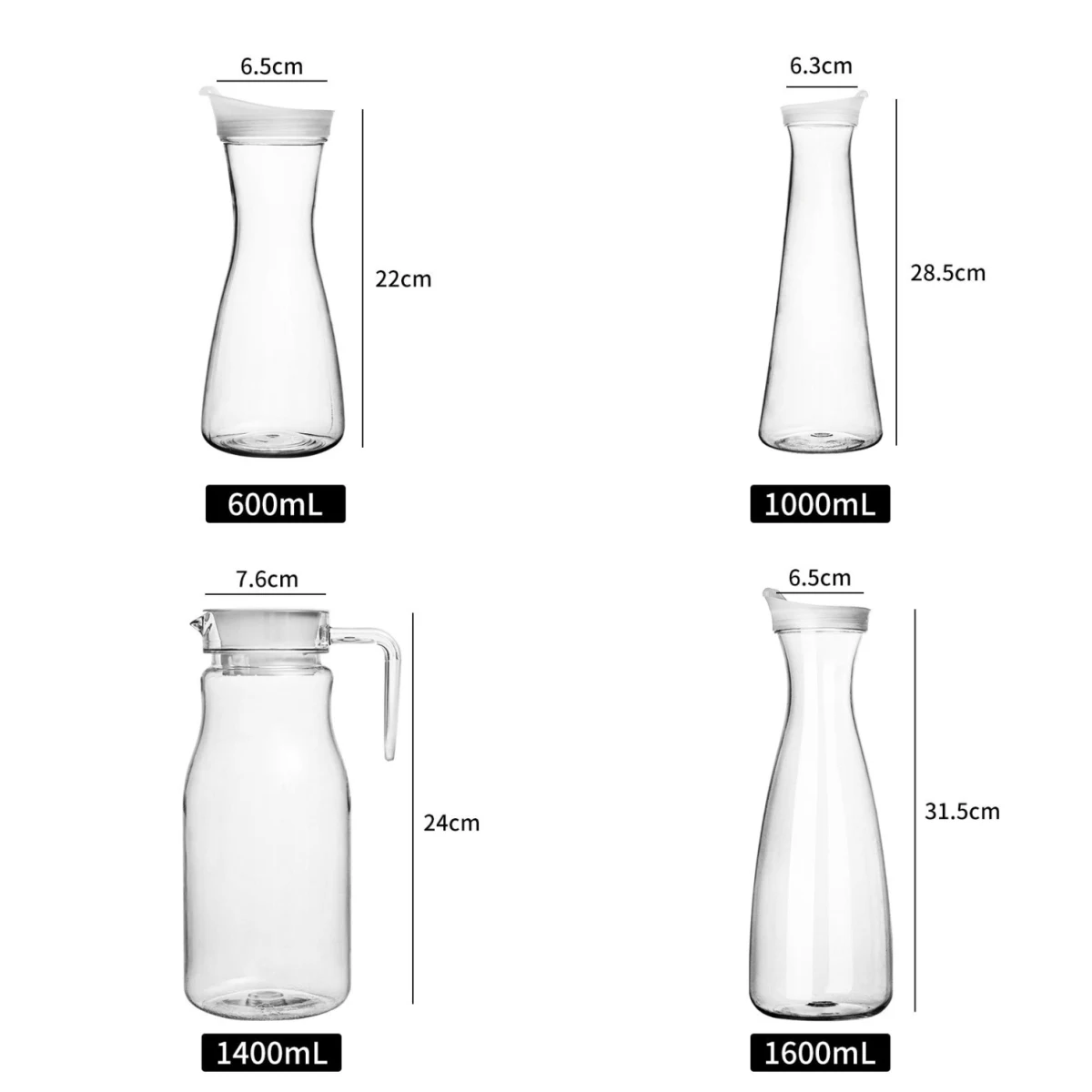
The clearest evidence is the narrow column. Several rows share a body of 6.5 cm and run from a small table carafe to a full 1.6 litre jug:
| Row | Capacity shown | Product size | Carton |
|---|---|---|---|
| BY-9170 | 600 ml | D6 × 20 cm | 42 × 42 × 47 cm |
| BY-9181 | 900 ml | D6.5 × 26.5 cm | 47 × 47 × 58 cm |
| BY-9171 | 1100 ml | D6.5 × 9.5 × 26.5 cm | 45 × 45 × 55 cm |
| BY-9180 | 1450 ml | D6.5 × 31.5 cm | 50 × 50 × 67 cm |
| BY-9173 | 1600 ml | D6.5 × 31.5 cm | 47 × 47 × 64 cm |
Six hundred millilitres to one and a half litres without the body getting wider. The growth is entirely vertical, which is exactly what a buffet counter wants: the same footprint, a different pour count. It also means the two ends of that range are not interchangeable on a tray — a 31.5 cm jug standing beside a 20 cm one reads as two different products, because it is two different moulds.
A wider body is a different number, not a bigger number
The premium block behaves the other way round. There the wide-bodied jugs live in their own mould family, and moving sideways in capacity usually means moving sideways in number. So the honest reading of the digits is: this is the shape, not this is how much it holds.
The Letter Names a Tier, and Two Moulds Use a Different Ladder
The trailing letter is where buyers most often assume a measurement. Nine moulds in the full-handle premium block use the same three letters, and across eight of them the mapping is identical:
| Mould | A | B | C |
|---|---|---|---|
| BY-9190 | 2000 ml | 1500 ml | 1000 ml |
| BY-9191 | 2000 ml | 1500 ml | 1000 ml |
| BY-9192 | 2000 ml | 1500 ml | 1000 ml |
| BY-9193 | 2000 ml | 1500 ml | 1000 ml |
| BY-9194 | 2000 ml | 1500 ml | — |
| BY-9195 | 2000 ml | 1500 ml | 1000 ml |
| BY-9197 | 2000 ml | 1500 ml | 1000 ml |
| BY-9198 | 2000 ml | 1500 ml | 1000 ml |
| BY-9196 | 1800 ml | 1400 ml | — |
| BY-9199 | 1800 ml | 1400 ml | — |
Eight moulds, three letters, one ladder, no exceptions — and then two moulds that sit two hundred millilitres lower for the very same letters. BY-9196A and BY-9199A both carry a B that is 1400 ml rather than 1500, and an A that is 1800 rather than 2000.
That is not a data-entry accident, because the same two moulds are also the only ones in the block whose dimensions were filled in: 8 × 20 × 12.5 cm for the 1800 ml row and 8 × 17 × 12.5 cm for the 1400 ml row. They are a rectangular-bodied pair sitting alongside a family of round-bodied jugs, and they inherited the letter convention without inheriting its volumes.
Which Means the Letter Cannot Be Converted
The practical consequence is short. Inside one mould, A is bigger than B and B is bigger than C. Between moulds the letter says nothing at all, and two hundred millilitres of capacity can be lost by assuming otherwise.
Put it in a sentence you can paste into an email to your own warehouse team: the letter ranks, it does not measure. If the purchase order says “the A version” and the supplier ships the mould you did not mean, the paperwork will agree with the shipment and the shelf will still be wrong. This is the single most common way a jug order goes sideways, and it costs nothing to prevent: write the millilitres next to the letter, every time.
The Size Field Does Not Settle It Either
The obvious fallback is the dimension column — if the letter is ambiguous, order by size. On this shelf that does not work either, because one size string is shared by rows that claim quite different capacities:
| Product size | Rows sharing it | Capacities shown |
|---|---|---|
| Φ8.5 × 24 cm | 7 | 1000 ml, 1100 ml, 1100 ml, 1200 ml, 1250 ml, 1500 ml, and one row with no capacity at all |
| D8.5 × 24 cm | 3 | 1100 ml, 1500 ml, 1600 ml |
| D6.5 × 31.5 cm | 5 | 1450 ml, 1600 ml, 1600 ml, 1600 ml, and one blank |
| D6.5 × 26.5 cm | 4 | 900 ml, 1100 ml, 1100 ml, and one blank |
| Φ11.5 × 25 cm | 2 | 1800 ml and 2.0 L |
| D8.5 × 19.5 cm | 2 | 800 ml, 1000 ml |
| D8.5 × 16.5 cm | 2 | 500 ml, 800 ml |
| D16 × 8 × 24 cm | 2 | 1800 ml, 2000 ml |
| Φ9.4 × 19.1 cm | 3 | 1000 ml, 1500 ml, 1500 ml |
Read the first line again: seven different products share the string Φ8.5 × 24 cm and between them they span half a litre. The size column is a mould-family marker. It tells you which jugs will stack with each other and which will not; it does not tell you what fits in the jug.
One row in that table is worth flagging on its own. BY-9162A and BY-9162A-1 quote exactly the same dimension, Φ11.5 × 25 cm, and the same carton, 54 × 54 × 52 cm, and the same pack of 32 pieces. One is listed at 1800 ml and the other at 2.0 L. Whatever the two entries are, they are not two measurements of two different jugs — and a five to ten per cent difference in fill level is exactly the kind of thing that shows up as a shortfall on a banquet floor.
It is also the only row on the shelf that breaks the unit convention. Every other capacity is written in millilitres; this one is written in litres. If you are diffing a supplier’s spreadsheet against your own, that single row will either sort to the bottom or fail to match at all.
The Dash Suffix Means Four Different Things
The last moving part is the dash. Six mould families carry one, and if you line them up the pattern dissolves:
| Base mould | Bare code | ‑1 | ‑2 | ‑3 |
|---|---|---|---|---|
| BY-9141A | 2000 ml, D16 × 8 × 24 cm | 1800 ml, same size | — | — |
| BY-9141B | 1100 ml, D8.5 × 24 cm | 1500 ml, same size | 1100 ml, no size | — |
| BY-9148 | 1000 ml, PC body | — | 1350 ml, PC body | 1000 ml, steel-lidded |
| BY-9160A | 1600 ml, bamboo lid | 1600 ml, steel lid | — | — |
| BY-9162A | 1800 ml, Φ11.5 × 25 cm | 2.0 L, same size | — | — |
| BY-9162B | 1500 ml, Φ9.4 × 19.1 cm | 1500 ml, identical | — | — |
On BY-9141A the dash makes the jug smaller. On BY-9141B it makes it larger. On BY-9148 it makes it larger at ‑2 and changes the lid at ‑3. On BY-9162B it changes nothing at all: BY-9162B and BY-9162B-1 print the same capacity, the same size, the same material and the same carton, so the two rows are the same jug entered twice.
A dash on this shelf means a second record exists. It does not mean newer, larger or better. The only reliable way to read it is to compare the two rows field by field — which takes about ten seconds, and is the difference between ordering the jug you sampled and ordering its neighbour.
One Jug, Four Product Pages
Nowhere is this more visible than in half-handle stainless, where a single 1600 ml mould is spread across four rows:
| Row | Lid in the material field | Pack | Carton |
|---|---|---|---|
| BY-9160A | Bamboo wood | 50 pcs | 51 × 51 × 57 cm |
| BY-9160A-1 | Stainless steel | 50 pcs | 51 × 51 × 57 cm |
| BY-9160A-1BAMBOO-WOOD-LID | Bamboo wood | 50 pcs | 51 × 51 × 57 cm |
| BY-9160A-STAINLESS-STEEL-LID | Stainless steel | 50 pcs | 51 × 51 × 57 cm |
Two lids, two dash variants, four rows, one mould — and the identical carton and pack count on all four, which is the tell that the physical jug never changed. The 1300 ml mould follows the same pattern with three rows, and the 1100 ml mould with four.
The lid lives in two places at once
For a partly translucent jug the lid is not a trim item. It is what keeps a full jug steady as it crosses a dining room, and it is what turns a carafe into something a guest can pour from. On this shelf the lid is recorded inside the material field — PC + Stainless Steel Lid, PC (Polycarbonate) + Bamboo Wood Lid — and nowhere else. There is no separate lid column, no lid field and no lid line on the order.
So the two things you need to settle are which lids you actually want, and whether the supplier is quoting you the bamboo row or the steel row. Both are legitimate; the point is that only one of them is on the quotation.
And the accessory is not spelled the same way twice
Look at the addresses rather than the codes. The steel variants read -stainless-steel-lid with a hyphen before the accessory, while the bamboo variants read -1bamboo-wood-lid with the digit and the word run together. Two conventions, one shelf. If you are building a purchase list in a spreadsheet and matching on the address, the bamboo rows will not line up with the steel ones, and the mismatch looks like a missing product rather than a naming quirk.
No Single Sub-Series Covers a Menu
The four sub-series are not four price points on the same ladder. Their capacity ladders do not overlap cleanly at all:
| Sub-series | Rows | Capacities present | Ceiling |
|---|---|---|---|
| full-handle premium | 34 | 1000, 1200, 1250, 1400, 1500, 1800, 2000 ml | 2000 ml |
| half-handle universal | 25 | 500, 800, 1000, 1100, 1250, 1400, 1500, 1600, 1800, 2000 ml | 2000 ml |
| juice pitchers | 19 | 500, 600, 800, 900, 1100, 1400, 1450, 1600 ml | 1600 ml |
| half-handle stainless | 16 | 1000, 1100, 1300, 1350, 1600 ml | 1600 ml |
Only one of the four spans the whole shelf. The premium block starts at a litre, so it cannot serve a table where a small carafe is the norm. The juice pitchers and the stainless-lidded block both stop at 1600 ml, so neither can carry the largest banquet jug. If your beverage list runs from a 500 ml table carafe to a 2 litre water service, the order is going to touch at least three of these four groups — and that is a lead-time question, not only a range question.
The narrowest group also holds the widest spread of colour. The stainless-lidded block lists colours on twelve of its sixteen rows, while the premium block lists them on nineteen of thirty-four. Half the shelf in total is silent on the subject.
The Carton Is Shared, the Count Is Not
One carton in this range is unusually promiscuous. The size 48 × 48 × 49 cm appears on twelve different rows, and between them those rows run from 500 ml to 1300 ml:
| Rows sharing 48 × 48 × 49 cm | Capacities | Pieces per carton |
|---|---|---|
| BY-9144D, BY-9145D | 500 ml, 800 ml | 75 |
| BY-9148, BY-9141B, BY-9143, BY-9145B, BY-9148-3, BY-9141B-2 | 1000–1250 ml | 50 |
| BY-9160C, BY-9160C-1, BY-9160C-BAMBOO-WOOD-LID, BY-9160C-1BAMBOO-WOOD-LID | 1100 ml | 50 |
Same box, fifty or seventy-five pieces depending on the row, and a capacity span of eight hundred millilitres. When someone quotes you freight per piece on this family, the number moves by half without the box changing size at all.
The other side of that coin is that nineteen of the ninety-four rows carry no carton dimension, and fifteen of those nineteen sit in the newest premium block. Those rows cannot be turned into a cubic-metre figure, so they cannot be compared against anything else on the shelf on a landed-cost basis. It is not a defect in the jug; it is a gap in the paperwork that arrives before the quotation does.
Two smaller oddities in the same field, both worth knowing before you build a costing sheet. One carton, 63 × 38 × 47 cm, has a distinctly flat footprint and belongs to the only polystyrene row in the range, BY-9163 — which is also the only row whose size column repeats the carton rather than the jug. And the four rows sharing 50 × 50 × 67 cm are not one product four times: they are a 1400 ml jug, a 1450 ml jug, a 1600 ml jug and one row with no capacity at all, packed 50 to a box.
Half the Shelf Says Nothing About Colour
Forty-seven of the ninety-four rows list no colours. Among the rows that do, three vocabularies are in use, and they are not nested:
| Colour list as printed | Rows | What it means for the order |
|---|---|---|
| Transparent, Tea, Grey | 20 | The full three-tint range |
| Tea, Transparent | 15 | No grey — clears and amber only |
| Grey, Transparent | 7 | No amber |
| Five-tint lists | 3 | Blue, orange and purple join the palette |
Two of those three tints are worth a sentence each. Tea is a colour name, not a beverage: it is the amber tint that makes a jug of iced tea look deliberate rather than weak. And a two-tint list is not a shorter version of a three-tint list; it is a different mould run, and the tint that is missing is missing because the mould for that capacity was never cut for it.
Which leaves forty-seven rows where the colour question has to be asked rather than read. That is not a reason to avoid them. It is a reason to put the question in the first email instead of the fifth.
Materials, Certificates and the One Resin Change
Almost everything here is polycarbonate — sixty-five of the ninety-four rows name it alone — and the remaining rows name it with a lid material attached: stainless steel on twenty-one rows, bamboo wood on six, and one row, BY-9183B, naming steel, wood and bamboo together. That last row is also the only one in the range with a packaging note attached to its pack count, twenty-four pieces in a white box rather than fifty in a plain carton.
One row goes the other way. BY-9163 is polystyrene, and it is the only polystyrene jug on the shelf at 1100 ml. If a hospitality buyer has standardised on polycarbonate for drop resistance and then orders that capacity from the wrong line, the jug will arrive looking right and behaving differently — lighter, stiffer, and far less forgiving of a knock on a tiled floor.
On paperwork: the drinkware lines carry third-party food-contact testing and a material-compliance declaration, and both can be sent to you as numbered files, so that a report can be matched to your own consignment rather than to a sentence on a website. Certificates travel with the goods, not with the market — what clears customs is a matter for your own import file. Name the destination country in the first email and ask for the document list in writing.
Moulding happens in-house at Yongkang, Zhejiang; containers are booked out of Ningbo or Shanghai. Minimum order is 500 pieces to a model; printing, colour and packaging are all produced on the same run. Stock models ship inside two weeks, and anything that needs a new mould is nearer a month.
Before the Number Goes on the Order
There is no need to memorise any of the above. What is needed is a habit: when a code is copied from a specification row onto an order, translate each of its three parts into something the supplier cannot misread.
| Part of the code | What it ranks | What to write in its place |
|---|---|---|
| The digits | The mould, and through it the body diameter | The body diameter in centimetres, and whether the jug must stack with an existing one |
| The letter | A tier inside one mould only | The capacity in millilitres, spelled out, next to the letter |
| The dash | That a second record exists — nothing more | The capacity and the lid material, taken from the row you actually sampled |
| The size string | A mould family, not a volume | The capacity again, plus the packed height so it clears your shelf |
| The carton | Nothing at all unless both rows share it | Pieces per carton and the carton size, so freight can be quoted per piece |
Five lines, and the fifth is the one that gets skipped. A jug that fits the menu and the shelf and the tray but arrives at the wrong freight cost per piece is still a problem order.
What to Do Next
Take one row from each of the four sub-series — a premium jug, a half-handle universal, a juice carafe and a stainless-lidded one — and ask for the millilitres, the body diameter, the lid material and the pieces per carton on all four, in writing, in one reply. Four rows is enough to show whether the specification sheets you are working from are the same ones the factory is working from.
If the open question is how the four handle architectures differ in the hand rather than on paper, the handle architectures goes through that. For the wider drinkware programme, the earlier pitcher note, the three-range comparison and the bar and milk-tea cups cover the rest of the shelf, and the cruet range and decanters handle the metering and decanting end. how the works are set up explains the setup. To start, send the code you are reading through the contact page and we will send back the row it belongs to.
A sample tray is the last step, not the first. Put the four jugs on it, fill them to the line you expect on the floor, and carry the tray the length of the room before you sign anything.
Five Questions Buyers Ask About Jug Model Numbers
Does the letter at the end of a jug model number tell me the capacity?
Only inside one mould. On eight of the ten moulds in the premium block, A is 2000 ml, B is 1500 ml and C is 1000 ml. Two moulds, BY-9196 and BY-9199, use the same letters for 1800 ml and 1400 ml. Treat the letter as a rank and write the millilitres on the order.
Two rows quote the same product size but different capacities. Which jug do I get?
Neither answer is safe. A nine-character size string such as Φ8.5 × 24 cm is shared by seven rows spanning 1000 to 1500 ml, and one pair of rows quotes an identical Φ11.5 × 25 cm at 1800 ml and at 2.0 L. Name the millilitres, and ask the factory to mark where the fill line sits on the sample they send you.
Does a dash in the model number mean a newer version?
It means a second record exists. On BY-9141A the dash lowers the capacity, on BY-9141B it raises it, on BY-9148 it does both in turn, and on BY-9162B it changes nothing at all. Compare the two rows field by field before choosing.
Can I cover 500 ml to 2 litres from one sub-series?
No. Only the half-handle universal group spans that range. The premium block starts at 1000 ml, and both the juice pitchers and the stainless-lidded group stop at 1600 ml, so a full beverage list will touch at least three of the four groups.
Is the lid part of the model number or a separate item?
It is inside the material field and inside the product address, and nowhere else. One 1600 ml mould appears as four rows across two lid materials, so settle the lid first and then confirm which of the two rows the quotation is built from.