Fruit Plates for Hotels: Same Diameter, Different Shipment
The Diameter Is the Easy Part
Choosing a fruit plate starts with a question about fruit. How much of it has to sit on the display at once, how deep the pile can be before the bottom layer is out of sight, and how much table the arrangement is allowed to occupy. Work that through and you arrive at a diameter, and the diameter feels like the decision. The display guide on this shelf takes that question apart properly, and it ends where this guide begins: with a number such as twenty-five centimetres and a category to go and find it in.
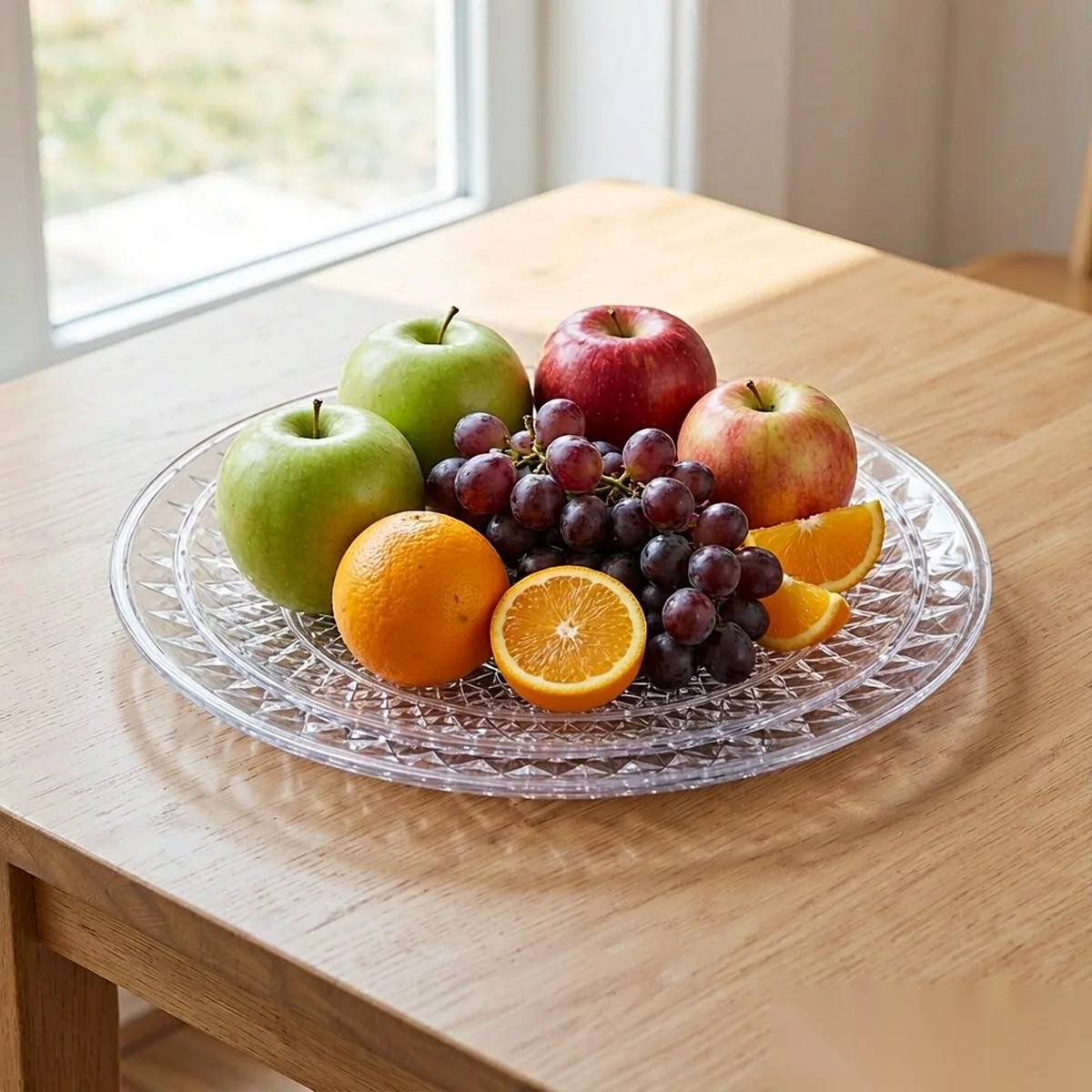
Go and look. Eleven product pages on this line publish a twenty-five-centimetre plate. All eleven give the material as polystyrene, all eleven print the same minimum order, and all eleven call the object a fruit plate. Eight of them publish a carton. Between those eight there are six different boxes, holding anywhere from thirty pieces to a hundred, and the lightest of them moves a given quantity of plates in roughly three times the space of the heaviest.
That is the second question, and it is the one the catalogue answers least well. The diameter tells you what the display will look like. The carton tells you what the shipment will cost, how many pallet positions it fills and how long receiving takes. Nothing on the page connects the two, and the pages do not agree with each other. This guide reads the carton column the way the display guide reads the rim: as a published figure with a story behind it.
Eight Published Boxes for One Diameter
Here is every page on the line that publishes a twenty-five-centimetre plate together with a carton, ordered from the lightest packing to the heaviest. Two arithmetic notes, because the last column is the one that matters and it is not printed anywhere: the carton volume in litres is the three carton numbers multiplied together and divided by a thousand, and pieces per cubic metre is the carton count divided by that volume and multiplied back by a thousand.
| Page | What the page is | Pieces per carton | Carton (cm) | Litres | Pieces per cubic metre |
|---|---|---|---|---|---|
| by-3011c | sword pattern | 30 | 27 × 27 × 52 | 37.9 | 791 |
| by-8051-by-8052-by-8053-by-8054-by-8055 | plain, five-size page | 70 | 49 × 25 × 44 | 53.9 | 1,299 |
| by-8503 | lotus | 80 | 49 × 25 × 44 | 53.9 | 1,484 |
| by-8603 | beaded | 80 | 51 × 26 × 39 | 51.7 | 1,547 |
| by-8401-by-8402-by-8403-by-8404-by-8405 | diamond, five-size page | 100 | 52 × 26 × 34 | 46.0 | 2,175 |
| by-8303 | diamond | 100 | 51 × 51 × 16 | 41.6 | 2,403 |
| by-8101-by-8102-by-8103-by-8104-by-8105 | crystal, five-size page | 100 | 52 × 26 × 30 | 40.6 | 2,465 |
| by-8201-by-8202-by-8203-by-8204-by-8205 | diamond, five-size page | 100 | 52 × 26 × 30 | 40.6 | 2,465 |
Three of the eleven pages that offer this diameter publish no carton at all, and they are not an afterthought — they are the stand versions, and they come back further down. Setting those aside for a moment, the eight rows above are the whole published answer to “what does a twenty-five-centimetre plate ship in”, and the answer is a range rather than a figure.
Read the ends of the table against each other. The sword-pattern plate and the diamond plate on the five-size page both describe a twenty-five-centimetre polystyrene fruit plate, and one of them puts thirty pieces in 37.9 litres while the other puts a hundred in 40.6. On a five-hundred-piece minimum that is seventeen cartons against five. The difference is not a rounding artefact and it is not a discount for volume. It is two different boxes, and the diameter is identical.
The two rows that share a box dimension are worth a second look as well, because they show the reuse running in both directions. BY-8503 and the plain five-size page both use 49 × 25 × 44 at this diameter, one at eighty pieces and one at seventy. Same box, two products, two counts. A buyer who learns the box from one page and applies it to the other is out by more than ten percent before the order is even placed.
The Same Box Under Three Different Diameters
If the carton belonged to the diameter, each box would appear at one diameter and one only. It does not. The clearest case on the line is a single box that turns up at three different diameters, on three different pages, with two different counts.
| Carton (cm) | Page | Diameter | Pieces |
|---|---|---|---|
| 27 × 27 × 52 | plain five-size page | 35 cm | 40 |
| 27 × 27 × 52 | BY-3011B, sword pattern | 30 cm | 30 |
| 27 × 27 × 52 | BY-3011C, sword pattern | 25 cm | 30 |
The two sword-pattern rows are the striking pair. Adjacent diameters, thirty centimetres and twenty-five, published with the identical carton and the identical count. Nothing in the table distinguishes them except the diameter itself, which means the smaller plate ships in a box the larger plate could also use — and that the box was chosen for the production run rather than for the object.
The reuse crosses families too. BY-8301, a thirty-five-centimetre diamond plate, and BY-8601, a thirty-six-centimetre beaded plate, share the carton 36 × 36 × 41 at fifty and thirty pieces respectively. At the small end, four pages publish a fifteen-centimetre plate at two hundred and eighty pieces each, in boxes of identical footprint whose heights run 36, 39, 40 and 41 centimetres — the same count, four boxes, five centimetres of spread.
What follows from all of this is narrow but useful. The carton column is a fact about the page, not a fact about the diameter, and not a fact about the family either. It cannot be interpolated, averaged, or carried across from a neighbouring row. Any figure used for planning has to be read off the specific page being ordered, and where a page lists several diameters, off the specific position in that page’s own list.
What the Box Arithmetic Says About the Plate
A carton figure is also the only public evidence about how the plates behave when they are stacked, and on this line that evidence is stranger than the packing counts. Take each box, work out how many nominal-diameter plates fit on its floor, divide the piece count by that to get the number of layers, and divide the box height by the layers. The result is the stack step the published numbers imply: how much vertical space one plate occupies inside its own carton.
| Page | Diameter | Carton (cm) | Pieces | Plates per floor layer | Layers | Implied stack step (cm) |
|---|---|---|---|---|---|---|
| by-8302 | 30 cm | 32 × 32 × 46 | 100 | 1 | 100 | 0.46 |
| by-8502 | 30 cm | 60 × 30.5 × 40.5 | 60 | 2 | 30 | 1.35 |
| by-8602 | 30 cm | 61 × 36 × 37 | 60 | 2 | 30 | 1.23 |
| by-8303 | 25 cm | 51 × 51 × 16 | 100 | 4 | 25 | 0.64 |
| by-8503 | 25 cm | 49 × 25 × 44 | 80 | 1 | 80 | 0.55 |
| by-8603 | 25 cm | 51 × 26 × 39 | 80 | 2 | 40 | 0.98 |
| by-8304 | 20 cm | 41.5 × 41.5 × 28 | 180 | 4 | 45 | 0.62 |
| by-8504 | 20 cm | 40 × 40 × 30 | 100 | 4 | 25 | 1.20 |
The reading assumes one plate per floor position at its nominal diameter and takes no credit for nesting beyond the arithmetic, which is the plainest way to read the table and the right way to start. On that reading the implied stack step runs from 0.46 cm to 1.35 cm across the mid-calibre run — close to a factor of three — and it does not track the diameter or the family in any tidy way. Within the lotus family alone, the thirty-centimetre plate implies 1.35 cm and its twenty-five-centimetre neighbour implies 0.55 cm, a factor of two and a half between adjacent sizes.
The shapes tell the same story from another angle. BY-8303 ships a twenty-five-centimetre plate in a box sixteen centimetres tall — shorter than the plate is wide — while BY-8302, thirty centimetres across on the same family, ships in a column forty-six centimetres tall. One diameter apart, the box turns from a flat tray into a standing column. Flat trays and tall columns do not behave the same way on a shelf, in a dishwashing rack, or in the fifteen minutes before a function starts.
None of this says a count is wrong. Rim depths scale with diameter, and plates that nest take less step than plates that stack on a rim, so a spread of implied steps is exactly what a mixed range should produce. What the spread does say is that the number is a property of the individual model rather than of the line, and that it can be settled in a minute: stack ten production samples and measure them. A supplier who knows the range will have the same figure on file.
One material note belongs here, because it is the same on every row discussed. The eight mid-calibre pages all publish polystyrene, and the only polycarbonate pair on the line, BY-8701 / BY-8702 at twenty-two and seventeen centimetres, sits outside this run entirely. Polystyrene is the sensible resin for a plate that stands still and is carried empty; it is also the resin that softens in a hot dish machine, so the wash method is worth stating on the enquiry rather than assuming.
The Generation That Adds a Base Removes the Box
Four pages on the line offer the plate on a moulded stand. They are the four-calibre versions, they are recognisable by the A suffix on the model numbers, and they are the pages where the carton column disappears.
| Page | Diameters offered | Base included, by diameter | Packing published | Carton published |
|---|---|---|---|---|
| BY-810XA, with stand | 35 / 30 / 25 / 20 cm | BY-802 / BY-802 / BY-801 / BY-801 | none | none |
| BY-820XA | 35 / 30 / 25 / 20 cm | BY-802 / BY-802 / BY-801 / BY-801 | none | none |
| BY-840XA, with stand | 35 / 30 / 25 / 20 cm | BY-802 / BY-802 / BY-801 / BY-801 | none | none |
Set those beside their elders. The five-calibre pages — BY-810X, BY-820X, BY-840X and BY-805X — publish a packing figure and a carton for every one of their five diameters, and they offer a fifteen-centimetre size the stand pages do not. The younger generation gives up a diameter and gives up the box, and what it adds instead is a line naming the base.
That line is doing two jobs at once, and only one of them is visible. The base model changes between thirty and twenty-five centimetres, so the four diameters are covered by two base models rather than four — useful to know, and the only place on the line where the stand is described as a numbered part. What the line does not do is count. It says a base is included; it never says how the two pack together, and there is no carton figure for the assembly at any diameter. The stand is a second line on the order even when it arrives in the same box, and the page cannot tell you which box that is.
A small inconsistency rides along with this. Two of the four stand pages are titled “Fruit Plate with Stand” and two are titled “Fruit Plate / Platter”, while all four list a base in the table. The title and the table disagree about what the product is, and a buyer searching one phrase will not find the other two pages at all.
Two Quotes for One Diameter, Nineteen Percent Apart
Put the two columns together and the commercial consequence is straightforward to work through. Take two quotations for five hundred pieces of the twenty-five-centimetre plate at the same unit price of one dollar FOB, and an illustrative ocean rate of two hundred and fifty dollars per cubic metre. Nothing here depends on the real price of freight; the exercise only needs it to be the same on both sides.
| BY-8303, diamond | BY-3011C, sword pattern | |
|---|---|---|
| Pieces per carton, as published | 100 | 30 |
| Carton, as published | 51 × 51 × 16 cm | 27 × 27 × 52 cm |
| Volume for 500 pieces | 0.21 cubic metres | 0.63 cubic metres |
| Cartons for the 500-piece minimum | 5 | 17 |
| Freight at the illustrative rate | about 52 dollars | about 158 dollars |
| Landed cost of the order | about 552 dollars | about 658 dollars |
Same diameter, same material, same minimum order, same unit price — and one order lands nineteen percent dearer than the other, entirely because of a cell neither page cross-references. The seventeen-carton version also fills three times the receiving time and the shelf space, which on a busy morning is its own cost.
The point of the comparison is not that one plate is the better buy. They are different products with different rims and different displays, and a property that wants the sculpted rim should buy the sculpted rim. The point is that at equal piece price the shipment is not equal, that the only published figure which reveals the difference is the carton cell, and that on the stand pages that cell is missing. Two quotations for the same diameter cannot be compared on the diameter. They can be compared on landed cost per piece, and the carton figure has to be pinned down in writing before that comparison exists.
Four Questions, in This Order
Everything above is readable from the product pages as they stand, which is the point: none of it needs new information from a supplier to notice, and all of it needs one message to settle. Ask in this order, because each answer narrows the next question.
First, the carton at the diameter you named. Not the range, not the page average — the pieces per carton and the carton size for the specific diameter on the specific page, given as two numbers. On the eight pages that publish both, this is a confirmation; on the stand pages it is the only way the figures exist at all.
Second, what happens on a mixed order. If the order takes two diameters off one page, does the carton figure change, and does the split follow the diameter? The line already shows both patterns — the sword-pattern plates share one box across two diameters, while the five-size pages give each position its own — so the answer has to come from the page being ordered rather than from the habit learned on another one.
Third, the stand. Which base model ships with which diameter, whether the base is ordered on the same line as the plate or on its own, and how the two pack together. Two base models cover four diameters, which is worth confirming against the plates actually being ordered.
Fourth, the stack. Ask for the nesting step on a production sample, or measure it yourself: ten plates, a ruler, thirty seconds. The published boxes imply anywhere from 0.46 to 1.35 centimetres per plate on this run, and the figure decides how the plates behave in the dishwashing rack and on the shelf between functions.
Then one paragraph about paperwork, because it belongs on the same message. This range is food-contact tested by SGS and material-compliant with RoHS; ask for the numbered report that matches your order, so the document names the resin in your carton rather than a claim on a webpage. Name the destination market on the enquiry as well — a test report clears the material for contact with food, and clearing goods through customs is a separate document that depends on where the container is going. Moulding for this range happens at our works in Yongkang, Zhejiang, with the goods leaving through Ningbo and Shanghai.
Questions Buyers Ask About the Carton Column
Why does the same 25 cm plate ship in so many different boxes?
Because the carton is chosen per page rather than per diameter. Eight pages on this line publish a twenty-five-centimetre plate and between them they use six boxes, from 37.9 to 53.9 litres, holding thirty to a hundred pieces. Each family packs its own rim profile, and the five-size pages pack their own run. The diameter fixes the display; it says nothing about the box, and no page on the line claims otherwise.
A page lists five diameters and five packing figures. Can I read them in order?
On this line, yes — the five-size pages print a size list and a packing list of the same length, so the third figure belongs to the third diameter. What the order does not license is carrying a figure across pages. The same diameter carries different counts on different pages, and the stand pages print no figures at all. Read the page you are ordering, position by position, and nowhere else.
Can the plate and the stand be ordered separately?
The base has its own model number, BY-801 or BY-802 depending on the diameter, and the stand pages name it in a line of its own. What they do not publish is how the two pack together or whether the five-hundred minimum counts plates or assemblies. If the stand matters to the order, ask for the base model, the packing of the pair, and the unit the minimum is counted in, in the same message.
Is a flat carton a sign that the plates are thinner?
Not on its own. The diamond twenty-five-centimetre plate ships in a box sixteen centimetres tall, which only works if the plates nest deeply; the thirty-centimetre plate from the same family ships in a forty-six-centimetre column. Both readings are physically reasonable, and they imply stack steps that differ by roughly a factor of three across the range. Stack ten samples and measure, rather than inferring wall depth from the box.
Is the five-hundred minimum counted in pieces or in sets?
Every page on this line prints five hundred pieces, and on the plain pages that is the whole answer. On the stand pages the count sits beside a line naming an included base, and the page does not say whether the base is inside the five hundred or beside it. That is a one-line question to settle before an order goes out, and it changes what the warehouse receives.
The rest of the line: BY-8305, BY-8501, BY-8505, BY-3011A, BY-8301A-BY-8302A-BY-8303A-BY-8304A, BY-8712, BY-9251-BY-8X01, BY-9253-BY-8X03, BY-9255-BY-8X05A. The fruit plate and platter range splits into lotus flower, diamond, beaded, sword pattern and stand sub-lines, with a separate covered-plate family for the domed pairs.
Three neighbouring guides read the same shelf from other sides. The cake dome guide takes the cover-and-plate pairs and their two units of measure; the bowls and plates guide sorts the wider shelf by shape; and the water pitcher pallet guide does for a pallet deck what this guide does for a page. When the question is which resin belongs where, the materials comparison is the place to start, and when it is how many servings a menu actually needs, the serve size guide works backwards from the beverage list.
The about page explains how the ranges fit together, and the contact page takes the diameter, the carton and the base model — all three in one message, in the order above.