Unbreakable Oil Bottles & Cruets for Hotels: Diameter, Fill Volume and the Pour Test
The Complaint That Starts the Order
Nobody orders oil bottles because they like oil bottles. They order them because of a specific, small, repeatable annoyance, and it is worth naming the annoyance first, because it decides which number on the spec sheet matters most.
- The ring on the cloth. A bottle that keeps dripping after the pour leaves a circle on every tablecloth it visits. Housekeeping replaces the cloth; nobody reorders the bottle.
- The lid that will not move. Oil dries into the thread. A lid that was finger-tight in the sample box can need two hands four months later, and a two-handed lid is a dropped bottle.
- The neck that never gets clean. A narrow body with a narrow neck is the easiest shape to mould and the hardest shape to wash, because nothing wide enough reaches the inside shoulder.
- The bottle nobody can refill quickly. During a busy service the refill happens standing up, one hand on the bottle, one hand on the tin. A wide mouth turns a twelve-second job into a six-second one, repeated every shift.
Four annoyances, four different spec decisions. That is why a cruet range is not a colour choice — it is a set of measurements, and the measurements are not all printed on the page.
What the Spec Sheet Says, and What It Leaves Out
Across the whole range the product pages publish six attributes and no more: Model Number, Product Size, Available Colors, Material, Packing Quantity and Carton Size.
There is no capacity column. Not on one SKU — on any of the seventeen. If you are building a quote from the site alone you can price the goods, the carton and the freight, and you still cannot answer the only question the food and beverage manager will ask, which is how much oil is in it.
That is not a criticism of the range; diameter and height are the honest, mould-level facts, and millilitres depend on wall thickness, neck height and where you draw the fill line. It does mean the buyer has an arithmetic step to do, and a written confirmation to collect. Both are below.
Diameter Sets the Pour, Height Sets the Fill
Split the two dimensions and each one owns a different problem.
Diameter sets the size of the opening you pour through, the width of the shoulder inside, and how much of the bottle a hand can grip. Push the diameter up and the pour gets faster and the wash get easier; push it down and the bottle starts to look like a design object and behave like a syringe.
Height sets how much liquid sits above the opening, and therefore how much pressure is behind the pour — and, multiplied by the diameter, how much the bottle holds.
| Model | Body Φ × height | Nominal cylinder volume | Packing |
|---|---|---|---|
| BY-9034 | Φ4.5 × 8.5 cm | ~135 ml | 240 pcs / carton |
| BY-9036 | Φ4.5 × 8.5 cm | ~135 ml | 240 pcs / carton |
| BY-9035 | Φ5 × 11 cm | ~216 ml | 192 pcs / carton |
| BY-9033 | Φ5.1 × 11.3 cm | ~231 ml | 192 pcs / carton |
| BY-9032 | Φ5.5 × 12 cm | ~285 ml | 144 pcs / carton |
| BY-9031 | Φ6 × 14 cm | ~396 ml | 144 pcs / carton |
| BY-9042 | Φ7.5 × 12.5 cm | ~552 ml | 96 pcs / carton |
| BY-9041 | Φ8.5 × 14 cm | ~794 ml | 96 pcs / carton |
Nominal cylinder volume = π × (Φ ÷ 2)² × height, from the published sample-size and carton data. It is an upper bound, not a fill level: it ignores wall thickness, the neck and the headspace a lid needs. Confirm the real fill line on a sample.
The Three-Pour Test
Capacity tells you how much goes in. The pour tells you whether anyone will still like the bottle in month three. Three pours on a sample, with a cloth and a stopwatch, will settle questions that a datasheet cannot.
Pour One — Where the Stream Lands
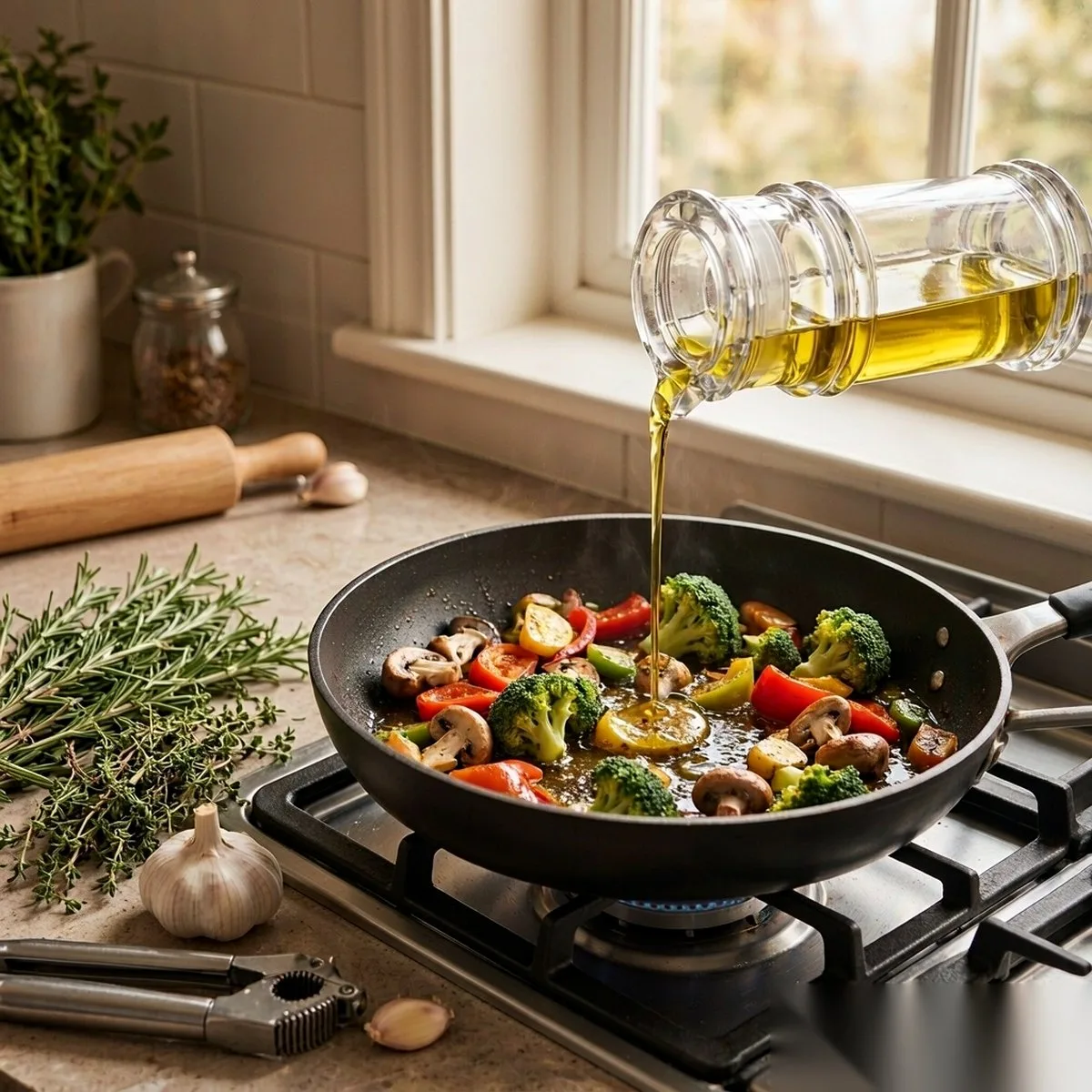
Fill to the shoulder, tip slowly, and watch the first second. A stream that lands on the cloth instead of the bowl is a bottle that will be held further away next time, which means a longer, faster, messier pour. Ask for the working sample to be filled to the level the kitchen will actually use, not to the brim.
Pour Two — What Happens in the Last Second
Stop mid-pour, the way a busy waiter stops. The interesting event is the moment the bottle comes back upright: a well-formed neck pulls the last of the stream back down with it, and a badly formed one lets it fall. Time it. One second of after-flow is normal; two is a cloth.
- Thread finish. A crisp, full thread lets the lid seat in one turn. A thread with a thin or short section will cross-thread when someone is in a hurry.
- Lip edge. Run a finger round the opening. Any flash at all will hold a drop of oil permanently against the outside wall and stain whatever it touches.
Pour Three — The Mark on the Cloth
Wipe the outside dry after the second pour, set it down, and come back in ten minutes. What you are looking for is not the ring from the oil itself but the ring from the lid, because a lid that traps oil in its thread deposits it in exactly the same spot every time. A sample that passes all three pours is a sample worth confirming a fill line on.
Why This Whole Range Is PS, and Where That Stops Being True
Every model in the range is polystyrene. That is worth saying plainly, because most of the drinkware on the same site is polycarbonate, and buyers who have just read a guide about pitchers or tumblers tend to arrive expecting the same answer.
The reasoning is economic rather than technical. Polycarbonate costs more per kilogram and buys you impact resistance and clarity at thickness. A cruet is filled on a counter, carried at chest height and stood on a table. It is not knocked against a glass, it is not stacked wet in a rack, and it never sees a dishwasher hot enough to matter. You would be paying the PC premium for an impact that does not happen.
One case does justify asking for the other resin: if the bottles travel on a tray across a wet pass, and the failure you actually experience is a drop from waist height onto tile, that is an impact event and it is worth a conversation. Bring the incident, not the theory.
| Decision | PS (this range) | What would change it |
|---|---|---|
| Impact | Filled and stood, not knocked | Drops from a carried tray |
| Heat | Counter and table temperature only | Hot-hold or a hot wash tunnel |
| Clarity | Good enough for a coloured or printed label | Unfilled, edge-lit display use |
| Cost | Lower resin cost, more pieces per carton | — |
The Smallest Bottle Is Not the Cheapest to Ship
Carton yield across the range is not a straight line, and it runs in the opposite direction to the size you are buying. A small bottle occupies a small space, so a carton holds many more of them, so the freight cost per bottle falls faster than the unit price does.
| Model | Nominal volume | Pcs / carton | Carton size | Pcs per m³ |
|---|---|---|---|---|
| BY-9041 | ~794 ml | 96 | 54 × 36 × 65 cm | 760 |
| BY-9042 | ~552 ml | 96 | 66 × 47 × 30 cm | 1,032 |
| BY-9711 | ~500 ml | 108 | 45.5 × 44.5 × 43.5 cm | 1,226 |
| BY-9032 | ~285 ml | 144 | 47 × 35 × 42 cm | 2,084 |
| BY-9033 | ~231 ml | 192 | 65.5 × 44.5 × 27 cm | 2,440 |
| BY-9034 | ~135 ml | 240 | 39 × 29 × 51 cm | 4,161 |
Pcs per m³ = packing quantity ÷ carton volume, both taken from the published specification. The spread here is 5.5×.
Two things follow. First, if you are comparing a small bottle and a large one on unit price you are comparing the wrong numbers — ask for landed cost per piece at the carton quantity you will actually buy. Second, if your requirement is a given number of millilitres on the table, the larger and smaller bottles are not interchangeable on freight: the same fill can be delivered in a five-hundred-millilitre bottle or in two smaller ones, and the carton maths makes that a real choice rather than a stylistic one.
Four Size Bands, and What Each One Is For
Sorted by nominal volume the seventeen models fall into four working bands. Choose the band first; the model inside it is then a shape, a lid and a colour decision.
- Under 150 ml — the two-seat drizzle. BY-9034, BY-9036, BY-9034A, BY-9036A. Small footprint and the lowest carton cost per piece, and the right bottle for a caddy that has to hold four positions without taking over the table.
- 200–240 ml — the standard table cruet. BY-9035, BY-9035A, BY-9033, BY-9033A, BY-9713. The band most hotels settle on, because it holds a full service and still lifts in one hand.
- 280–400 ml — the sharing and buffet band. BY-9032, BY-9032A, BY-9031, BY-9031A, BY-9712. For a sharing dish or a buffet counter, where the cost you are trying to remove is the walk to the store room.
- 500 ml and above — the counter bottle. BY-9711, BY-9042, BY-9041. Fill-and-carry rather than table-top; the two models carrying the red and tea lids sit in this band.
The same catalogue holds the rest of the tabletop set. Oil bottles and cruets are the pouring pieces; condiment sets, seasoning bowls, squeeze sauce bottles, sugar bowls and jars, toothpick holders and napkin and tissue stands fill out the positions around them, and all of it sits inside the wider seasoning and condiment range.
If you are specifying a whole service rather than a bottle, these published guides cover the neighbouring decisions: condiment sets and tabletop accessories, bar supplies, bowls and plates, fruit plates and platters, water pitchers, cups and tumblers, champagne glasses, embossed and patterned drinkware and the material comparison.
Half the Colour Column Is Empty
Eight of the seventeen pages name a colour. Nine do not. The nine are not an error and they are not out of stock; the page simply does not declare one, and an undeclared colour is not a promise.
The paired models are the easiest place to see how this works. Six of the seventeen carry an a suffix, and each pair is the same mould in the same carton with the same packing quantity:
| Model | Declared colour | Sibling model | Declared colour |
|---|---|---|---|
| BY-9031 | Transparent | BY-9031A | Gold |
| BY-9032 | not declared | BY-9032A | Gold |
| BY-9033 | not declared | BY-9033A | Gold |
| BY-9035 | Pink | BY-9035A | Gold |
| BY-9036 | Pink | BY-9036A | Gold |
Two other models, BY-9041 and BY-9042, carry a variant note inside the model number itself — a red lid and a tea lid — which means the lid is a separate decision from the body and should be named separately on the order.
The practical rule: order the colour, not the photograph. A single product photo is one bottle from one mould; a mould produces a transparent shell and a metallised one, and a colour that is not written down cannot be held against a delivery.
Covers Per Bottle: The Top-Up Cycle
The last number to fix is not on the spec sheet at all, and it is the one the floor manager will judge the order by: how many covers a filled bottle serves before somebody has to walk back to the store room.
Take a nominal fill from the table above, then subtract what is never served — the oil left in the shoulder, the film that stays on the wall, the tenth of the bottle that a refill leaves. An experienced rule of thumb is that a cruet delivers roughly 80 per cent of its nominal cylinder volume as usable pours.
- A ~396 ml cruet with a 5 ml drizzle is around 63 covers from the 80 per cent figure.
- The same bottle with a 15 ml pour into a sharing dish is around 21 covers.
- A ~135 ml cruet cannot cover a sharing table at all — it belongs on a two-seat table with a single drizzle application, and buying it for a buffet will look like a bargain for exactly one week.
Multiply covers per bottle by the number of bottles your table setting uses — oil, vinegar, soy, chilli is four positions on a four-position caddy — and you have the figure to plan a shift around rather than a single order quantity.
Before the Container: Six Confirmations and Where Each One Lands on Paper
Every one of the following is a one-line confirmation. The right-hand column is the point: each clause has to appear somewhere you can point at later, because a clause that only exists in an email thread will not settle a dispute when the container is on the water.
| What you are confirming | Where it should appear | Why it is worth the line |
|---|---|---|
| Fill line, in millilitres, at a stated height | Specification sheet, signed sample | The range publishes diameter and height, not volume |
| Resin, written as the material name | Order confirmation | Single-resin range today; a substitution is invisible in a photo |
| Colour, as a word, for each model ordered | Order confirmation, line by line | Nine of seventeen pages do not declare a colour |
| Lid type, if it is not the standard lid | Order confirmation | Some models carry a second lid variant in the model name |
| Food-contact documentation, by document number | Certificate pack shipped with the goods | Ask which report travels with this particular order |
| Carton dimensions as shipped | Packing list | Carton yield drives landed cost more than unit price does |
FAQ: Oil Bottles and Cruets for Hotels
What volume does a Φ6 × 14 cm cruet actually hold?
The published sample size gives a nominal cylinder volume of about 396 ml, which is the space the body could hold if it were a straight tube. The usable fill is lower, because the neck occupies part of the height and a lid needs headspace. Treat 396 ml as the ceiling and ask for the fill line to be marked on the sample before the order is confirmed.
Why is the whole range polystyrene rather than polycarbonate?
All seventeen models are PS. A cruet is filled on a counter, carried at chest height and stood on a table, so it does not take the impacts that justify polycarbonate in a tumbler, and it does not meet the temperatures that would require it. Choosing PS here keeps the resin cost and the carton weight down. If your failure mode is a dropped bottle from a carried tray, say so and the resin question is worth reopening.
Can two colours of the same bottle ship in one order?
Yes, and the paired models are built for exactly that. Six models exist as a plain and an a version at the same size, in the same carton, with the same packing quantity; the difference between them is the colour that is declared on the page. Name the colour you are ordering for every line rather than relying on the product photograph, because nine of the seventeen pages do not state one.
How many cruets does a 120-seat dining room need?
Work from covers per bottle rather than from seats. A 120-seat room set four to a table is 30 settings; with oil and vinegar on each, that is 60 bottles in service before any spares. Add a working buffer of one refill per bottle per shift and a small spares bin for threads and lids, and the order lands between three and five cartons depending on the model.
What paperwork should travel with a cruet order?
The specification sheet with the confirmed fill line, the order confirmation listing resin and colour per line, the packing list with the as-shipped carton dimensions, and the food-contact documentation requested in advance by document number. Ask for that last set with the enquiry rather than after the goods leave, because some of it is issued per order rather than per product line.
Tooling and moulding happen at our own works in Yongkang, Zhejiang; finished goods leave China via the ports of Ningbo and Shanghai. A single model starts at 500 pieces, and printed logos, a chosen colour and branded packaging are all made to order on the same production run. If you have a sample bottle in front of you and want a fill line confirmed against it, send the dimensions and a photograph through the contact page and we will answer with the measurement rather than the marketing line. Ask for the paperwork by its reference number rather than by name: the food-contact testing behind this range is SGS and the material compliance is RoHS, and both arrive as numbered documents, which is what lets you tie a report to your own container instead of to a general statement on a website. Put the destination market in your first message and we will set out in writing which documents travel with the goods. More about how the range is made sits on the about page.