Wine Glasses, Water Jugs and Tumblers for Hotels: One Order, Three Spec Sheets
Three Ranges, One Table
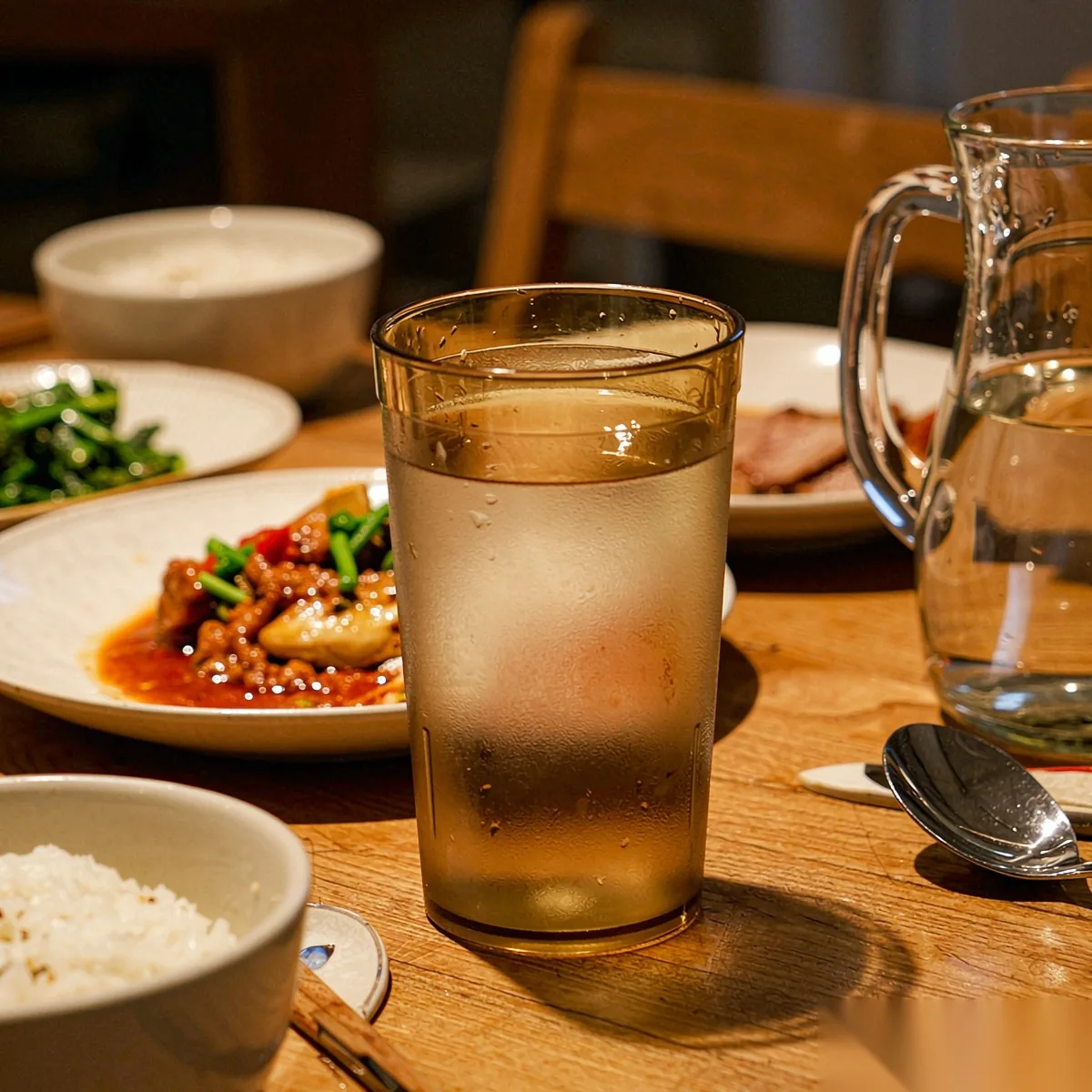
A jug, a stemmed glass and a tumbler do three different jobs on the same table, and they arrive at a hotel on the same purchase order more often than not. The jug stands at the end of the setting with the water for the whole table. The stemmed glass sits at one place and holds one drink at a time. The tumbler is the piece nobody counts: it turns up at breakfast, in the room, on the terrace and beside the pool, and it is the one that gets refilled without anyone watching.
Because they arrive together, buyers treat them as one purchase. Because they are published separately, they are three purchases with three different documents behind them. This guide reads the three ranges as this site publishes them — 35 wine and champagne glasses, 94 water jugs and carafes, 72 tumblers and cups, 201 product pages in all — and sets them beside each other in the units they genuinely share. Where the three cannot be compared, it says so rather than averaging them into a number that looks tidy.
Three Ranges, Three Resin Policies
A single word — polycarbonate — is how most suppliers describe a drinkware catalogue. Split the same claim across these three ranges and it comes apart into three different policies, and a buyer who writes “PC” once on an order has described one of them.
| Range | What the product pages state | Pages |
|---|---|---|
| Wine and champagne glass (35) | PC (polycarbonate) | 27 |
| PMMA (acrylic) | 6 | |
| not stated | 2 | |
| Water jugs and carafes (94) | PC (polycarbonate) | 59 |
| PC body with a lid in stainless steel or bamboo | 34 | |
| PS (polystyrene) | 1 | |
| Tumblers and cups (72) | PC (polycarbonate) | 32 |
| PS / PC, both letters in one cell | 20 | |
| PS (polystyrene) | 18 | |
| AS | 1 | |
| not stated | 1 |
Every figure is a count of published pages, read from the three ranges on 5 October 2026.
Three things follow, and each of them changes what goes on an order. The stemware range carries two resins inside one capacity ladder: six pages — BY-9918-1, BY-9918-2, BY-9918-3, BY-9919-1, BY-9919-2 and BY-9919-3 — are acrylic, and every other page in the range is polycarbonate. Shot the same way and priced in the same band, the two groups read as one line. They are not, and the difference is the thing a glass meets first: a knock at the rim. Acrylic takes a sharper moulded edge at a lower cost; polycarbonate takes the impact that keeps a glass on a tray after a shoulder in a crowded room. Ask which group a quotation is drawn from before the quantity is fixed.
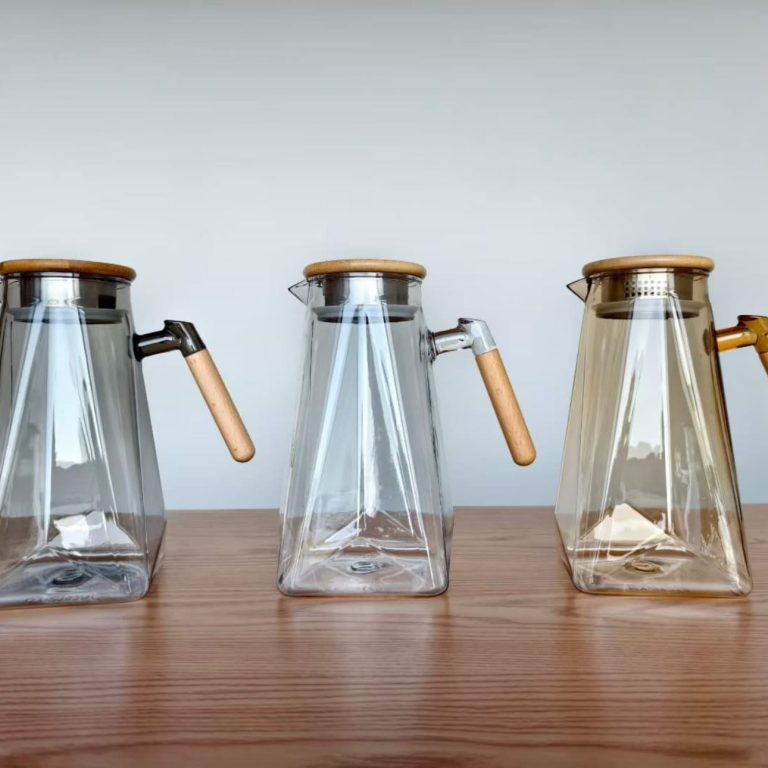
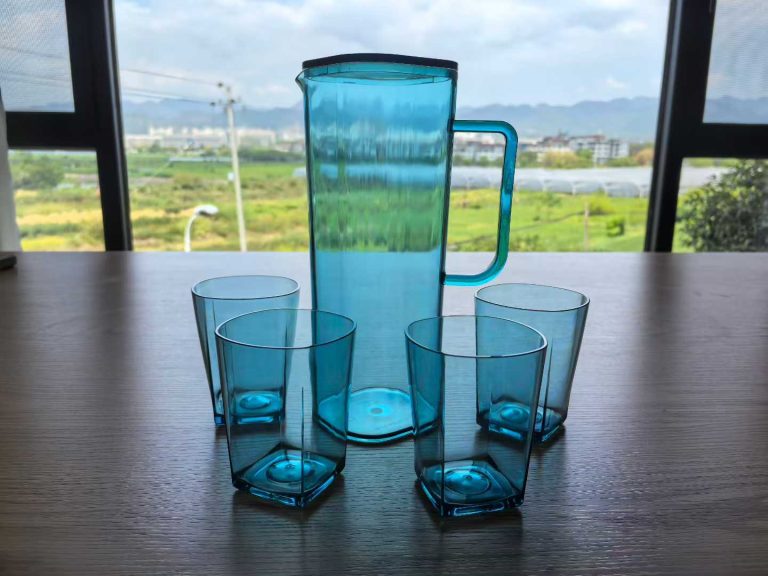
The jug range is polycarbonate top to bottom except for one model, BY-9163 at 1,100 ml in PS — but 34 of its 94 pages describe a second material in the same box. The lid is stainless steel or bamboo on those lines, so a jug order is not a single-material order, and a wash specification written for the body does not automatically cover the lid.
The tumbler range is the genuinely split one: 18 pages of polystyrene, 32 of polycarbonate, and 20 pages carrying both letters in one cell. That dual label is honest about real practice, because some of these models are moulded in either resin depending on the run. It is also a question rather than an answer, since a page that names both does not say which one is in the water. The ten sub-ranges under tumblers and cups inherit that split rather than settling it — octagonal glasses, diamond glasses, frosted glasses, striped glasses, polka dot glasses, bamboo joint glasses, pentagonal glasses, beer glasses, mouthwash cups and the bar and milk-tea range.
Six Hundred Millilitres Is the Only Volume the Three Ranges Have in Common
Sort all 201 pages by the capacity in the table and one figure turns up in all three ranges: 600 ml. Two of the three share 500 ml and 1,000 ml, and 50, 150, 250, 280, 330 and 550 ml are held in common by the stemware and the tumblers. Six hundred millilitres is the only number that belongs to all three, which makes it the one place where a like-for-like comparison is possible at all.
| Range | Model | Product size | Resin | Pieces per carton | Carton, cm | Pieces per m³ |
|---|---|---|---|---|---|---|
| Wine and champagne | BY-9912B | H20.5 × 6.7 × 8 cm | PC | 72 | 56 × 38 × 66 | 513 |
| Water jugs | BY-9170 | D6 × 20 cm | PC | 50 | 42 × 42 × 47 | 603 |
| Tumblers | BY-1748 | D8.9 × 12.7 cm | PS | 72 | 57 × 39 × 44 | 736 |
| Tumblers | BY-8068 | D7.8 × 15.5 cm | PS / PC | 60 | 51 × 42 × 32 | 875 |
The density figure comes from dividing the pieces in a carton by the volume of the carton, both read from the same page.
Four objects, one volume: a 20.5 cm stemmed bowl, a 20 cm carafe, a short tumbler and a tall tumbler. Two of the four are polycarbonate, one is polystyrene and one may be either. Put them in a cubic metre and the gap widens again — 513 pieces of stemware, 603 jugs, 736 or 875 tumblers. Nominal capacity is where a comparison starts, not the unit it finishes in, because what the container charges for is the geometry that carries the volume, not the volume.
One caveat belongs beside any capacity column: a published figure is a nominal fill, usually to the rim, and a served measure sits below it. Where a glass is judged on a 175 ml pour, ask for the level rather than the capacity. BY-9175C shows the other edge of that problem — it publishes 600 ml and a packing quantity and no carton at all, so it cannot be compared on volume until somebody supplies the box.
The Three Sheets Do Not Have the Same Columns
Here is the comparison that decides how much work a three-range programme really is. Take the eight attributes this catalogue uses and count how many pages in each range fill each one in.
| Attribute | Wine and champagne (35) | Water jugs (94) | Tumblers and cups (72) |
|---|---|---|---|
| Model number | 35 | 94 | 72 |
| Product size | 35 | 54 | 72 |
| Capacity | 12 | 91 | 69 |
| Material | 33 | 94 | 71 |
| Packing quantity | 35 | 79 | 71 |
| Carton size | 33 | 75 | 71 |
| Available colours | 0 | 47 | 8 |
Counts are pages that publish a value in that column. The three ranges are filled in to three different depths, and the empty cells are in different places.
Read the Capacity row first, because the gap is widest there. Twelve of the thirty-five stemware pages publish a volume; the other twenty-three publish none — not in the table and not in the title. That is not a fault to be corrected before anyone buys, it is the shape of the range: the stemware line has been built around bowl names and a diameter, and a buyer who wants a volume has to ask for it. It also explains the previous section: inside the stemware range there were only twelve volumes available to be shared.
Then read Product Size, where the gap runs the other way. Forty of the ninety-four jug pages publish no dimension at all; they publish a capacity instead, and the pages fall into families — the full-handle models, the half-handle universal models, the half-handle stainless steel models and the juice pitchers — where one specification sheet covers a whole group. A jug buyer who needs a height for a shelf gets it by asking rather than by reading.
Then read Available Colours, and note which range carries the least. Not one of the thirty-five stemware pages lists a colour. Forty-seven jug pages do, because a lid in steel or bamboo arrives in finishes somebody has to choose between. Eight of the seventy-two tumbler pages do. Where appearance is doing most of the work in the buying decision, the sheet says least about it.
The practical fix costs one email. Pick the four fields that decide your programme — volume, resin, carton and colour — and ask for them back on one template for all three ranges. Copying each range’s own columns into one spreadsheet is what produces a comparison with two thirds of the cells empty and the empty cells in different rows.
Three Ways to Write Down the Same Measurement
The dimension column is the other place the three ranges refuse to line up. Each has its own convention, and inside the tumbler range there are four.
| Range | How the size is written | Examples from the range |
|---|---|---|
| Wine and champagne | two numbers — usually bowl diameter and height — and on some rows the axis letters are spelled out | 8.5 × 20.2 cm · H24.2 × T5 × D5.5 × B7.2 cm |
| Water jugs | Φ or D followed by height | Φ8.5 × 24 cm · D8 × 16 cm |
| Tumblers and cups | Φ or D, or a three-axis stack notation, and on some rows no prefix at all | Φ7.6 × 9 cm · D8 × 5.7 × 18 cm · Top Dia. 7.7 × Bottom 6 × Height 9.6 cm · 10 × 8 cm |
Quoted from the live specification tables of the three ranges.
None of these is wrong and none of them is the same, so the small piece of work has to happen before the order: for each range, ask for top diameter, base diameter and height, written with the letters, in one column. The base diameter earns its place beside the top for three concrete reasons. A jug’s base decides whether it stands upright in a glass-washer basket. A tumbler’s base decides how a hundred of them behave when they are stacked in a cupboard. A stemmed glass’s foot decides how much of a tray it takes and how the tray behaves when it is carried one-handed.
One row deserves a question rather than a reading. BY-9161 publishes 1,250 ml and a product size of 63 × 38 × 47 cm — the same three figures as the carton of BY-9163 in the same range. A dimension that size is a box and not a jug, and a shelf built to that number will be built wrong. It is one row out of 201, which is exactly the point: in a catalogue this size the exceptional row is the one that costs somebody an afternoon.
A Carton Holds Twenty-Four Jugs or Three Hundred Cups
Packing quantity is the first number that behaves completely differently across the three ranges, and it is the one that turns a quotation into a shipment.
| Range | Pages publishing a quantity | Smallest carton | Largest carton | Examples |
|---|---|---|---|---|
| Wine and champagne | 35 of 35 | 48 pcs | 144 pcs | 48 (BY-8061) · 120 (BY-8008) · 144 (BY-9912H) |
| Water jugs and carafes | 79 of 94 | 24 pcs | 75 pcs | 24 (BY-9183B, white box) · 50 (BY-9170) · 75 (BY-9310B) |
| Tumblers and cups | 71 of 72 | 30 pcs | 300 pcs | 30 (BY-8069) · 140 (BY-8020B) · 300 (BY-8015) |
Ranges are quoted from the live packing-quantity column.
Three consequences follow, and all three are administrative before they are physical. The first is that a minimum order of five hundred pieces is a different shipment in every range. At the representative models above, five hundred stemware pieces leave as seven cartons, five hundred jugs as ten, and five hundred tumblers as two. The minimum is the same figure in all three quotations and a completely different amount of floor space, paperwork and freight.
The second is that a carton is a handling decision as much as a packing one. Twenty-four jugs of 1,500 ml in a presentation box and three hundred tumblers of 210 ml are both described as one carton, and only one of them is lifted by one person and stacked five high. Weight is not published anywhere in these three ranges, so the question worth asking is not how heavy a carton is but how high it stacks — the answer comes back quickly and it settles the pallet plan.
The third is that a programme multiplies. Three ranges at four models each is twelve minimums before anything interesting has happened, and the arithmetic is easier to picture in cartons than in pieces: at roughly seven, ten and two cartons per model, twelve models is about seventy-six cartons — a pallet and a half rather than a container.
What a Cubic Metre Holds of Each Range
Container freight is priced on space, so the number that decides what a load really costs is not the unit price but the count that fits in a cubic metre. Computed across all three ranges, the answer separates both between the ranges and inside them.
| Range | Pages with both figures | Lowest | Median | Highest | Spread |
|---|---|---|---|---|---|
| Water jugs and carafes | 75 | 179 (BY-9183B) | 420 | 1,072 (BY-9310B) | 5.99× |
| Wine and champagne | 33 | 426 (BY-9920A) | 785 | 3,319 (BY-9912H) | 7.78× |
| Tumblers and cups | 71 | 330 (BY-9332) | 1,524 | 8,342 (BY-6621) | 25.24× |
Density is worked out page by page: pieces per carton divided by the volume of the carton, wherever a range publishes both figures.
Between the ranges, the medians separate by a factor of about three and a half: a cubic metre holds roughly 420 jugs, 785 stemmed glasses or 1,524 tumblers. Inside the ranges the spread is wider than most buyers expect, and the widest spread belongs to the range treated as a commodity. Twenty-five to one inside the tumbler range means the carton and not the cup decides the freight bill, and a programme costed from unit prices alone will be wrong by more than a container’s worth.
The lowest figure in the comparison is worth naming, because it is a choice rather than an accident. BY-9183B is a 1,500 ml full-handle jug packed twenty-four to a white box, and the presentation box is why it fills a cubic metre with 179 pieces where a plain-packed 500 ml jug manages 1,072. Six times the volume for a better-looking carton is a decision only the buyer can make; the point is that somebody should make it on purpose.
What Goes First Is Not the Same in the Three Ranges
The three ranges do not fail in the same place, which is why one durability clause cannot cover a three-range order.
| Range | Where it goes first | What the range publishes about it |
|---|---|---|
| Wine and champagne | the rim, then the bowl-to-stem or bowl-to-foot junction | nothing — no wall thickness, no weight, no drop height |
| Water jugs | the root of the handle, then the lip of the spout | the handle architecture, which the range already splits into four families |
| Tumblers and cups | the stacking rim, then the base | nothing, though the moulded pattern is the closest visible proxy |
Read from the published columns: the three failure points are described in the sections the ranges actually publish, and none of them is measured.
A stemmed glass is judged on whether it is still standing after a tray is carried between two tables. A jug is judged on whether it is still holding two litres after being lifted by one handle a thousand times. A tumbler is judged on whether its rim survives being nested a hundred deep, six times a day, for two seasons. Those are three different tests with three different answers, and not one of the three is a published figure.
There is a practical substitute for the missing numbers. Ask for one piece from each range and put the three of them through the journey the property actually runs: carry the jug full along the length of the room, set the glassware down on the tray you own, stack the tumblers as deep as the cupboard allows. An hour of your own service is worth more than any adjective in a brochure, and it is the only test that judges the three ranges on the thing they genuinely share — that a guest will one day knock one of them over. Each range also has a guide of its own, on wine glasses, on water jugs and on cups and tumblers, alongside the handle architecture and the champagne end of the stemware line.
One Container, Three Ranges
Take the medians and load a single 40 ft high cube at a working 67 m³ of usable volume.
| Range | Median carton | Pieces per carton | Cartons in 67 m³ | Pieces |
|---|---|---|---|---|
| Water jugs and carafes | 0.118 m³ | 50 | 567 | 28,350 |
| Wine and champagne | 0.097 m³ | 72 | 692 | 49,824 |
| Tumblers and cups | 0.079 m³ | 140 | 850 | 119,000 |
One container, three answers, and a factor of 4.2 between the heaviest and the lightest fill of the same box.
A single-range order is easy to plan. A three-range order is a division problem, and it is worth working once on paper.
| Range | Cartons | Pieces | Volume |
|---|---|---|---|
| Water jugs and carafes | 180 | 9,000 | 21.2 m³ |
| Wine and champagne | 230 | 16,560 | 22.3 m³ |
| Tumblers and cups | 280 | 39,200 | 22.1 m³ |
| Total | 690 | 64,760 | 65.6 m³ |
Arithmetic on the same medians, leaving 1.4 m³ of the 67 for pallets and door space.
Sixty-five and a half cubic metres of a sixty-seven cubic metre box, and nearly sixty-five thousand pieces across three ranges in one shipment instead of three. That is the reason to plan the ranges together even though they are sold separately: the container is the one line item where the three of them are genuinely one order. Read the arithmetic as a shape rather than a quotation — the medians come from the published cartons and a real load built on a different model mix will land somewhere else. What does not change is the division of labour: the jugs take the volume and the tumblers take the count.
What One Purchase Order Cannot Say for Three Ranges
| A single order line assumes | What the three ranges actually do |
|---|---|
| one resin | three policies — and 34 jug lines carry a second material in the lid |
| one carton count | 24–75, 48–144 and 30–300 pieces per carton |
| one lead time | a catalogue model is boxed inside a fortnight and a half; a run that needs a new mould takes about twice that |
| one certificate | the paperwork names the model it covers rather than the order |
Four lines that have to be written once per range instead of once per order.
None of these is a complaint about the ranges. Each is simply a line that has to be repeated three times, and the practical answer is a single sheet with three columns — one per range — carrying the same four fields: resin by name, pieces per carton, the lead time for the model quoted and the certificate reference that travels with it. Buyers who write that sheet find the three ranges behave. A single line describing “unbreakable drinkware” usually finds out at the port instead.
Send the three ranges you are considering, the capacities you have settled on and the market the goods ship to, and the reply comes back as three columns rather than one — a resin line, a carton count and a container plan for each range. The about page covers how the catalogue is made; an enquiry goes through the contact page.
On documentation the position is deliberately narrow. The food-contact testing behind this catalogue is SGS and the material declaration is RoHS, and both name the model they cover, so a certificate can be filed against a carton rather than against a general statement. What a shipment needs at a border is set by the country it enters, so the useful move is to say where the goods are going and let the answer come back per range. The materials comparison covers where the two resins belong when the open question is which one suits a station.
Yongkang, in Zhejiang province, is where the moulds for all three ranges sit, and the cartons are booked out of Ningbo or Shanghai. The minimum for a single model is five hundred pieces, and adding a logo, a custom tint or branded packaging does not raise it, because those travel on the same production run as the plain version.
Programmes that include these three ranges usually extend in four directions.
- Up the stemware line: the wine and champagne glasses range carries champagne glasses and decanters and carafes beside the wine service.
- Behind the bar: beer glasses for the taps and bar supplies for everything that never sees a glass.
- Along the buffet and into the room: ice cream cups, bowls and plates, fruit platters and condiment sets and cruets.
- Adjacent to the same tabletop: the handled jugs for pour-from-the-side service and the patterned drinkware where the mould carries the design. The full catalogue sits under All Products.
FAQ: Wine Glasses, Water Jugs and Tumblers for Hotels
Can all three ranges go on one purchase order?
Yes, and most hotel programmes are bought that way. The order needs three lines rather than one, because the resin policy, the carton and the lead time differ by range. Give each range its own line with its own resin name and its own packing quantity and the order is straightforward; combine them into one line and the differences surface after the goods are on the water.
Why do most wine glass pages not list a capacity?
The stemware range has been built around bowl names and diameters, so only twelve of its thirty-five pages publish a volume and twenty-three publish none — neither in the table nor in the title. The figure exists, it simply is not published on the page. Ask for the capacity and the served level of the specific model being quoted, and ask for both in writing, because a nominal figure read from a bowl shape is not the same as a pour.
Which of the three ranges is the most efficient to ship?
By volume, the tumblers. The median tumbler carton yields about 1,524 pieces per cubic metre against 785 for the stemware range and 420 for the jugs, and one container carries roughly 4.2 times as many tumblers as jugs. That is a statement about packing, not about value: jugs occupy the volume because a two-litre jug is a two-litre shape, and no carton can change the geometry of the object inside it.
The cup pages say PS / PC. Which resin will actually arrive?
Ask, and ask before the order is released. Twenty pages carry both letters because those models are moulded in either resin depending on the run, and a page that names both does not record which one is on the water. The useful question is not which resin is better but which resin this run uses, followed by a request to have the answer written on the confirmation.
How do I compare three quotations that use different units?
Convert everything to two figures: pieces per cubic metre and resin by name. A price per piece compares the wrong things when one range packs 24 pieces to a carton and another packs 300. Once both figures are on one sheet the differences between the three ranges become visible in the same column, which is all a programme needs to make a decision rather than a guess.