Stainless Steel Cutlery for Hotels: A Wholesale Buyer’s Guide
Cutlery is the one thing on a restaurant table that is bought by the piece and lost by the piece.
Nothing in this range shatters on a tile floor, so the material argument that runs through most
hotel-supply conversations barely applies. Every one of the 250 lines just added to the
Cutlery & Tableware Series reads Material: Stainless steel and stops there — which is true, and which
settles almost nothing.
What is left to decide is more interesting. How many pieces are in a set, and what that number
says about where the goods are going. What colour the metal is, and why the colour clusters the way it
does. How many different numbering systems sit inside a single category. And four numbers that would
decide the whole purchase — weight, grade, carton yield, finish — none of which appears
anywhere in the range.
Four Pieces or Forty-Eight: the Set Size Is a Channel Map
Line the 250 products up by the number printed next to each set and a shape appears that has
nothing to do with styling. Set sizes run from a single piece all the way to 48, but they do not spread
evenly, and each cluster belongs to a different kind of buyer.
| Pieces per set | Lines in the range | Where they sit |
|---|---|---|
| 4 | 107 | Loose service sets |
| 5 | 49 | Loose service sets |
| 6 | 23 | Loose service sets, gift boxes |
| 2 | 21 | Gift boxes, kids’ sets |
| 3 | 15 | Loose service sets |
| 12, 16, 24, 32, 48 | 18 | Canteen, tray and tube sets only |
The Four-Piece Cover Is the Default Unit
Four pieces take 107 of the 250 lines, and five take another 49. That is a range built around the
Western à-la-carte cover — fork, knife, spoon, teaspoon, with the five-piece version adding
a second spoon or a dessert fork. If your dining room is a rice-and-spoon service, that fourth piece is
the one you will buy, store, count and replace without ever putting it on the table. It is worth looking
at the three-piece lines before accepting a four-piece default.
The spread inside this family is wide enough to be useful. A plain cover is available as
model 219 (4 pieces), as HK1013, as PT001 and as CX4 — same piece count, different handle geometry, which is the only
thing that changes the feel in the hand. Higher up the range sit YR-FT001 (5 pieces) and model 327, and the
five-piece mouldings include YR-FT014 (model 6459) and 1032A.
Everything Above Ten Pieces Is a Canteen Purchase
Of the 18 lines that carry more than ten pieces, every single one sits in
Canteen, Tray & Tube Sets. Nothing in the loose-set family goes past ten, and nothing in any gift family goes past six.
The reason is straightforward: past ten pieces you have stopped buying a cover and started buying a
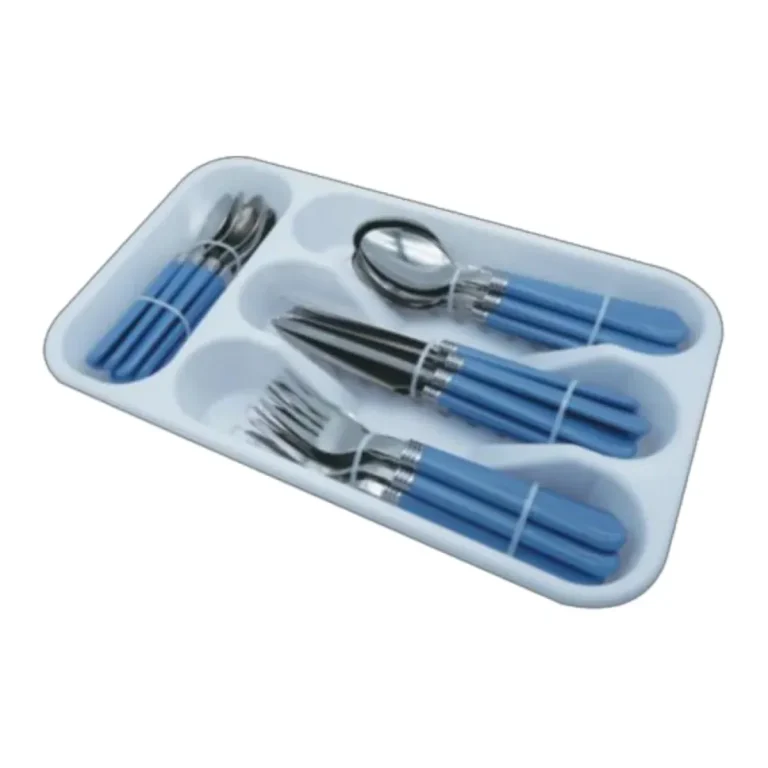
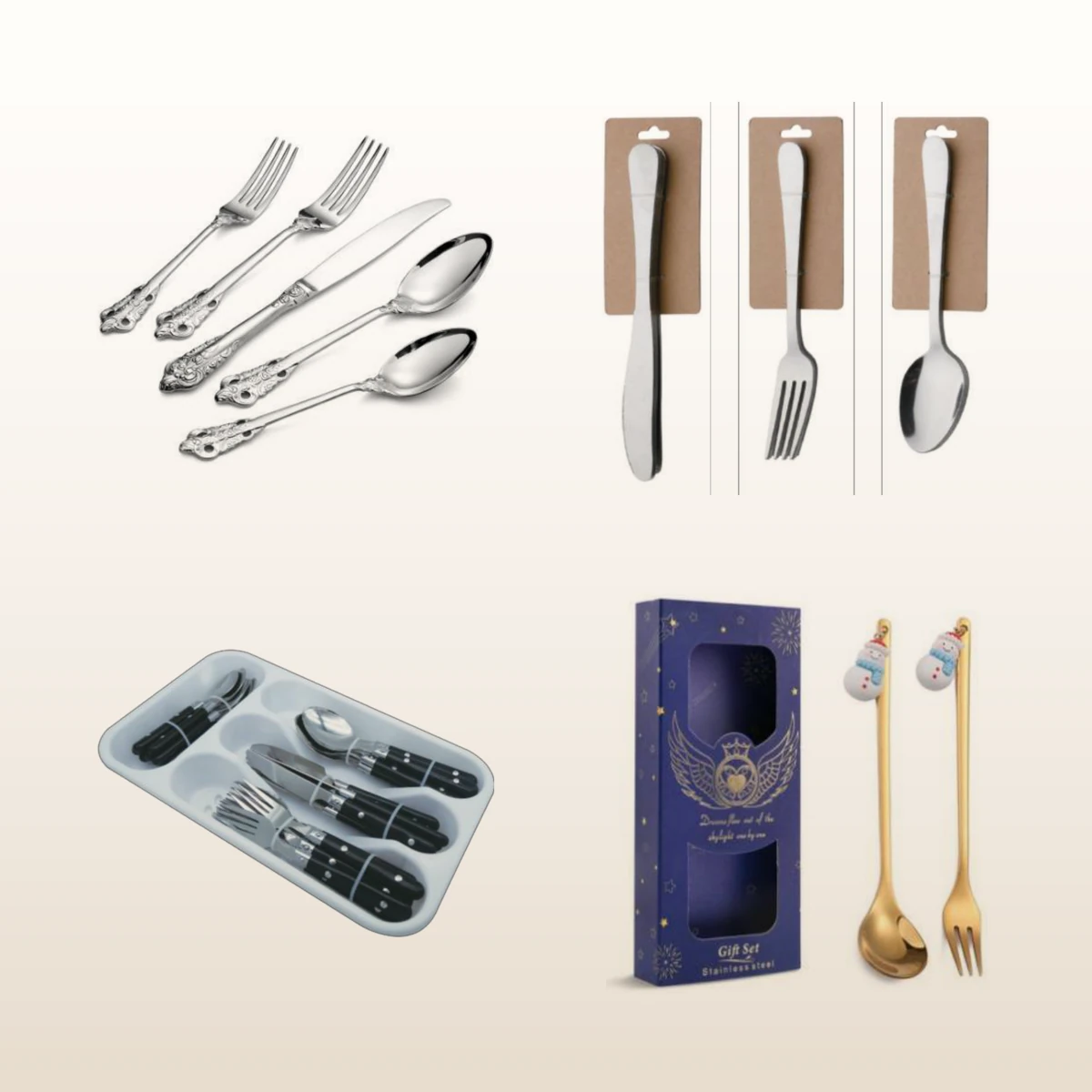
service, and the packaging changes with it — HD001 (24 pieces, moulded serving tray), HD002, 611P-32 (32 pieces) or a clear storage tube.
Three of these are worth naming because they show how the set size is really a multiple rather
than a quantity. 2560-48, 5000A-48 and B8918-24 all divide cleanly into twelve four-piece covers, which is what
a canteen order actually is: twelve settings, packed as one carton. If your operation runs in covers,
order in multiples of four and the arithmetic stays honest.
Two and Six: the Retail End
The Boxed Cutlery Gift Set family runs 2, 4 and 6 pieces and never further. So does the Christmas family, where YR-FT162 and
YR-FT163 are typical, and the Kids’ range sits at two pieces flat — YR-FT101 and YR-FT102. These are not service
sets with a box around them; the box is the product. Buying them for a dining room means paying for
printed packaging that goes straight into a bin, and buying loose lines for a retail shelf means selling
steel with nothing to hold it. The two-piece boxed lines — YR-FT115 and YR-FT134 among them — are
the clearest cases of this.
Silver Goes into the Kitchen, Gold Ends Up in a Box
Across the whole range the colour count reads Silver 184, Gold 61, and five lines offered in
both. That looks like a taste split. Sorted by packaging it is not a taste split at all — it is a
channel map, and a very sharp one.
| Family | Lines | Silver | Gold | Both |
|---|---|---|---|---|
| Stainless steel cutlery sets | 162 | 156 | 5 | 1 |
| Canteen, tray and tube sets | 22 | 20 | 2 | 0 |
| Boxed cutlery gift sets | 56 | 7 | 49 | 0 |
| Christmas gift sets | 7 | 0 | 3 | 4 |
| Kids’ cutlery sets | 3 | 1 | 2 | 0 |
Gold is 88 per cent of the boxed gift family and three per cent of the loose sets. Silver is the
reverse. The pattern is consistent enough to plan around: gold is a presentation finish, ordered because
the goods are going onto a shelf or into someone’s hands as a gift, and silver is a working finish,
ordered because the goods are going into a dish rack.
“Stainless Steel” Is True of the Substrate and Silent About the Surface
Here is the part worth slowing down for. Every one of the 250 pages prints
Material: Stainless steel, and on a gold line that statement is about the steel underneath the
colour. The colour itself is a second process applied on top of the steel, and the specification table
has no row for it. The same gap runs the other way: on a silver line, “Silver” names a colour
and says nothing about whether the surface is mirror-polished, satin-brushed or a matte tumble finish.
Two pieces with the same model number shape and the same photograph can differ on all of it.
This matters most where the finish meets a dishwasher, because the finish is what leaves first.
A mirror-polished surface shows the first clouding early; a brushed surface hides it and then thins
unevenly; a coated colour can lift at the contact points and along the bowl edge, which is where a
spoon actually touches a bowl. None of that is visible in a catalogue photo, and all of it decides what
the table looks like in year three.
Ask About the Finish, Not the Colour
Colour is a legitimate thing to order; it is just not a specification. Three sentences close the
gap, and they belong on the quotation rather than in a chat message. First, name the surface finish and
not the colour — mirror, satin or tumble — and ask for a sample of the actual production
finish rather than a promotional piece. Second, on any gold or coloured line, ask which process produces
the colour and how it is applied. Third, ask what the finish is expected to look like after three hundred
commercial wash cycles, and get the answer in writing. A supplier who has thought about this will answer
in one line; a supplier who has not will answer with the word “stainless”.
Eighteen Numbering Systems Under One Category
Sort the 250 model numbers by their leading letters and something unusual shows up. This is not
one numbering system with 250 entries in it. It is a collection of at least eighteen, bolted together
under a single category.
| Prefix family | Lines | Example |
|---|---|---|
| YR-FT | 164 | YR-FT014 |
| no prefix, pure number | 34 | 6459, 15230 |
| CX | 7 | CX4 |
| M | 7 | M168 |
| HK, HD, PT, B, YS, D, OND, PG, SX | 33 | HK1013, PT001, SX032 |
| YR-HFT, DK, OS, P, PGD, YT | 9 | YR-HFT001, YT004-DK |
For comparison, the drinkware side of this site runs one numbering block from end to end. The
tableware range does not, and the reason is honest: it was assembled from several workshops, and each
workshop arrived with its own label gun. Keeping the numbers as issued is the right call — renaming
them would break the paper trail back to the factory — but it changes what a model number is worth
to you.
It is worth one line of explanation. A model number in this range is a workshop’s internal
code, not a standard. 6459 and 611P-32 and B8918-24 tell you nothing about how many pieces are in the set or what the
handle looks like, because the number was never designed to carry that. So when two suppliers quote what
looks like the same reference, similar references are not evidence of the same product. Ask for a
photograph of the production item beside the model number, and compare the handle, not the digits.
The Four Numbers the Range Does Not Print
Every product page in this range carries the same short specification table. It is accurate and
it is complete as far as it goes, which is not very far. Counted across all 250 pages, this is the field
coverage:
| Field | Pages carrying it |
|---|---|
| Model number | 250 of 250 |
| Material | 250 of 250 |
| Available colours | 250 of 250 |
| Pieces per set | 241 of 250 |
| Packaging | 76 of 250 |
| Product size | 0 of 250 |
| Carton size | 0 of 250 |
| Packing quantity | 0 of 250 |
| Unit weight, steel grade, finish | 0 of 250 |
That is not a defect in the catalogue; it is how this trade prints. A cutlery catalogue shows
the shape, the piece count and the box, and leaves the engineering to the quotation. But it does mean
four numbers have to be asked for in writing before you can compare anything.
Grams per Piece
Weight is the number that decides how a piece behaves. A heavier piece sits still on a plate
edge, is noticed when it falls, and survives being scraped into a tub; a light piece leaves the table
without anybody hearing it. It also decides what the bussing tub weighs at the end of a shift, which is a
staffing question rather than a product question until somebody’s wrist answers it. Ask for grams
per single piece, not per set.
The Grade Behind the Word “Stainless”
“Stainless steel” covers a family of alloys that behave differently and cost
differently, and the difference shows up in a dishwasher and in a price list rather than on a photo. Two
quotations with the same picture and the same set size can sit on different alloys. Ask which grade, and
ask for it on the paperwork.
Carton Yield
With no carton size and no packing quantity anywhere in the range, you cannot work out freight
or shelf space from the product pages at all. For a loose 4-piece set this matters less; for
a canteen line — 48 pieces to a set — it is the difference between one pallet and four. Ask
for sets per carton, carton dimensions, and cartons per pallet, and price the freight off those rather
than guessing.
Where the Finish Sits in the Price
The fourth missing number is the one this article has already argued for: mirror, satin or
tumble, and on coloured lines, the coating. It is the easiest of the four to leave out of a quotation,
because a sentence about polishing reads like decoration until the first reorder arrives looking
different from the first delivery.
What 500 Pieces Means Depends on the Line You Are Standing On
One more number deserves its own section, because it is printed on every page and it does not
mean the same thing twice. The minimum order line on each product page reads 500 pieces.
Put that line beside a two-piece gift set and it is an instruction to buy 250 sets. Put the same
line beside a 48-piece canteen set and 500 pieces is ten sets and a fraction — a quantity that is
not even a whole order. Nothing on the page says whether the minimum is counted in sets or in single
pieces, and the two readings differ by a factor of 48.
This is the single most useful sentence to settle before a price is agreed, because everything
else hangs on it: the volume discount, the freight estimate, the warehouse space, and whether the order
is viable at all for a 90-seat restaurant. Write it as a question with two boxes to tick — minimum
of 500 sets, or minimum of 500 single pieces — and ask for the answer in the
quotation. On the loose four-piece families the two readings are close enough that the distinction
rarely bites; on the canteen families it is the whole order.
For practical planning, a complete four-piece cover means four different models, so the smallest
order that furnishes one cover type in real service quantity works out to two thousand pieces, or five
hundred covers. If your dining room seats one hundred and twenty, a single round of orders is more than
four times the working stock. That is not a reason to order less — it is a reason to know your
annual loss rate before the carton arrives, because the covers you already own are the covers you are
replacing.
Where Cutlery Goes Missing
Because nothing here breaks, the replacement budget is not a breakage budget. It is an attrition
budget, and it is worth knowing which door the pieces use on the way out. In a normal week there are six
of them: the tub the server scrapes plates into; the rolled napkin that goes in the bin still wrapped; the
bottom of the dish rack, tipped out with the water; the floor edge by the pass, swept up with the crumbs;
the guest’s pocket, most often with a teaspoon or a steak knife; and the rubbish bag at the end of
the night, when a tray is emptied in a hurry.
Two product properties change how many pieces use each door. Weight is the first: a heavier piece
is less likely to be swept off a plate edge and more likely to be spotted on the floor. Handle length is
the second: a longer handle stands proud of a stack, which makes it easier to count and harder to
disappear. Neither is printed on any page in this range, and both are answerable in one question.
The counting device is cheap and worth doing once. Ask the dish-return team to weigh the cutlery
tub at the end of three separate shifts and write the number on the wall. Carry a full load across the
room once and feel where it sits. Then set a reorder point from a real figure instead of from a guess,
and re-check it after a season. A kitchen that knows its monthly loss number stops arguing about unit
price, because the loss number is almost always larger.
Five Questions for Two Suppliers Quoting the Same Photograph
Two quotations can carry an identical picture, an identical piece count and an identical colour,
and still be different purchases. These five lines separate them, and all five are answerable in writing
within a day.
- Is the five-hundred minimum counted in sets or in single pieces? On a two-piece
set the two readings differ by half; on a 48-piece set they differ by a factor of 48. - What is the steel grade, and what does one single piece weigh in grams? These two
numbers separate alloys and handle weights that a photograph cannot. - On a coloured line, which process applies the colour and how is it applied? And
on a plain line, is the finish mirror, satin or tumble? Ask for a sample of the production finish. - How many sets fit in one carton, and what are the carton and pallet dimensions?
Without these, freight and warehouse planning are guesswork. - Which documents travel with the shipment, and what is each one’s reference
number? Ask for the references rather than the category names, so the paperwork can be tied to
your consignment instead of to a general claim. A test report and an import permission are two different
things, and a supplier who is comfortable with the distinction tends to draw it before you ask.
One more line, about timing. A standard model in this range is ready in seven to fifteen days;
a run that needs new tooling runs closer to thirty. That gap is worth knowing before the question of a
custom logo, a chosen colour or branded packaging comes up, because it is the difference between
restocking and a project.
The Range as a Whole, and Where to Start
Read as a whole, the Cutlery & Tableware Series is a sourcing range rather than a product line: 250 items, several
workshops, eighteen numbering systems, a colour split that tracks packaging rather than taste, and set
sizes running from one piece to forty-eight. That makes it broad, and it makes the specification work
yours to do. The five sub-families are the fastest way in: Stainless Steel Cutlery Sets for working covers, Boxed Cutlery Gift Sets and
Christmas Gift Sets for shelf and gifting, Canteen, Tray & Tube Sets for institutional volumes, and the Kids’ range for smaller hands.
The shortest useful next step is to send us the cover you actually run: pieces per cover, the
seats you set, and the finish you want to see in year three. We will come back with the corresponding
lines, the weight and grade of each, and the carton figures, so the quotation can be compared line by
line rather than photograph by photograph. More about how we work is on the About Us page, and the
Contact Us page is where a first enquiry begins.
Questions Buyers Ask About Stainless Steel Cutlery
What does a four-piece cutlery set actually contain, and is it the right cover for a hotel dining room?
A four-piece set is a fork, a knife, a spoon and a teaspoon — the Western table cover. Four pieces is the largest single group in this range, at 107 of 250 lines, with five-piece sets making another 49. Choose it when every seat gets all four pieces; if your service is one main utensil plus a spoon, the three-piece lines save you buying, washing and replacing a piece that never reaches the table.
Why are most gift-boxed cutlery sets gold while most loose sets are silver?
Because the colour tracks the presentation format rather than a design preference. Across the range, 49 of 56 boxed gift sets are gold and 156 of 162 loose stainless sets are silver. Gold is usually ordered as a presentation finish for retail shelves and gifting; silver is ordered as a working finish for the dish rack. If you need one colour across both a retail line and a dining room line, say so at enquiry stage, because the finish is a separate process from the steel.
Can stainless steel cutlery go through a commercial dishwasher every day?
The steel will, and the finish is what you should ask about. The pages in this range state the material as stainless steel; they do not state the grade or the surface finish, and those are the two variables that decide how a piece looks after a few hundred wash cycles. Ask which grade, ask whether the surface is mirror, satin or tumble, and on coloured lines ask how the colour is applied and how it behaves at the contact points where a spoon meets a bowl.
What does a 500-piece minimum order mean when a set contains 48 pieces?
That depends on the unit, and the page does not say. Read as sets, 500 means twelve thousand pieces; read as single pieces, it means ten sets and a fraction, which is not a whole order. Settle the unit in writing before agreeing a price, because on the loose four-piece families the two readings are close together while on the 48-piece canteen lines they differ by a factor of 48.
Which documents should arrive with a cutlery shipment, and in what form?
Ask for them by reference number rather than by category name, so that each one can be tied to your consignment rather than read as a general claim. Two things are worth keeping apart here: a test report proves what was tested, while an import permission is granted by the receiving country, and the two are not interchangeable. Which paperwork clears a consignment therefore depends on the destination market. Say which market the goods are destined for, and ask for the list of documents that will travel with the order in writing.
Elsewhere in this series: if the open question is which resin belongs where, begin with the
materials comparison. Stemware has its own notes in wine glasses and champagne glasses; the taps and the back bar in beer glasses and
bar supplies; guest rooms in cups and tumblers. For the table itself there are water jugs, handled pitchers, bowls and plates, fruit platters, condiment sets,
oil cruets and decanters.