Drinkware Sizes for Hotel Beverage Menus: From Serve Size to SKU
A Menu and a Catalogue Are Written in the Same Unit, and Read Differently
Both are lists of millilitres, which makes it tempting to lay one against the other and start matching. They do not match that neatly. A menu is a list of things a guest can order; a catalogue is a list of things that already exist. The gap between those two documents is where a first drinkware order usually goes wrong, and it is not a gap you close by reading more carefully — it is a gap you close with arithmetic.
This piece works that arithmetic out loud. It takes the full drinkware shelf and reads the capacity figures off every drink-serving vessel on it: the cup and tumbler range, the jug range, the stemware range and the dessert and ice-cream range. Four ranges, 274 specification rows, and one number that a beverage list cannot do without. What comes back is a shelf that is far denser than a menu needs in one direction, far thinner in another, and quietly silent on the field that decides how much a guest actually drinks.
If you would rather skip to the tool, the worked list in the middle of this article maps fourteen common menu entries onto the rungs that exist. Everything before it explains why the mapping is not one-to-one.
Four Steps Between a Recipe and a Rung on the Shelf
A recipe is written for a liquid. A purchase order is written for a vessel. Between the two sit four conversions, and only the first of them is something a kitchen controls.
| Step | The number you have | What happens to it | What it becomes |
|---|---|---|---|
| 1 | Recipe volume, e.g. 220 ml of latte | Nothing. This is the figure the barista works to. | 220 ml of liquid |
| 2 | Ice, if the drink is served over it | Displaces liquid. A full glass of ice leaves roughly two-thirds of the volume for the drink. | 330–350 ml of liquid plus ice in a 500 ml vessel |
| 3 | Fill line | Is not published on any page in this catalogue. You either measure it on a sample or accept the brim. | An unstated figure |
| 4 | Gross capacity of the vessel | Is the only millilitre figure the shelf publishes, and the only one you can order against. | A rung such as 350 ml |
The recipe figure is the only one you control
Nobody buys a glass because of a recipe. They buy it because the drink looks right in it, and the drink looks right when the liquid sits somewhere between half and three-quarters of the way up the wall. That is a visual judgement, which is why it is worth writing down as a number before the order goes out: ask for the fill volume, not just the capacity, and ask for it on the sample rather than in the abstract.
Ice is the conversion nobody prices in
A cold drink ordered in a 500 ml vessel does not deliver 500 ml of anything. Cubes stack, and the space between them is not all drink. A tumbler filled to the brim with ice and then with liquid carries in the region of 300 to 350 ml of the liquid itself — which is why a menu that specifies 400 ml of iced tea for a 500 ml rung is specifying the vessel correctly and the drink twice.
The practical consequence runs in both directions. Size the vessel for the liquid, and a cold menu drifts one rung up the ladder from where the recipe sits; size it for the appearance, and the recipe needs trimming. Either is fine. What is not fine is ordering to the recipe figure and then discovering the glass is a quarter empty at service.
No page in this catalogue prints a fill line
This is worth stating plainly because it is the kind of gap a buyer only notices after the first delivery. Counting every field name used across all 661 products on this site, there is no field anywhere for fill volume, usable volume, net volume or pour line. The word does not appear once. What the specification tables carry is gross capacity — the volume the vessel holds if you fill it to the rim and stop.
For a jug that is fine: nobody fills a water jug to the brim. For a tumbler it matters, and it matters most at the sizes a cocktail or a long drink is served in. Treat the published figure as the outside of the envelope, then confirm the working line on a physical sample before the order is confirmed. A photograph will not tell you.
The rung that already exists is the one you buy
The last conversion is the one that decides the order. A menu can ask for any volume it likes; the shelf can only sell the rungs that are on it. So the useful question is not “what is the right size for this drink” but “which rung is close enough, and what does the drink have to do to fit it” — and that question needs the ladder in front of you.
Fifty-One Capacities for a Menu That Needs Eight
Count out a mid-market beverage menu and the serve volumes collapse into a short list. An espresso; a 180 to 220 ml group for tea and filter coffee; 250 ml for juice; 300 to 350 ml for soft drinks and iced coffee; 400 to 500 ml for long cold drinks and draught beer; 500 to 700 ml for bubble tea; 150 ml for wine by the glass; and a litre for table water served by the jug. Eight bands, and a whole menu can be planned around them. The shelf answers with fifty-one numbers.
Here is the ladder. Across the four drink-serving ranges, 179 of the 274 specification rows publish a capacity figure, and between them they use 51 distinct values, running from 50 ml to 2,000 ml.
| Range | Rows | Publish a capacity | Published span | Resin on the shelf |
|---|---|---|---|---|
| the cup and tumbler range | 72 | 69 | 50 – 1,000 ml | PC on 32, PS on 18, PC/PS on 20, one acrylic |
| the jug range | 94 | 90 | 500 – 2,000 ml | PC throughout; 28 rows add a steel or bamboo lid |
| the stemware range | 35 | 12 | 50 – 630 ml | PC on 27, acrylic on 6 |
| the dessert and ice-cream range | 73 | 8 | 150 – 350 ml | PS on 37, PC on 12, mixed on 24 |
Where the rungs pile up
The ladder is not evenly built. Ten capacities carry six or more products each, and between them they hold 95 of the 179 rows — more than half the shelf on ten numbers.
| Capacity | Products | Ranges involved |
|---|---|---|
| 1,100 ml | 16 | jugs only |
| 1,500 ml | 13 | jugs only |
| 1,000 ml | 13 | twelve jugs and one cup |
| 2,000 ml | 11 | jugs only |
| 1,600 ml | 9 | jugs only |
| 500 ml | 8 | three jugs and five cups |
| 350 ml | 7 | five cups and two dessert vessels |
| 300 ml | 6 | five cups and one dessert vessel |
| 250 ml | 6 | five cups and one stem |
| 180 ml | 6 | four cups and two dessert vessels |
Read the column on the right and a pattern appears. Everything above 1,000 ml belongs to the jug range and nothing else. Everything a guest drinks from a glass sits below 1,000 ml and is spread thinly across cups, stems and dessert vessels. The shelf is deep where the table is served from, and shallow where the guest is.
Twenty rungs carry one product each
At the other end of the distribution, twenty of the 51 capacities are used by exactly one product. They are not clustered at the extremes either; they are scattered through the middle of the range, which is why a menu drawn from life keeps landing on them.
| Capacity | The only product on that rung | Its dimensions |
|---|---|---|
| 90 ml | BY-9204 | Φ6 × 6.4 cm |
| 170 ml | BY-9912F | 5.5 × 9 cm |
| 310 ml | BY-8021C | 8.4 × 9.2 cm |
| 320 ml | BY-6623 | 7 × 13.5 cm |
| 370 ml | BY-9304D | Φ7.6 × 5 × 14 cm |
| 380 ml | 9920D | 6.4 × 21 cm |
| 390 ml | BY-8018B | 7.5 × 13.7 cm |
| 410 ml | BY-8021B | 8.3 × 12 cm |
| 480 ml | BY-9337 | D9 × 6.5 × 20 cm |
| 510 ml | BY-8021A | 8.5 × 14.2 cm |
| 570 ml | BY-9304B | Φ9 × 5.8 × 16 cm |
| 580 ml | BY-1717 | D8 × 8.5 × 15.7 cm |
| 630 ml | BY-9920A | 7.5 × 25 cm |
| 650 ml | BY-8020A | 8.8 × 16.5 cm |
| 750 ml | BY-1787 | D9 × 16 cm |
| 900 ml | BY-9181 | D6.5 × 26.5 cm |
| 1,200 ml | BY-9166 | Φ8.5 × 24 cm |
| 1,450 ml | BY-9180 | D6.5 × 31.5 cm |
Two smaller rungs complete the list: 100 ml and 140 ml, both of them stemware. Eighteen single-product rungs spread from 90 ml to 1,450 ml is a lot of shelf committed to one drink each. It also means the ladder has holes where no product has ever been made, and two of those holes are wider than the rungs around them: there is nothing at all between 100 ml and 140 ml, and nothing between 650 ml and 750 ml.
Eight Products at 500 ml, and Not One Shares a Shape
One capacity proves the point better than the ladder as a whole. Five hundred millilitres appears on eight products. Eight products, eight different sets of dimensions — the proportion is exact, and it is not a coincidence.
| Product | Dimensions | Range | Resin |
|---|---|---|---|
| BY-9310B | D6.8 × 17.6 cm | the juice pitchers | PC |
| BY-9141D | D8 × 16 cm | half-handle jug | PC |
| BY-9144D | D8.5 × 16.5 cm | half-handle jug | PC |
| BY-1788 | D8.3 × 14.6 cm | the beer glasses | PC/PS |
| BY-1728 | D8 × 6.5 × 16.8 cm | the beer glasses | PC/PS |
| BY-8059 | 8.2 × 12.5 cm | the beer glasses | PC |
| BY-8020B | 9.2 × 10.4 cm | the bamboo-joint tumblers | PC |
| BY-9338 | D7.9 × 24.5 cm | the bar and milk-tea cups | PS |
The spread runs from 10.4 cm to 24.5 cm in height on the same stated volume. The tallest of the eight is BY-9338, at 24.5 cm; the widest 1,000 ml jug in the range stands 17.8 cm. Put the two side by side and the smaller vessel is nearly seven centimetres the taller — because one is a conical beer glass that flares, and the other is a wide-bodied jug.
This is the single most useful thing to understand about buying drinkware from a capacity number. The millilitres tell you what the vessel holds. They tell you nothing whatsoever about its height, its width, whether it will fit under a coffee machine spout, whether it will stand on a tray without tipping, or whether it will go through the glasswasher rack you already own. All of that is in the dimensions column, and on the eight 500 ml products it is different every time.
The Two Ranges Overlap Three Times
Cups run from 50 ml to 1,000 ml. Jugs run from 500 ml to 2,000 ml. The two spans cross over a five-hundred-millilitre band, and inside that band they meet at exactly three capacities.
| Shared capacity | On the cup side | On the jug side |
|---|---|---|
| 500 ml | five cups, three of them in the beer glasses | three jugs |
| 600 ml | two cups in the beer glasses, plus one stem | two juice pitchers |
| 1,000 ml | one cup, BY-8069, at D10 × 19.5 cm | twelve jugs across all four sub-series |
Three rungs in common between two ranges of 166 products. If a menu plan assumes the cup range and the jug range are interchangeable over their overlap, it is working from an assumption the shelf does not support — and the one cup that reaches 1,000 ml is the clearest example. BY-8069 is filed as a cup. At ten centimetres across and 19.5 cm tall it is a large vessel by any reading, and if a beverage list calls for a litre of iced tea served in something a guest drinks from, this is the shape that answers it. Everything else at 1,000 ml is a jug: poured from, not drunk from.
The practical rule that falls out of the overlap is worth writing into a menu brief. Below 500 ml, the cup range is the only place to shop. Above 1,000 ml, it is the jug range only. Between the two, check both — and check the dimensions, because a 500 ml cup and a 500 ml jug are not two versions of the same object.
The Small-Drink Band Publishes Twenty Rungs for Six Jobs
Set the jug range aside and look only at what a guest drinks from. Between 150 ml and 400 ml — the band that covers tea, coffee, juice, soft drinks, iced coffee and most of a cocktail list — the catalogue publishes twenty distinct capacities: 150, 170, 180, 200, 210, 220, 230, 250, 270, 280, 300, 310, 320, 330, 340, 350, 370, 380, 390 and 400.
Twenty rungs for what a beverage manager would describe as six jobs. The rungs are not evenly spaced either: at the crowded end four separate values sit inside 30 millilitres of each other, and the two widest holes in the whole ladder — nothing at all between 100 ml and 140 ml, nothing between 650 ml and 750 ml — sit just outside the band.
This density is not a fault in the range. It is what happens when a shelf is built to answer queries rather than to serve a plan: every time a hotel asked for something a little different, another mould was added at the volume that was asked for. Ordering from the shelf therefore means choosing between near-identical-sounding numbers, and the way to choose is to stop comparing capacities and start comparing geometry. Two rungs twenty millilitres apart are usually two different shapes; that difference is the one you can actually see on a tray.
| The band | Rungs available | What a menu usually needs |
|---|---|---|
| 50 – 140 ml | four: 50, 90, 100, 140 | espresso and a tasting pour — the thinnest part of the shelf |
| 150 – 250 ml | eleven, including six at 250 ml and six at 180 ml | tea, filter coffee, cappuccino, wine by the glass |
| 270 – 400 ml | nine | juice, soft drinks, iced coffee, cocktail, dessert service |
| 500 – 750 ml | six: 500, 510, 550, 570, 580, 600, plus 650 and 750 | bubble tea, draught beer, long drinks |
| 800 ml and up | ten, all jugs | table water, juice service, milk and cream |
The Band a Cold Menu Lives In Is the Band Built in PS
Capacity decides what the vessel holds. Resin decides what it can be asked to hold. Split the two drink-serving ranges by temperature band and the resin column sorts itself out in a way that has nothing to do with the drink list.
| Band | Products | PC | PS | Note |
|---|---|---|---|---|
| 50 – 299 ml | 27 | 17 | 8 | one acrylic; the hot-drink band |
| 300 – 599 ml | 40 | 17 | 23 | the only band where PS leads |
| 600 – 1,000 ml | 24 | 20 | 4 | PC resumes |
| 1,001 – 2,000 ml | 68 | 67 | 1 | jugs: one PS row in the whole band |
There is exactly one band in the whole set where polystyrene outnumbers polycarbonate, and it is 300 to 599 ml — tea mugs, tumblers, beer glasses, iced-drink cups, the working middle of a beverage menu. Twenty-three PS products against seventeen PC ones. Everywhere else the order reverses.
That is a decision about temperature, not about cost. PS is a cold-service resin. It tumbles, it is light, it is cheap to move, and it does not want boiling water in it. The tumblers filed under the bar and milk-tea cups, the octagonal tumblers and the small straight-walled cups are largely PS because they were designed for iced drinks, milk tea and juice — and the hot end of that same band is quoted in PC instead.
So when a menu brief says “a 350 ml tumbler for hot drinks”, the capacity is half the specification. The other half is the resin, and the shelf splits at exactly this point. Ask for the hot-service version and you will be quoted from the PC side of the band; ask for a cold drink and the wide PS side is open to you, including the shapes that cannot be made in PC at the same price.
The Catalogue Fills In the Carton Twice as Often as the Pour
Field coverage is not something a buyer usually audits, but it explains a great deal about how a drinkware catalogue behaves. Counting every field name used across all 661 products on this site gives this order:
| Field | Products carrying it |
|---|---|
| Material | 661 |
| Model Number | 613 |
| Packing Quantity | 380 |
| Product Size | 366 |
| Available Colors | 354 |
| Carton Size | 303 |
| Pieces per Set | 241 |
| Capacity | 187 |
| Packaging | 76 |
| Weight | 15 |
| Base Included | 4 |
Read that table as a statement of priorities. The carton is described on 380 pages. What the vessel holds is described on 187 — fewer than a third of the shelf, and roughly half as often as the box it travels in. Slightly further down, Weight appears on fifteen products and Base Included on four.
None of this is unique to one supplier. It reflects what the industry is asked for: containers are ordered by the carton, so the carton is specified; and a purchase order that names a code and a quantity does not strictly need the capacity. But a menu does. If your own ordering process starts from the carton rather than the pour, this table is the reason — and writing the serve size into the brief is how you invert it.
Two Ranges Print Almost No Capacity at All
The coverage problem gets sharper when it is split by range, because the two ranges a dessert menu depends on are the two that publish a capacity figure least often.
| Range | Rows | Publish a capacity | Share of the range |
|---|---|---|---|
| the cup and tumbler range | 72 | 69 | 96% |
| the jug range | 94 | 90 | 96% |
| the stemware range | 35 | 12 | 34% |
| the dessert and ice-cream range | 73 | 8 | 11% |
Cups and jugs are consistent to within a handful of rows. Stemware is patchy: only a third of the glassware range quotes a volume, and the twelve that do are enough to show that the figures range from 50 ml to 630 ml without saying which glass belongs to which pour. The dessert range is the extreme case — eight capacity figures across seventy-three products, or roughly one page in nine.
The reason is structural rather than careless. A dessert or salad vessel is not sold against a drink measure; it is sold against a portion. Where a capacity does appear it lands between 150 ml and 350 ml, which is the ice-cream and sundae band, and the rest of the range is specified by diameter and height so that a chef can judge how a scoop will sit. If a menu pairs a plated dessert with a specific measure of sauce or a fixed pour of ice cream, that measure will not be on the page. It has to be measured off a sample.
What a Beverage List Has to Tell You: Six Columns
Everything above is about reading the shelf. The other half of the job is making the menu readable to the people who will place the order. Six columns turn a beverage list into a document a supplier can quote against, and only one of them is a millilitre figure.
| Column | Why the shelf cannot supply it | Example entry |
|---|---|---|
| Serve volume | A recipe figure, not a product figure | 220 ml |
| Service temperature | Decides the resin, which the menu usually omits | hot — needs PC, not PS |
| Ice | Changes the effective pour by roughly a third | yes, full glass |
| Geometry | The only place the eight 500 ml products differ | tall and narrow, must clear a 24 cm shelf gap |
| Glasswasher fit | A rack dimension, not a product dimension | must clear a 12 cm rack height |
| Replacement unit | A capacity and a colour, not a code | one rung, transparent, breakage-replacement only |
Fill it in once and the ordering conversation changes shape. Instead of sending a supplier a list of drinks and hoping, you send a table in which every row already names the resin, the rough geometry and the constraint the vessel has to survive — and the reply you get back is a set of product codes rather than a set of suggestions.
A Worked List: Fourteen Entries and Where They Land
Here is that table filled in for a mid-market hotel beverage menu, mapped onto the rungs that actually exist on the shelf. The last column is the one to read against your own list, because it is where the shelf and the menu disagree.
| Menu entry | Typical serve | Ice | Rung to buy | Where it lands |
|---|---|---|---|---|
| Espresso | 30 ml | no | 50 ml or 90 ml | BY-6621 or BY-9204 — no rung below 50 ml |
| Tea, pot service | 200 ml | no | 200 ml | BY-9201 |
| Filter coffee | 180 ml | no | 180 ml | BY-8007 |
| Cappuccino | 220 ml | no | 220 ml | three products on that rung |
| Hot chocolate | 280 ml | no | 280 ml | BY-9222-2 |
| Fresh juice | 250 ml | no | 250 ml | BY-8058 |
| Iced latte | 300 ml | yes | 400 ml | BY-9340 — one rung up for the ice |
| Iced tea, long | 350 ml | yes | 500 ml | the 500 ml rung; a 350 ml vessel arrives half full |
| Soft drink, bottle | 330 ml | yes | 500 ml | three products sit at 330 ml |
| Bubble tea | 500 ml | yes | 650 ml | BY-8020A — 600 and 650 both exist |
| Draught beer | 500 ml | no | 500 ml | BY-1788 |
| Wine by the glass | 150 ml | no | 170 ml | BY-9912F |
| Sparkling wine | 125 ml | no | 140 ml | nothing exists between 100 ml and 140 ml |
| Table water, by the jug | 1,000 ml | no | 1,000 ml | BY-8553C — twelve jugs on this rung |
Four of those fourteen rows end up a rung away from the recipe rather than on it, and the reason is visible in the third column every time. Every mismatch in the table is a cold drink. Ice moves the vessel up; nothing else does.
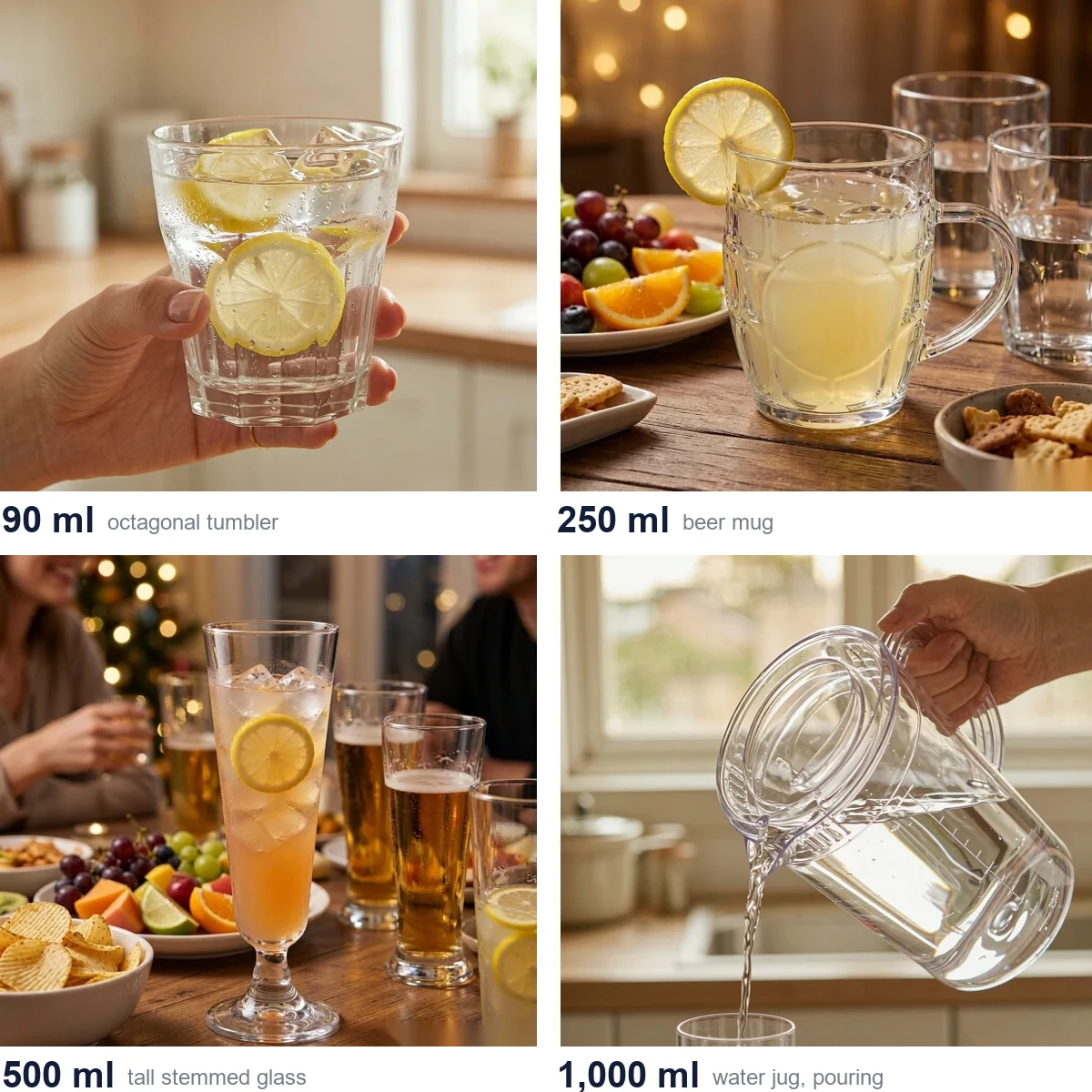
The two rows that cannot be fixed by moving a rung are the espresso and the sparkling wine. Thirty millilitres has no vessel on this shelf at all, so a single espresso lands in a 50 ml cup or a 90 ml octagonal tumbler and simply does not fill it — a service decision rather than a sourcing one. Sparkling wine at 125 ml is served in stemware that the catalogue specifies at 140 ml because there is nothing between 100 ml and 140 ml to choose from. Both are worth knowing before the list is printed, not after.
What the Menu Cannot Specify on Its Own
Colour appears on eight cup pages and on no glassware at all
Available colour is the field with the widest coverage gap in the whole drinkware set. Forty-seven of the ninety-four jug rows name their colours. On the cup range it is eight rows out of seventy-two. On the dessert range, four out of seventy-three. On the stemware range, none at all — not one page.
That does not mean the stemware only comes in one colour. It means the field is not used as a specification there, so a menu brief that asks for a tinted glass will get an answer from a person rather than from a page. Ask early. A colour that has to be matched to an existing service is a lead time, not a line item.
Forty jug pages print no dimension at all
The second gap is the one that bites hardest when a menu is being fitted to a shelf or a glasswasher. Across the jug range, only 54 of 94 rows publish a product size. Forty pages carry a capacity, a material and a packing figure and nothing else.
For a menu this matters because the two numbers that decide whether a vessel is usable are height and mouth diameter, and neither of them is a capacity. A 350 ml tumbler that has to clear a 12 cm rack and an 18 cm shelf gap is not specified by writing 350 ml. Where the dimension column is empty, the figure has to be measured on a sample or supplied on request — so ask for it before the first order rather than after the first delivery.
Before the List Goes to Print
Five things are worth nailing down in writing while the menu is still a draft, because all five are cheap now and expensive later.
- Write the serve volume and the resin together, never the volume alone. A 350 ml vessel is two different products depending on whether the drink is hot.
- Say which drinks are served over ice, and add a rung for each of them. Ice is the only routine cause of a vessel arriving too small.
- Ask for the fill line on a physical sample. No page in this catalogue prints fill volume, and no photograph can show it.
- Ask for the dimensions whenever the column is empty, and give the two constraints that matter: the shelf gap above the glass and the internal height of the glasswasher rack.
- Fix the replacement unit while the price is being negotiated. A beverage programme loses glassware continuously, and restocking one rung is easier if the rung was named in the original order.
On volume, the position is straightforward. No single model leaves in fewer than five hundred pieces, and that applies to a logo, a colour and branded packaging on the same run. A model already in the range is ready inside a fortnight; one that needs a new mould runs closer to a month. Because the shelf is dense at the volumes a menu uses, most programmes never need new tooling at all — the rung is already there, and what is being chosen is the shape around it.
On paperwork, keep it literal: ask for the testing under a reference you can quote back, so the document follows the order rather than the other way round. What this range holds is food-contact testing under SGS together with RoHS material compliance, and both describe the material itself; neither is a licence to bring goods into a particular country. Name the destination market, and settle which papers accompany each order before it is placed.
Everything in this range is moulded in Yongkang, in Zhejiang province, and it leaves China through the port of Ningbo or the port of Shanghai. Details of the works are on the site. When the list is ready, send it over through an enquiry and we will map it back to the rungs that already exist — codes, dimensions and the resin each row should be ordered in.
Sizing Questions Buyers Send Us
Should we size the glass to the recipe or the recipe to the glass?
Size the glass first where the drink is served over ice, because the ice takes up volume the recipe cannot see, and size the recipe first everywhere else. The working rule is that the liquid should sit between half and three-quarters of the way up the wall at service, so the number to agree is the fill volume and the vessel is chosen to deliver it.
Why does the same 500 ml come in eight different shapes?
Because capacity and geometry are independent on this shelf. All eight products at 500 ml carry different dimensions, running from 10.4 cm to 24.5 cm in height. The millilitre figure tells you what the vessel holds; only the dimensions column tells you how tall it stands, how wide its mouth is and whether it fits where you intend to put it.
Can one jug serve both table water and juice?
It can, and the rung to pick is around 500 ml to 800 ml, where the range is at its densest. Below 500 ml the cup range is the only option and above 1,000 ml the jug range is the only option, so a single vessel covering both services lives in the narrow band where the two ranges overlap — 500 ml, 600 ml or 1,000 ml.
How do we specify ice when no page states a fill line?
By naming the ice in the brief and confirming the working line on a sample. Nothing in this catalogue records a fill or net volume for any product, so the published figure is always the capacity to the rim. For iced drinks, expect to move up one rung from the recipe volume and check it in a glass rather than on a drawing.
What is the smallest order if a menu needs only one rung?
Five hundred pieces for a single model, whether or not it carries a printed logo, a chosen colour or branded packaging. Because the shelf already covers the volumes a beverage menu uses, most programmes are ordered from existing rungs, which also keeps the lead time at around a fortnight rather than the month a new mould takes.
Reading Alongside This One
Two pieces settle questions this one raises but does not answer. materials comparison works through which resin belongs on a cold menu and which on a hot one, and three-range comparison runs the same exercise for stemware, jugs and tumblers side by side. Beyond those, the series covers wine glasses, champagne glasses, beer glasses, cups and tumblers, handled pitchers, decanters and bar and milk-tea cups. Where a code rather than a volume is the puzzle, jug model numbers takes the jug numbering apart one character at a time.