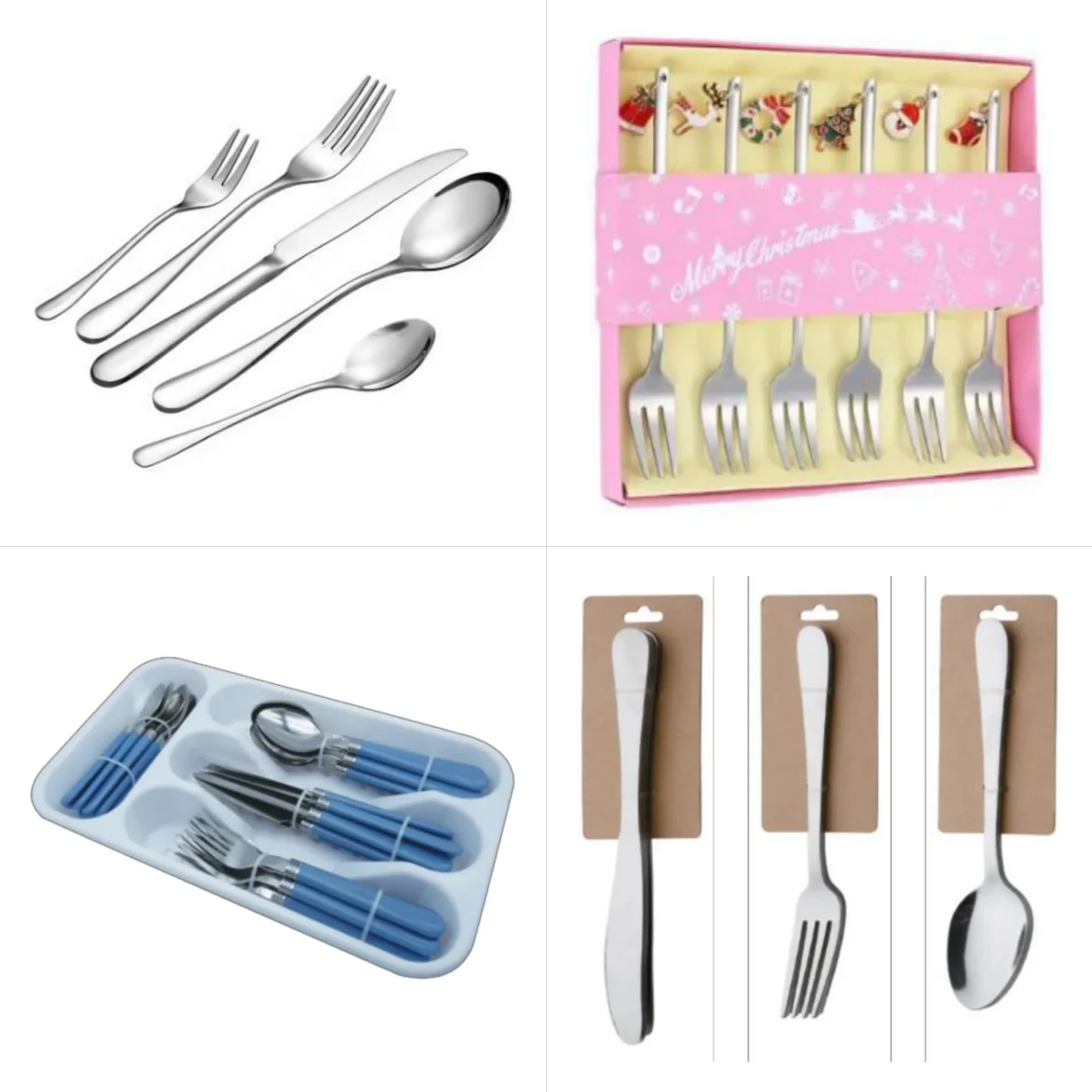
Stainless Steel Cutlery Sets for Hotels: Model Numbers, Set Sizes and Packaging
Two hundred and fifty lines of stainless steel cutlery sit in this cutlery & tableware series, and the specification table on every single one of them says the same three things: a model number, the words “Stainless steel”, and a colour. What none of them say is a millimetre, a gram, a steel grade or a gauge. On most drinkware ranges a buyer can compare capacities and carton volumes across the shelf; on this one the paper stops where the material begins.
That is not a reason to skip the spec sheet. It is a reason to read it differently. The five fields this line does publish — model number, material, colour, pieces per set and, on a third of the rows, packaging — carry more structure than they first appear to, and the model number in particular is doing the work a dimension column would normally do. Read it carelessly and every set looks like the next; read it properly and the shelf organises itself into families, service styles and order quantities.
Five Fields, and Only One of Them Has Numbers in It
Across all 250 rows the field coverage looks like this. Three of the five are always filled; the two that describe the physical object are the first to disappear.
| Field | Filled | What it actually records |
|---|---|---|
| Model Number | 250 / 250 | A family code, sometimes with the set size folded into it |
| Material | 250 / 250 | The same two words, “Stainless steel”, on every row — no grade, no finish, no gauge |
| Available Colors | 250 / 250 | Silver on 184 rows, gold on 61, both colours on 5 |
| Pieces per Set | 241 / 250 | The only number on the shelf, from 1 to 48 |
| Packaging | 76 / 250 | A packaging word on 76 rows; the other 174 say nothing |
Product Size: zero rows. Carton Size: zero rows. Packing Quantity: zero rows. A buyer who wants to know how long a dinner knife is, how heavy a teaspoon feels, or how many sets fit in a carton will not find it on any of the two hundred and fifty pages. materials comparison explains what that means for the drinkware half of the catalogue; on the cutlery shelf the gap is total, and the reading has to come from the fields that do exist.
Eighteen Systems, and One of Them Owns Two-Thirds of the Shelf
Split the 250 model numbers by their leading code and the shelf organises into eighteen systems: seventeen letter prefixes plus a cluster of 34 bare-number codes that carry no letters at all — split those numbers one by one and the count of distinct families reaches forty-five. Whichever way you cut it, one family dwarfs the rest: models beginning YR hold 167 of the 250 rows — about two of every three sets on the shelf — and they stretch across every sub-category from two-piece children’s sets to six-piece gifts. They are joined in the stainless steel cutlery sets sub-category by everyday four- and five-piece rows, while the boxed and seasonal gifts live on the boxed cutlery gift sets, Christmas cutlery gift sets and kids cutlery sets pages. The next largest prefixes barely register by comparison.
| Prefix | Rows | Typical sets | Colours on the prefix |
|---|---|---|---|
| YR | 167 | 1 to 10-piece table sets and the whole gift-box range | Silver 105, gold 57, both colours 5 |
| CX | 7 | Four- and five-piece; four of the seven are dual-configured | Silver |
| M | 7 | Four- and five-piece, one dual row | Silver |
| HK | 6 | Four-piece only, models HK1010 to HK1017 | Silver |
| HD | 5 | Four rows at 24 pieces, one at 4 | Silver 3, gold 2 |
| PT | 5 | Four-piece only, models PT001 to PT005 | Silver |
| 611P | 7 | Canteen sets at 12, 16, 32 and 48 pieces | Silver |
A note on that YR row, because the arithmetic behind it is the honest kind: 105 silver rows, 57 gold and 5 that ship in both colours — meaning 57 of the 61 gold rows on the entire shelf sit inside this one prefix. It is also the shortest path to a consistent table: YR-FT007 is a four-piece silver set, YR-FT046 a four-piece gold gift set, and YR-FT102 a two-piece gold set for children, all sharing the same two letters and, with them, the same polish. A buyer who shortlists one family first is not being lazy; on this shelf it is the most reliable way to keep the finish uniform across a large order. The smaller prefixes earn their keep as second finishes and spare families: YS03 and YS008-2 cover the three- and four-piece everyday bands, and HK1010, PT001 and OND01 give a kitchen a visually distinct second service without leaving the shelf.
Where the Piece Count Lives When the Field Is Empty
Nine of the 250 rows publish no pieces-per-set figure at all. Five of them are canteen sets, and on those five the number is still recoverable — it is printed inside the model code itself: P611P-16, PG-5000A-16, PG-611P-16, PGD-16 and 611P-16 are all sixteen-piece sets by their names, and 611P-48 is a forty-eight. Two gift rows, YT004-DK/DF/DS/TS-4 and DK/DF/DS/TS/ICS-4, end in a “-4” that reads like a piece count and should be confirmed rather than assumed. The last two, YR-FT156 and YR-FT157, are pure model codes whose numbers mean nothing at all — they are catalogued by family position, not by content. On this shelf, the model number is not a label; it is often the last place the data survives.
The 611P canteen system is worth a paragraph of its own, because it appears under three different spellings: 611P-16, P611P-16 and PG-611P-16 are the same family written three ways — bare, with a leading P, and with a leading PG — and the neighbouring 5000A system does the same trick across 5000A-32, B-5000A-16 and PG-5000A-16. A buyer searching the shelf by prefix will find one spelling and miss the others. On this line, search by the digits, not the letters.
One Page, Two Different Sets
Six rows refuse to commit to a single configuration. Their pieces field reads “4 / 5 pcs” — and in one case “3 / 5 pcs” — meaning the same model is sold as two different set builds. Four of the six belong to the CX family, which is effectively built around the idea.
| Model | Field value | What it means in practice |
|---|---|---|
| 2771 | 3 / 5 pcs | A three-piece everyday set that extends to five with serving pieces |
| CX3 | 4 / 5 pcs | Four-piece place setting, or five with a teaspoon added |
| CX8 | 4 / 5 pcs | Same dual build, different handle profile |
| M186 | 4 / 5 pcs | M-family dual row; the M167–M189 series surrounds it with fixed four- and five-piece rows |
Dual rows are useful and dangerous in equal measure. Useful, because one model can serve a breakfast room that wants a compact four-piece and a banquet room that wants a teaspoon on the table, from a single production item. Dangerous, because “which configuration is standard?” has no answer on the page — and neither does “does the five-piece build change the price?”. Both belong in the first reply to a quotation, in writing, before the order goes to production. A cutlery & tableware series order that assumes four-piece pricing and receives five-piece invoicing is an argument that one sentence would have prevented.
The Only Object Words on This Line Are Packaging Words
With no sizes and no weights, the closest thing this shelf has to a physical description is the Packaging field — and it is filled on fewer than a third of the rows. Where it is filled, the vocabulary splits cleanly by channel.
| Packaging word | Rows | Where it appears | What it signals |
|---|---|---|---|
| Printed gift box | 64 | Gift sets and three of the kids sets | Retail-ready; the box is part of the product |
| Moulded serving tray | 5 | Large canteen sets: 611P-32, D-32, 611P-48 and the two 5000A tray rows | Institutional service; the tray is a serving item |
| Clear storage tube | 5 | The 16-piece canteen rows, including 611P-12 and P611P-16 | Back-of-house storage; tubes stack and protect |
| Blister card with euro slot | 2 | DK/DF/DS/TS/ICS-4 and YT004-DK/DF/DS/TS-4, both gold | Self-service retail; the card hangs on a pegged display |
The Euro Slot Is a Planogram Decision
Two rows out of 250 — DK/DF/DS/TS/ICS-4 and YT004-DK/DF/DS/TS-4 — mention a euro slot, and it is the most commercially specific word on the whole shelf. A euro slot means the blister card hangs on the standard European retail hook: the set is designed to be merchandised, not unpacked. For a hotel that runs a gift corner or a resort shop, that one word tells you the display problem is already solved; for a catering buyer it is irrelevant packaging cost. Either way, it is the difference between a set that ships in a printed carton and one that arrives ready for a pegboard — and only two rows say it.
The other side of the coin: 174 rows publish no packaging word at all. That does not mean bulk — some of those rows certainly ship boxed — it means unrecorded. If the packaging matters to your channel, ask for it by name in the quotation, and ask whether the box prints your logo or the factory’s. The 64 printed gift boxes concentrate in the boxed cutlery gift sets sub-category, with three of the kids cutlery sets rows boxed the same way; the rest of the shelf stays silent.
What One MOQ Line Buys, Set by Set
Every row on this shelf — all 250 — carries the same minimum order line: 500 pieces. The word is pieces, not sets, and on a line that sells two-piece and forty-eight-piece sets from the same MOQ, the conversion matters more here than anywhere else in the catalogue.
| Set size | Sets per MOQ line | Pieces actually ordered |
|---|---|---|
| 2-piece | 250 sets | 500 |
| 3-piece | 167 sets | 501 |
| 4-piece | 125 sets | 500 |
| 5-piece | 100 sets | 500 |
| 6-piece | 84 sets | 504 |
| 12-piece | 42 sets | 504 |
| 16-piece | 32 sets | 512 |
| 24-piece | 21 sets | 504 |
| 32-piece | 16 sets | 512 |
| 48-piece | 11 sets | 528 |
The rounding is forced upward — you cannot order two-thirds of a set — so the pieces actually shipped drift a little above 500 on most rows. The planning consequence cuts the other way, and it is the one that surprises buyers most often: a hundred-cover restaurant that wants a four-piece setting on every table is ordering 400 pieces, which lands a hundred pieces short of the MOQ on a single four-piece model. The ways round it are ordinary and worth deciding early: take 125 sets and hold the spares as breakage cover, split the table count across two models, or step up to a five-piece build where 100 sets meets the line exactly.
Two Worked Programmes on This Shelf
A Staff Canteen That Seats Three Hundred
Institutional catering lives in the canteen tray & tube sets sub-category — 22 rows, every one silver, every one large. The piece ladder runs 12, 16, 24, 32 and 48, and the families are the 611P system and its neighbours: 611P-16 and 611P-32 at the core, 611P-12 and 611P-48 on either side, and the HD family holding four rows at 24 pieces. Trays and tubes appear on ten of the 22 rows — 611P-32 in a moulded serving tray, 611P-12 in a clear storage tube — which is as close as this line comes to describing how the goods live between services.
The order math is friendlier here than on the table side: a 32-piece canteen set converts the 500-piece line into just sixteen sets, so even a modest pilot order clears the MOQ on one model. What the spec cannot tell you is the composition — how the 32 pieces divide among knives, forks and spoons is printed nowhere — so the sample has to answer it.
A Hundred-and-Twenty-Key Hotel With a Gift Corner
The table side draws from the four- and five-piece band: YR-FT007 and YR-FT014 for the restaurant, a dual row like CX3 where breakfast wants four and banquets want five, and the HK and PT families — HK1010, PT001 — when a second, visually distinct finish is needed for the grill room. At 120 covers the four-piece restaurant order runs 480 pieces — twenty short of the line — so it rounds to 125 sets with a twenty-five-set spare pool, which on cutlery is not waste but the replacement stock the dish room will consume anyway. The gift corner then draws on the gold rows in the boxed cutlery gift sets: YR-FT109 in a printed gift box for the shelf, or the hanging YT004-DK/DF/DS/TS-4 if the shop walls are pegged, and YR-FT162 from the Christmas range in season. Colour as a channel signal on this shelf is read in full in the earlier cutlery guide; the short version is that silver dominates the back of house and gold owns the box.
What the Sample Has to Answer, Because the Paper Cannot
On a shelf with no dimensions, the sample review is not a formality — it is the entire specification process. Five checks, in the order a dish room will discover their absence:
- Weight per piece. Heft is the first thing guests notice and the last thing a spec sheet records. A kitchen scale and one line per piece is the whole test.
- Gauge and stiffness. Flex a knife against the table edge. A blade that springs back on sample will fold on tray three hundred.
- Edge and tine finish. Run a finger along every edge and inside every fork tine. Polish that catches a glove will catch a lip.
- Finish consistency across the family. Mix pieces from two models of the same family on one table laid and check the polish matches under dining-room light, not warehouse light.
- Dishwasher survival at your cycle. Ten cycles through your own machine, then re-check the edges — tea-staining and edge dulling show up by cycle five.
Cutlery spends its working life in mouths, so the paperwork deserves the same discipline as the polish. Ask for the food-contact report under its own document number — the testing behind this range was carried out by SGS, and the RoHS compliance is documented separately — and name the country the consignment clears customs in when you order, because it is the import rules at that border, not the certificate in the box, that decide what the inspection will ask for.
Where This Shelf Sits in the Rest of the Catalogue
Cutlery is the last thing a guest picks up and the first thing the dish room counts, and it shares a table with everything else in the range: water pitchers and handled jugs and cups and tumblers pour beside it, wine glasses and chafing dishes and buffet warmers set the places around it, and the hot side of a buffet runs on the cookware and heat sources — whose cooktop compatibility is a reading of its own. A table programme that orders cutlery in isolation usually ends up re-ordering the glasses to match — worth reading those shelves before the cutlery order is signed.
The reading order this guide suggests: settle the prefix first (YR covers most needs), then the piece count against the service style, then the packaging against the channel — and when the fields run out, as they often do on this shelf, read the model number, because on cutlery it is the code that carries the data.
The Numbers to Have Ready Before You Write
| # | Have this ready | Why it matters on this line |
|---|---|---|
| 1 | Covers per service and services per day | Converts seat count into sets; the piece ladder does the rest |
| 2 | The set size you want, per zone | Four-piece for tables, 16–48 for canteens; dual rows need the configuration named |
| 3 | Colour by channel | Silver back of house, gold in the box — confirm which rows carry which |
| 4 | Packaging requirement, stated or waived | 174 rows are silent; boxed, tubed or hung is a decision, not a default |
| 5 | The country the goods clear customs in | Determines which import rules the paperwork must satisfy |
| 6 | Whether the model count stays under one family | One family keeps the finish consistent; mixed families need a sample match first |
The contact page and the about page pages carry the company details; a first message that lands with the six lines above filled in usually comes back with a quotation and a sample plan in the same reply.
How many sets does a 500-piece minimum order buy on a 24-piece cutlery set?
Twenty-one sets. The 500-piece line counts individual pieces, so a 24-piece model converts to 20.8 sets, which rounds up to 21 sets or 504 pieces. The same line buys 250 two-piece sets and 11 forty-eight-piece sets.
Why do some cutlery models list two set sizes, like 4 / 5 pieces?
Six models on this shelf are sold in two configurations of the same product: the four-piece place setting extends to five with a teaspoon or serving piece added. Confirm in writing which configuration you are pricing, and whether the larger build changes the unit price.
What does the euro slot on a blister card mean for a hotel gift shop?
It means the card hangs on standard European retail hooks, so the set is ready for a pegged wall display without extra fixture work. Only two of the 250 cutlery rows carry the euro-slot wording, both gold gift sets.
Can I get the steel grade or the weight of a piece before ordering?
Not from the product pages: the material field reads “Stainless steel” on all 250 rows and no weights, lengths or grades are published. Request a sample and weigh the pieces; the sample review is the specification process on this line.
How do I keep the finish consistent across a large cutlery order?
Concentrate the order inside one model family — the largest family alone holds 167 of the 250 sets — and lay pieces from different models of that family on one table under dining-room light before approving production.