
Par Level Is Not an Order Quantity: Sizing Hotel Drinkware by Burn Rate
The Shelf and the Purchase Order Answer Different Questions
By the time a hotel buyer reaches the quantity column, the interesting decision has already been made. The model is chosen, the resin is chosen, the price is agreed. What remains looks clerical: how many. And it is usually answered from the top of the head — a round number, a memory of last year’s order, or whatever the store room can still absorb.
That is where the money quietly goes wrong. The number on the shelf tonight and the number on the purchase order are two different numbers, produced by two different sums, and the second one is often the first one with a margin added. They are not the same number. A par level is a service guarantee measured in hours. An order quantity is a cash commitment measured in months. Confusing them produces the two most common outcomes in this category: a property that runs dry in the middle of a conference week, and a store room holding four years of a model that was discontinued.
This page works through both sums, with a worked example, and ends with the arithmetic that decides when to reorder. Every figure below is an assumption you replace with your own; the structure is the part worth taking.
Three Ways Stock Leaves a Hotel, and Only One Is About the Glass
Breakage is the loss everyone names, and it is the one a supplier can influence. It is not the largest. In a property with a pool, a banquet floor and room service, stock leaves by three routes that need to be counted separately, because each has a different fix.
The first is breakage in service: a glass dropped at the pass, a jug knocked off a trolley, a tumbler cracked in the wash. This is the only one that is a property of the article — wall thickness, the shape of the foot, how the piece behaves when it meets a tiled floor. Better goods reduce it. Nothing eliminates it.
The second is disappearance: pieces that leave the building inside a guest’s bag, off a poolside tray, or into a staff locker. This is a control problem, and it scales with how far the piece travels from the store room. A pool bar loses more than a room-service pantry, and no specification changes that.
The third is retirement: stock that is intact but no longer wanted. A rebrand, a new menu, a refurbishment that changes the table setting, a stack of glasses that has gone cloudy after four hundred washes. Retirement arrives in blocks, not in drips, and it is the reason a property can hold a five-year supply of a perfectly serviceable piece it will never use again.
Order sizing fails when the three are added into one vague percentage. Count them separately for one quarter and the pattern is obvious: breakage is steady, disappearance is seasonal, retirement is a step.
Build the Par in Four Numbers
A par level is the quantity that keeps the service running between two washes. It has four inputs, and only one of them is a guess.
Covers per service. Not rooms — covers. A hundred and eighty rooms with two hundred and sixty at breakfast is a breakfast operation of two hundred and sixty, and the breakfast is where most glass is used in a day.
Pieces per cover. Count what actually leaves the shelf, not what is on the table in the photograph. Breakfast is usually one juice glass plus one tumbler; dinner is water, wine and often an after-dinner serve; a pool bar is one piece per drink with the empties coming back to the same station.
Wash turnaround. How many days a piece spends between the shelf and the shelf. One day is a property with an overnight wash; two days is a property whose banquet stock goes out on Friday and returns on Monday.
Reserve. The buffer that covers a broken wash cycle, a late delivery of clean stock, or a function that arrives with twenty more guests than the sheet said. Twenty to thirty per cent of the daily draw is a normal working figure.
Here is the sum for a mid-sized resort, using round assumptions that are easy to replace:
| Station | Covers | Pieces per cover | Pieces drawn per day |
|---|---|---|---|
| Breakfast buffet | 260 | 1.3 | 338 |
| Restaurant, dinner | 150 | 2.1 | 315 |
| Pool bar | 90 | 1.0 | 90 |
| Daily draw | — | — | 743 |
With a one-day wash turnaround, the property needs 743 pieces in circulation and 743 again in the wash, plus a reserve of roughly a quarter of one day’s draw: about 1,670 pieces across all models. Split that across the model list — two tumblers, a juice glass, a wine glass, a water jug — and the number per model is a few hundred, not a few thousand. This is why a par level is built by model and reported as one total; the total is a summary, not an instruction.
Turn the Par Into a Year
The par tells you what must exist. It says nothing about what must be bought, because most of the par survives the year. The annual purchase is the attrition, and attrition in food-service drinkware is usually between fifteen and thirty per cent of par, depending on how the property handles the three losses above.
| Annual attrition | Pieces replaced per year, par 1,670 | What drives it to this level |
|---|---|---|
| 15% | 251 | all-indoor service, single outlet, tight store-room control |
| 22% | 368 | pool, banquet floor and three outlets sharing one store room |
| 30% | 502 | heavy outdoor use, events programme, high staff turnover |
The middle row is the one worth staring at. Three hundred and sixty-eight pieces a year is the annual replacement for a property of a hundred and eighty rooms — and the minimum order on this catalogue is five hundred pieces per model. Those two numbers are close enough to change how the first order should be read.
Five Hundred Pieces Is a Calendar, Not a Quantity
A five-hundred-piece minimum sounds like a container. For a mid-sized property it is closer to a year of attrition for one line. That distinction matters at the quotation stage, because it decides whether the minimum is a constraint or an accident.
If a property’s annual replacement for a model is around five hundred, then the minimum order is roughly its annual need, and the sensible first purchase is the minimum. If the annual need is nearer two thousand, the minimum is a fraction of a year and the order should be sized in months of cover rather than in minimum-order units. If the annual need is under two hundred — a small boutique, a single restaurant — the minimum is more than a year of supply, and the honest conversation is about which two models to consolidate onto so the quantity lands somewhere useful instead of sitting in the store room.
There is a second calendar hidden in the same number. Standard production runs seven to fifteen days, and OEM work — logo printing, a custom colour, printed packaging — runs around thirty. Add sea freight and the gap between the decision and the shelf is typically six to ten weeks. That gap is the safety stock you must carry while the order is in transit, and it is why reorder points are set in pieces rather than in weeks.
The First Ninety Days Are a Measurement
A first order is usually treated as a trial of the supplier. It is more useful as a trial of the arithmetic. Ninety days of counting turns assumptions into a rate, and the rate is what every later decision rests on.
Three counts, once a week, in the same units: pieces issued from the store room, pieces broken or retired and written off, and pieces missing at the end of a stocktake. Divide breakage by covers served in the same period and you have a number in pieces per thousand covers that is comparable across outlets, across seasons, and across suppliers.
Two cautions on reading it. First, the first month is contaminated by the opening: old stock is retired, new stock is still being broken in the store room rather than in service, and staff are still learning which trolley takes the corner badly. Second, breakage that happens in the wash belongs to the wash. A glass that cracks in a rack is telling you about rack spacing and stacking height, which is a specification question — the pitcher guide and the patterned drinkware guide both treat stacking and wall thickness as the things that decide where a piece fails first.
Write the Reorder Point Down
The reorder point is the stock level at which the next order is placed, and it has one job: to keep the shelf stocked until the new goods arrive. It is not a percentage of par. It is consumption during the lead time plus a buffer.
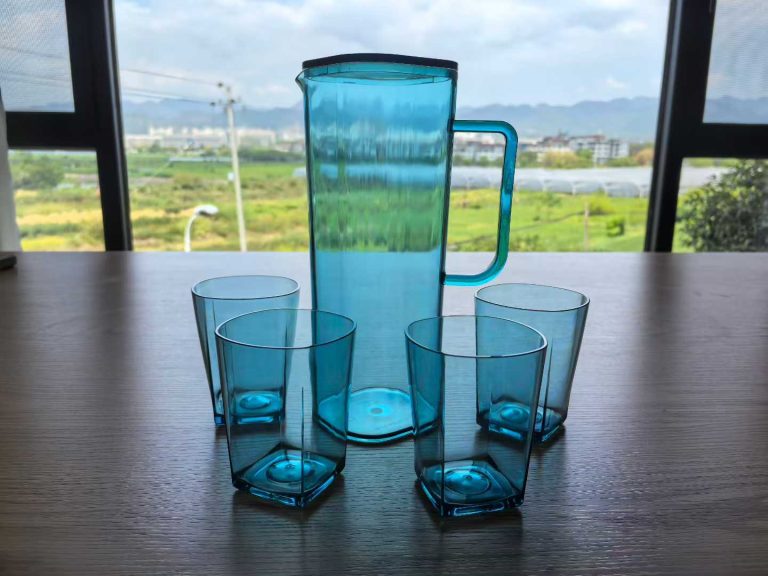
Take a single tumbler model with a daily draw of sixty pieces, a twenty-one-day replenishment lead time, and a twenty per cent buffer for a late vessel or a broken wash cycle. The reorder point is 60 × 21 × 1.2, or 1,512 pieces. Cross that level and the order goes out the same week — not when the shelf looks thin, and not when someone remembers.
Two practical notes. The lead time must be measured from purchase order to shelf, not from supplier to port; the inland leg is where optimistic schedules die. And the reorder quantity should be a whole number of cartons, because a carton is the unit that ships, counts and stacks. On the plastic line most rows publish a packing quantity and a carton size, which lets you round before you order rather than after — the pallet loading guide works through what that rounding does to a container.
What Belongs in the Purchase Order
Six lines turn the arithmetic into something a supplier can quote against and a store room can check on arrival:
- Model, resin, colour and capacity, per line — with the resin written out, not abbreviated.
- Quantity per model, and the number of cartons it produces.
- Par level and expected annual replacement, so the supplier can see whether the order is a trial or a programme.
- Lead time required, stated as an arrival date rather than a production duration.
- Packing requirement: how many pieces per carton, and whether the carton will be opened and re-used for storage.
- The handling the goods will meet in service — pool deck, banquet trolley, dishwasher rack — because that is the sentence that decides which specification matters.
None of this is exotic. It is the difference between an order that is a guess with a price attached and one that can be checked against a shelf count ninety days later.
Where These Numbers Come From
The ranges on this site are organised the way a store room is: cups and tumblers, water pitchers and jugs, bar supplies, fruit plates and platters, bowls and plates, seasoning and condiments, with the full catalogue behind them. A model like the pentagonal tumbler or the one-litre jug is a line in the par; a mixed order is a par built across several.
For the specification side, the materials comparison covers what the resins do in service, the wine glass guide and the champagne guide deal with the pieces that fail most expensively, and the cookware packing guide breaks down what a packing figure refers to before you quote a per-piece cost from it. When the par is built and the models are chosen, send the two lists through the contact page and the quantity conversation starts from a number rather than an instinct.