Napkin Holders & Tissue Boxes for Hotels: Measure the Refill First
This Is the One Tabletop Item You Buy in Reverse
A wine glass is chosen against a pour. A jug is chosen against a capacity. A sugar bowl is
chosen against a portion count. Each of those decisions begins with the vessel and works outward to
the menu. This category runs the other way, and that single fact explains most of what follows.
A napkin holder receives a product that already exists in your operation and cannot be
resized to suit it. The napkin you buy, or the tissue box you buy, arrives with a footprint decided by
its own maker. The holder’s whole job is to accept that footprint, keep the stack upright, let one
unit come out at a time, and keep dust off the rest. Nothing is poured into it, nothing is measured out
of it, no portion is served from it and no load rests on it. Within this range it is the only object
whose working day involves neither liquid nor food — a point that matters later, when the
paperwork question comes up.
So the first number you need is not on the page. It is on your own shelf, in the dimensions of
the refill you are already buying. What follows is what the range actually contains, what the seven
specification tables do and do not publish, and the six measurements that turn a vague enquiry into a
one-exchange answer.
Seven Models, Three Objects, One Category Name
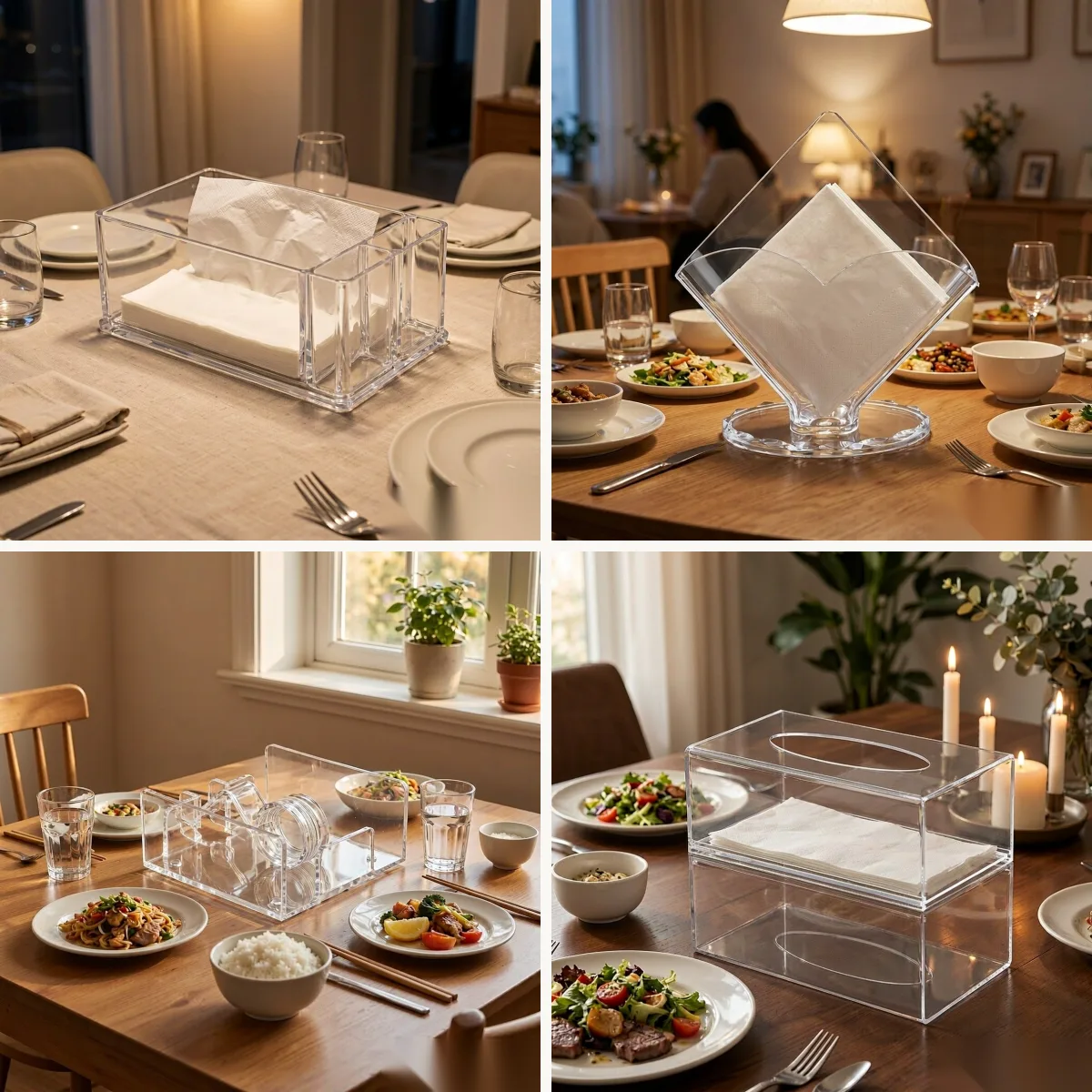
The napkin holder category holds seven models, and they are not seven sizes of one item. Measured by what they
accept, they are three different products that happen to share a label.
| Form | Models | What it receives | How it is loaded |
|---|---|---|---|
| Closed dispenser box | BY-3016 · BY-3017 · BY-9405 | Boxed pop-up tissue | Through an opening in the face or upper panel |
| Upright frame | BY-9401 · BY-9402 | A sheet or a boxed tissue stood on edge | Through a central slot, hanging clear of the surface |
| Low rack with retaining rings | BY-9403 · BY-9404 | A folded stack lying flat | Laid against the back plate, held down by two rings |
The name admits the problem. It offers two nouns joined by a slash — holder and stand
— and the seven product titles repeat the same pair. The image files repeat it a third time.
Whatever you need, the label you are shopping under was written to cover all three forms at once.
The photograph is the only reliable guide, because the size column is written identically for
a lean-to rack and for a closed box. One of the seven also does two jobs at once: BY-3017 carries a divided
base, and its product photograph shows a narrow second compartment beside the napkin section — the
sort of well that toothpick holders are built to fill, such as BY-9101, BY-9102 or BY-9103. That is worth noticing on its own terms.
A holder that has absorbed a second function cannot be compared, line for line, with one that has
not.
The Two Numbers That Decide the Fit Are Not Published
Six attributes appear on each of the seven tables: model number, product size, material,
packing quantity, carton size and the minimum order line. Here is what a fit decision needs: the
internal clearance of the load area, and the width of the opening through which the refill is taken.
Neither appears on any of the seven pages.
That is not a small omission. A closed box exists to accept a particular tissue format, and
formats differ enough that a box built for one will not hold another comfortably. Clearance has to be
generous enough for the stack to sit flat and for the top sheet to pull free, and tight enough that the
sheets do not slump sideways. A few millimetres separate a box that dispenses cleanly from a box that
jams on the third sheet.
The opening matters for a different reason. Its width sets how much of the sheet stands proud
of the box, and that in turn sets whether a guest can take one sheet without dragging the next one out.
A narrow opening tears the sheet at the fold. A very wide one lets the stack drop back out of reach.
For the two lean-to racks the decisive number is neither of those. It is the clear depth in
front of the back plate — the room a folded napkin needs if it is to lean rather than spill. Those
two models publish 15.7 × 17.3 cm and 13.7 × 15.2 cm, and neither entry describes that depth.
Read all seven entries together and a pattern appears about what the size column is for. It is
an envelope: the space the object occupies on a shelf and inside a carton. That is the number a freight
calculation needs, and it is the number the tables give. It is not the number a fit decision needs, and
the two should not be allowed to stand in for each other when a quotation is being read.
Three Diameter Symbols and Four Missing Dimensions
Two further problems sit in the same column, and either would be caught immediately by anyone
who tried to draw the object from the data.
Four of the seven entries give a pair of numbers. BY-9401 reads Φ18 × 16.5 cm; BY-9402 reads Φ17 × 15.5 cm;
BY-9403 reads 15.7 × 17.3 cm; and BY-9404 reads 13.7 × 15.2 cm. Every one of the four is a three-dimensional object. Two of them stand
upright on a foot, and the photographs show height as plainly as width. A pair of figures describes
something flat. None of these four is flat.
Three of the seven begin with the diameter symbol. BY-3016 at Φ14 × 8.5 × 5.7 cm, BY-9401 at Φ18 × 16.5 cm and
BY-9405 at Φ18.6 × 11 × 8 cm. Not one of those three is a round object: the photographs show a rectangular dispenser box,
an upright leaning frame, and a two-tier box with a rectangular plan. A diameter symbol is not a
decorative prefix. It tells a reader that the first figure is measured across a circle and that the
remaining figures are height and perhaps base. Applied to a rectangle it removes the reader’s
ability to know which edge each figure describes — precisely where the reader is checking
whether the item fits.
The workable rule for a first enquiry: treat the size column as a set of figures in an order
that has not been declared, and ask the supplier to name each one. It costs a single line in an email
and removes the possibility of a fit error that no photograph would reveal.
Five Cartons, and 541 to 1,378 Pieces per Cubic Metre
All seven lines publish a carton size and a packing quantity, which is enough to work out how
much container space each model really costs.
| Model | Pieces / carton | Carton (cm) | Pieces per m³ | Cartons for MOQ 500 |
|---|---|---|---|---|
| BY-3016 | 120 | 60 × 44 × 35 | 1,299 | 5 |
| BY-3017 | 120 | 59 × 41 × 36 | 1,378 | 5 |
| BY-9401 | 84 | 51 × 44.5 × 43.5 | 851 | 6 |
| BY-9402 | 84 | 49 × 39 × 40.5 | 1,085 | 6 |
| BY-9403 | 72 | 64 × 53 × 39 | 544 | 7 |
| BY-9404 | 90 | 69 × 46 × 41 | 692 | 6 |
| BY-9405 | 56 | 47 × 38 × 58 | 541 | 9 |
Convert each carton to cubic metres and divide by what it carries, and the seven entries
spread from 541 pieces per cubic metre to 1,378 — a factor of 2.55 for objects
that all sit on a table and all hold paper.
The spread is not driven by the size of the holder. BY-9403 is among the shortest items in the
range at 15.7 cm across, and it ships at 544 pcs/m³ because its carton measures 64 × 53 × 39
cm and carries 72 pieces. BY-3017 covers a comparable footprint and ships at 1,378, because its carton is
59 × 41 × 36 cm and carries 120. Carton geometry and packing quantity set the number; the
product size does not.
Follow it through to the minimum order. Five hundred pieces is the floor on every model in
this range, and because the cartons differ, that floor is a different physical consignment on each
line: five cartons of BY-3016 and BY-3017, six of BY-9401, BY-9402 and BY-9404, seven of BY-9403, and nine of BY-9405.
At container scale the gap opens again. A 40-foot high cube holds roughly 67 cubic metres,
which converts to about 87,000 of the densest model and about 36,000 of the least dense. The same order
quantity, in the same category, fills a container more than twice as completely on one line as on the
other. None of that appears in a unit price, which is why it deserves a column of its own in any
comparison: two quotations can look level on price per piece and sit far apart on cost per cubic metre
landed.
Two nearby lines are worth pricing in the same enquiry, since all three end up on the same
table: the base trays a holder stands on, such as BY-9071, BY-9072 or BY-9073, and the cake dome that covers a plate of pastry beside
it, such as BY-9253 or BY-9254. Ordered together they share a container and a shipping schedule, and the
comparison above then applies to the whole group rather than to the holders alone.
Why Polystyrene Is the Right Answer in This Category
Six of the seven are polystyrene. The seventh, BY-9405, is listed as PC / PS and carries the word
unbreakable in its product title — a split entry that runs against what the rest of this
catalogue trains a reader to expect.
Elsewhere the default is polycarbonate and polystyrene is the exception that has to justify
itself. The handled jugs are PC. The decanters are PC. The champagne glasses are PC. Here the order reverses, and the reason is what
this object never has to survive.
It is not carried: it sits where it is put. It is not loaded: the heaviest thing it holds is
paper. It is not stacked: nothing rests on top of it. It does not meet the heat of a served dish,
because no dish is served from it. The three forces that end the working life of drinkware —
impact, load and thermal shock — are all absent from its day.
The one place the material has to work is the opening. A sheet is pulled through a slot, and
that pull is a small repeated force applied to a thin edge at an angle. A wall that is thin near the
slot is where a crack would begin. This is the sort of detail a sample answers better than a
specification sheet: load the holder, pull a sheet twenty times, and look at the slot edge.
Whether that is why BY-9405 carries a blend is not stated on its page. A split material column can
mean two things — a tougher grade chosen for one stressed part, or different resins in different
components of the same item — and the difference is worth a question, because it decides what a
repeat order will look like next season.
Set the two families side by side across this catalogue and a rule shows up. Polycarbonate goes
on the objects that leave the table and come back by hand: tumblers, jugs, decanters and champagne glasses. Polystyrene goes on the
objects that stay where they are put: the sugar bowls, the oil cruets, the fruit plates and this one. The resin tracks the distance
the object has to travel, not the price of the object.
Where the two resins sit side by side on the same shape, the choice stops being abstract, and
the materials comparison covers that ground for the drinkware lines. The condiment sets and the sugar bowls belong to the same polystyrene family
as this one — three tables where the material question is settled before the model question
starts.
The One Item Here That Food-Contact Testing Does Not Cover
One difference separates this category from every other line in the catalogue, and it is
easier to state now than to discover later.
A napkin never touches food. Neither does the box a napkin is taken from. This item never
holds a drink, never receives a portion, and never meets anything a guest eats. In the terms that
matter to an importer, it is not a food-contact article at all.
The documentation this range carries — SGS food-contact testing and RoHS material
compliance — belongs to the articles that do meet food or drink. Asking for a food-contact
report on a napkin box is asking a question the file was never written to answer. Where paperwork is
part of your process, request it by document number and satisfy yourself that the number refers to the
material and the item on your order rather than to another article travelling in the same container.
The questions that do apply are different, and there are two of them: what temperature the
item will meet in service, and how it is expected to be cleaned. Polystyrene does not enjoy a
commercial dishwasher. A hot cycle softens and clouds it, and a clear wall that left the workshop
transparent will not stay that way through a season of high-temperature washes.
That has a practical effect on where the item can be placed. A dispenser box beside a buffet,
riding the same rack as the plates, will not last. The same box on a guest-room desk, wiped between
arrivals, will still look new after several seasons. Both are legitimate orders; only one of them is the
order you are placing, and the cleaning method is the line that decides which.
Put the cleaning method in writing with the order rather than raising it afterwards, and the
choice of model follows from it — the same way a colour or a printed panel is settled at the
start rather than negotiated at the end.
Measure Your Refill: Six Numbers to Send Your Supplier
The specification table will not tell you whether a holder fits your paper. Your own refill
will, and six measurements are enough to make an enquiry answerable in one exchange.
1. One Sheet, or One Box
For a loose stack, the length and width of a single napkin. For boxed tissue, the outside footprint
of the box. Two different shapes of answer, and they lead to two different families in the range.
2. The Height of the Stack You Want to Load
Half a pack and a full pack are not the same order. Stack height decides whether a lean-to rack will
hold its angle or slide forward as the paper goes down.
3. Loose or Boxed
Whether the refill arrives as a stack or inside its own carton. The first two forms in the range take
loose paper; the third exists for paper that comes in a box.
4. The Face the Opening Must Turn To
Top, side or front. On a narrow table the direction of the opening is the difference between a usable
item and one that has to be turned round to be used.
5. The Depth of the Surface
A guest-room desk and the centre of a dining table give different clearances. The published sizes
begin to mean something once this number is written next to them.
6. Whether It Will Ever Be Machine Washed
A yes here takes polystyrene out of the conversation and moves the choice up to the PC grade. A no
keeps the whole range open and makes the cleaning instruction, not the resin, the thing to agree.
Send those six lines and the reply can be a straight yes or no against each of seven models.
Send a request for a napkin holder and what comes back is a set of photographs — which is how most
orders in this category begin, and why most of them take three exchanges to land.
Two commercial lines belong in the same message, because they decide the shipment rather than
the item: the packing quantity of the model you prefer, and how many cartons your order quantity
becomes. Both are already published on every page, and both are easy to leave out when the enquiry is
written around a photograph. A logo, a colour and printed packaging can each be specified on the same
order line, at the same minimum quantity as the plain model.
Production for this range sits in Zhejiang; the ports used for loading are Ningbo and Shanghai,
chosen by the carrier’s sailing schedule. A stock model can be packed within a fortnight, while a
run built to a new drawing takes about a month. Five hundred pieces is the floor on every model here,
and the contact page is the shortest route to an answer on the six numbers above — whether the enquiry covers one
property or a group of them.
If the table is being specified as a whole rather than item by item, the bowls and plates, the cutlery line and the bar supplies
sit in the same layer of the project, and the tableware category carries the lengths, openings and stacking figures for the
group. The about page sets out where the works are and how an order is placed.
FAQ: Napkin Holders and Tissue Boxes for Hotels
What is the difference between the napkin holders and the tissue stands in this range?
Three forms share the category name. Three models are closed dispenser boxes (BY-3016, BY-3017 and BY-9405) that take boxed pop-up tissue through an opening in the face. Two are upright frames (BY-9401 and BY-9402) that hold a sheet standing on edge. Two are low racks with retaining rings (BY-9403 and BY-9404) built for a folded stack lying flat. The product photograph is the only reliable guide, because the size column is written the same way for all three forms.
Can the internal dimensions be confirmed before an order is placed?
Yes, and they should be. The published size is the outer envelope, which serves a freight calculation rather than a fit decision. Ask for the internal clearance of the load area and the width of the opening, and send the two measurements of your own refill at the same time. A sample settles the opening edge better than any figure: pull a sheet a few dozen times and look at the slot.
Is polystyrene robust enough for a hotel dining room?
It is the correct grade here, because the object is never carried, never loaded and never stacked, and never meets the heat of a served dish. What it does not tolerate is a commercial dishwasher: high-temperature cycles soften and cloud it, so placement and cleaning method decide its working life more than the resin does. Where an item will ride the dish rack, order the PC grade instead.
How many cartons does a 500-piece order become?
Between five and nine, depending only on the model. The two smallest dispenser boxes pack 120 per carton and reach five hundred in five cartons; the two-tier box packs 56 and needs nine. The spread in shipping volume is wider still: measured per cubic metre the seven models run from 541 to 1,378 pieces, so the same order quantity occupies substantially more container space on some lines than on others.
Does a napkin holder need a food-contact certificate?
No, because it never meets food. Food-contact testing covers the articles in this catalogue that hold a drink or receive a portion. For this item the two questions worth putting in writing are the service temperature it tolerates and the cleaning method it is intended for, and if the cleaning method matters it is better settled before the model is chosen than after.